


The Taiwan Civic Anti-Fraud Association yesterday said it would assist eight people who were scammed by advertisements on Facebook in suing Meta, the first such lawsuit in Taiwan against the company.
The association would help cover the litigation expenses and has filed a lawsuit against Meta, the parent company of Facebook, under the Fraud Crime Hazard Prevention Act (詐欺犯罪危害防制條例), the Fair Trade Act (公平交易法), the Consumer Protection Act (消費者保護法) and the Civil Code, it said, adding that it was aiming for NT$11.67 million (US$386,066) in compensation for damages, which is 20 percent of the victims’ collective losses of NT$58.37 million.
The advertisements lured investors on Facebook by using the names of well-known people, such as writer Wu Tan-ju (吳淡如), political commentator Cheng Hung-yi (鄭弘儀), Advanced Micro Devices Inc CEO Lisa Su (蘇姿丰) and e-commerce platform founder “Mr 486” (486先生), as well as names of well-known companies, including Cathay Securities Co (國泰證券), it said.
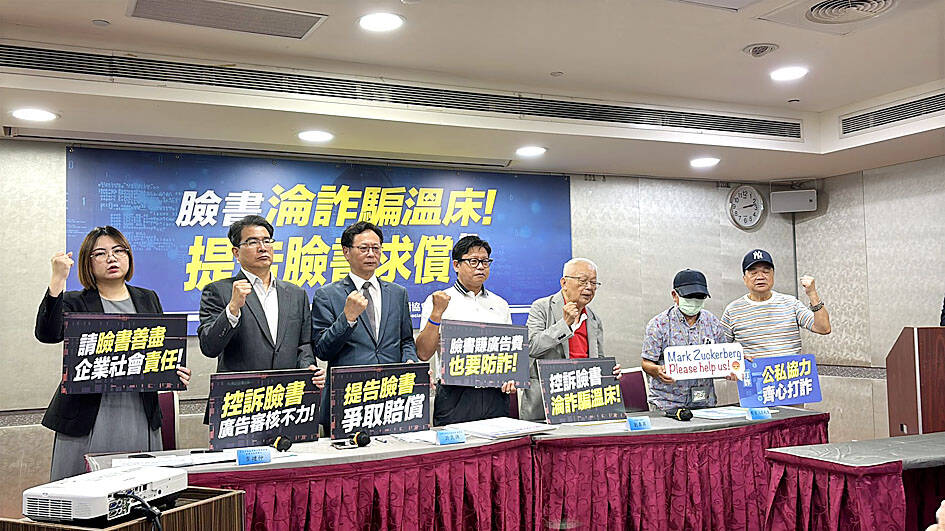
Photo: Wang Kuan-jen, Taipei Times
Association president Hsu Liang-yuan (許良源) cited police data as showing that from September last year to February, the property damage incurred from 22,892 investment scams was about NT$42.7 billion, which accounted for 66 percent of total property losses from all scam cases.
Ninety-four percent of investment fraud victims were exposed to the scam through the Internet, and social media advertisements were the main source, he said, adding that it was Facebook’s failure to review and remove scam advertisements that made the platform a hotbed for scams.
One of the eight people suing Meta, a man known as Mr H, said he had seen an advertisement for a book giveaway from someone he thought was Su on Facebook. He downloaded an investment app that turned out to be fake and was deceived into losing more than US$730,000.
The scammers even lent money to him first to earn his trust, before catching him in the trap, Mr H said.
Facebook should not profit from advertisements while shirking its responsibility of clamping down on fraudulent ads, he said.
Association managing supervisor Lawrence Lee (李禮仲), who is also the convener of the association’s legal committee, said that its team of lawyers, which includes Hsiao Yi-hung (蕭奕弘), Sung Chung-ho (宋重和) and Hsu Yi-ling (徐翌菱), have spent nearly four months preparing for the lawsuit.
About 60 scam victims reached out to the association for advice, and after hearing their stories and learning of their limited resources, the association decided to help eight of them file a lawsuit, Lee said.

The military has spotted two Chinese warships operating in waters near Penghu County in the Taiwan Strait and sent its own naval and air forces to monitor the vessels, the Ministry of National Defense (MND) said. Beijing sends warships and warplanes into the waters and skies around Taiwan on an almost daily basis, drawing condemnation from Taipei. While the ministry offers daily updates on the locations of Chinese military aircraft, it only rarely gives details of where Chinese warships are operating, generally only when it detects aircraft carriers, as happened last week. A Chinese destroyer and a frigate entered waters to the southwest

A magnitude 6.1 earthquake struck off the coast of Yilan County at 8:39pm tonight, the Central Weather Administration (CWA) said, with no immediate reports of damage or injuries. The epicenter was 38.7km east-northeast of Yilan County Hall at a focal depth of 98.3km, the CWA’s Seismological Center said. The quake’s maximum intensity, which gauges the actual physical effect of a seismic event, was a level 4 on Taiwan’s 7-tier intensity scale, the center said. That intensity level was recorded in Yilan County’s Nanao Township (南澳), Hsinchu County’s Guansi Township (關西), Nantou County’s Hehuanshan (合歡山) and Hualien County’s Yanliao (鹽寮). An intensity of 3 was

Japanese Prime Minister Sanae Takaichi’s comment last year on Tokyo’s potential reaction to a Taiwan-China conflict has forced Beijing to rewrite its invasion plans, a retired Japanese general said. Takaichi told the Diet on Nov. 7 last year that a Chinese naval blockade or military attack on Taiwan could constitute a “survival-threatening situation” for Japan, potentially allowing Tokyo to exercise its right to collective self-defense. Former Japan Ground Self-Defense Force general Kiyofumi Ogawa said in a recent speech that the remark has been interpreted as meaning Japan could intervene in the early stages of a Taiwan Strait conflict, undermining China’s previous assumptions
Taiwan Railways Corp (TRC) today announced that Shin Kong Mitsukoshi has been selected as the preferred bidder to operate the Taipei Railway Station shopping mall, replacing the current operator, Breeze Development Co Ltd. Among eight qualified firms that delivered presentations and were evaluated by a review committee, Shin Kong Mitsukoshi was ranked first, while Breeze was named the runner-up, the rail company said in a statement. Contract negotiations are to proceed in accordance with regulations, it said, adding that if negotiations with the top bidder fail, it could invite the second-ranked applicant to enter talks. Breeze in a statement today expressed doubts over


 RSS
RSS