


Buddhist Master Shih Chao-hwei (釋昭慧) on Saturday encouraged people not to claim the government’s NT$10,000 (US$331) cash handout and urged the Executive Yuan to provide an option for people to donate it back to the government for designated purposes.
The cash handout is to be disbursed late next month at the earliest, the Cabinet said last week.
People can claim the handout through direct bank transfer, registered transfer, ATM withdrawal, post office withdrawal and a roster-based distribution system, it said.
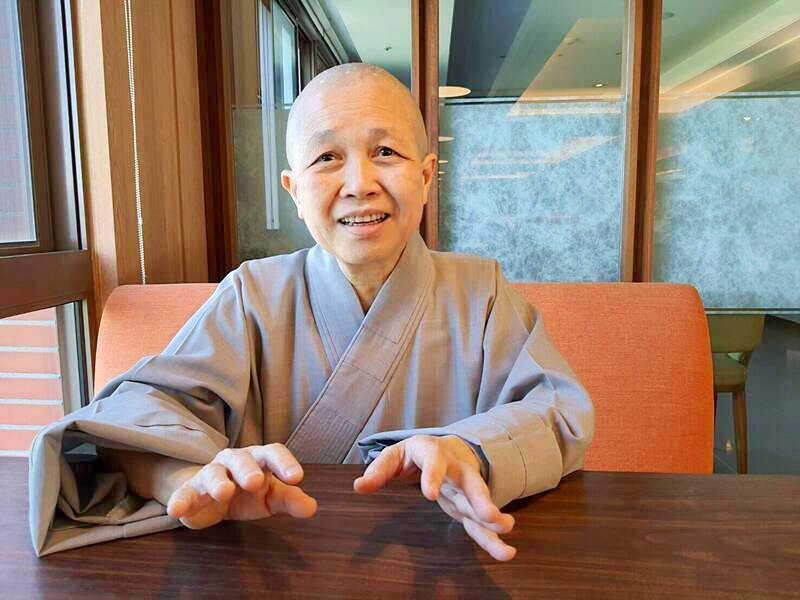
Photo: Taipei Times
Shih wrote on Facebook that the Executive Yuan should provide an option for “refusing to claim NT$10,000 and transferring it to a designated account for expanding the nation’s life.”
That fund should only be used for disaster relief, she said.
Shih, a Hsuan Chuang University Department of Religion and Culture professor, said the cash handout was not included in the annual budget, so the Executive Yuan has to incur debt to distribute it.
“Incurring debt to give out cash” would cause a domino effect, prompting local governments to do the same, she said, adding that it is like drinking poison to quench thirst, and the bad precedent would leave the country with no peace.
Emptying the national treasury would leave heavy debt for future generations and would offer only limited aid to the underprivileged, but it would widen the gap between rich and poor, she said.
If local and central governments are vying to give out cash, fiscal discipline would be weakened, and if a natural disaster occurs or a war breaks out, the country would fall into a serious national crisis, she said.
Shih urged the Cabinet to provide the return option, so that people who oppose the cash handout can peacefully show their displeasure, while taking action to protect the nation.
Executive Yuan spokeswoman Michelle Lee (李慧芝) yesterday said the Executive Yuan would consider the suggestion.
“The Executive Yuan thanks [Shih] for the initiative to protect the country, and would carefully discuss the possibility of implementing it,” she said.
Democratic Progressive Party (DPP) caucus chief executive Rosalia Wu (吳思瑤) said she supports Shih’s idea, and that it reflects many people’s thoughts on the issue.
With amendments to the Act Governing the Allocation of Government Revenues and Expenditures (財政收支劃分法) forcing the central government to allocate an additional NT$400 billion to local governments next year and the recently approved universal cash handout, the central government is facing reduced funding, and returning the handout as a donation would help a lot, Wu said.
However, while she supports the idea of a designated account, she said it should be used for a wider range of purposes, because local governments have taken away a large amount of funding, while leaving the implementation duties and responsibilities to the central government.
She said that the central government has been paying off debt in the past few years, but has been forced to incur debt this year.
If there is extra and flexible funding from the donations Shih suggested, that could be used to invest in national development, which would better benefit people, and the public and legislature can monitor its use, Wu said.
Additional reporting by Hsieh Chun-lin

FUKUOKA SITUATION: Japanese media reported that the pathogen is expected to be identified by the summer, while the CDC downplayed the idea that it was hMPV A “mysterious cold-like illness” reported in Japan’s Fukuoka Prefecture does not seem to be a new disease, but Japanese authorities have been asked about the situation, the Centers for Disease Control (CDC) said yesterday. The Fukuoka Prefectural Medical Association on Wednesday told a news conference that a “mystery cold” that has become a hot topic on social media is “highly likely to be caused by some kind of viral infection,” Japan’s KBC News reported. “Many people are experiencing symptoms starting with a sore throat, followed by a runny nose, phlegm and a severe cough,” KBC News reported, citing association officials. Health authorities are

Nvidia Corp CEO Jensen Huang (黃仁勳) arrived in Taiwan yesterday ahead of upcoming AI and technology events, saying he plans to meet with clients and Taiwan Semiconductor Manufacturing Co Chairman C.C. Wei (魏哲家) during his visit. After landing at Taipei Songshan Airport, Huang posed for photos with fans and handed out Yakult drinks to reporters and supporters waiting at the scene, saying he has “a lot to do” during the trip. Asked about reports that Nvidia’s planned headquarters site in Taipei’s Beitou Shilin Technology Park could break ground on May 27, Huang said that if the company holds an event, he would

The Ministry of Finance this afternoon announced the winning numbers for the March-April uniform invoice lottery. The winning number for the NT$10 million (US$318,060) special prize is 19531471, and the winning number for the NT$2 million grand prize is 85941329. Three numbers were drawn for the NT$200,000 first prize: 07225810, 20231230 and 83518781. Those with receipts matching the last seven digits of any of the first-prize numbers will win the NT$40,000 second prize, while those matching the last six digits will win the NT$10,000 third prize. Those whose receipts match the last five digits of the first-prize numbers can claim the NT$4,000 fourth prize,

SIX SUBSIDIES: The monthly allowance for older farmers is to increase to NT$10,000, and NT$5,000 is to be given to homemakers under the national pension system, Lai said The government is to implement major welfare policies for disadvantaged groups, including raising the monthly allowance for older farmers to NT$10,000 and providing homemakers with NT$5,000 per month, President William Lai (賴清德) said yesterday. Lai made the remarks during a visit to Wangling Temple in Chiayi County, saying that the planned increases were being introduced amid economic growth and an increase in tax revenue. Touting a policy, in which the government plans to provide a monthly allowance of NT$5,000 for every child under the age of 18 in a bid to address Taiwan’s low birthrate, Lai said that if received for the


 RSS
RSS