


The proportion of new environmental impact assessment (EIA) committee appointees with engineering backgrounds is inappropriately high, environmental groups told a news conference yesterday, urging the appointees to decline the offer.
The Ministry of Environment on Monday last week unveiled the list of newly appointed EIA committee members, with half of the 14 non-governmental members reappointed from the previous term.
Of the 14 appointees, nine have an environmental engineering background, and one has a background in ocean engineering, together accounting for 71 percent, Air Clean Taiwan founder Yeh Guang-perng (葉光芃) said.
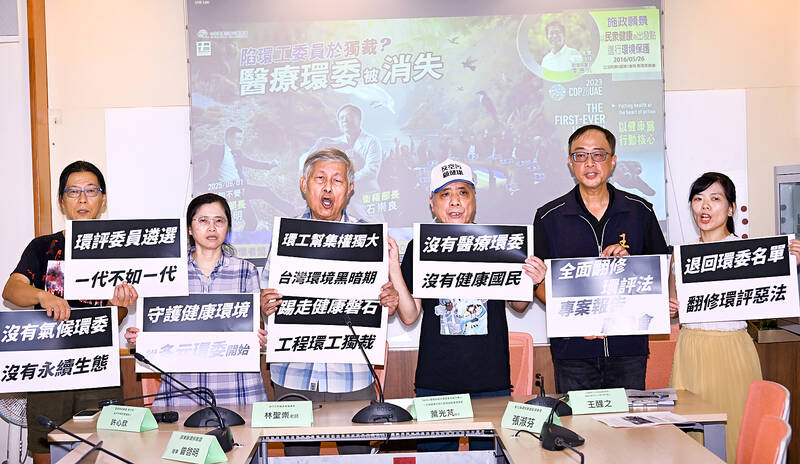
Photo: Fang Pin-chao, Taipei Times
Minister of Environment Peng Chi-ming (彭?明) in his first appointment of EIA committee members concentrated power to engineers while wiping out medical care and public health representation, Yeh said.
The list also lacks non-governmental climate representatives, he said, adding that an ecology representative’s ability to serve as an environmental guardian would be highly doubted.
Some appointees are known to have acted as “environmental killers” in supporting controversial construction projects or helped cover up misconduct, he said.
An EIA committee with most members with an engineering background could drive Taiwan into an environmentally dark age, he said.
Therefore, environmental groups in southern, central and northern Taiwan gathered to protest the “unprecedentedly autocratic” list of EIA committee members, he said.
The protests would only increase if the authorities ignore the problem, he added.
Waimushan Conservation Action convener Wang Hsing-chih (王醒之) said that National Taiwan Ocean University ocean engineering professor Chien Lien-kwei (簡連貴), who had been the EIA meeting president during the initial EIA review of the Hsieh-ho Power Plant conversion project and allegedly changed the meeting room without notifying the attending environmental groups, was reappointed.
Chien forcefully conducted the EIA review in line with the government’s policy and refused to listen to different opinions, he said, adding that he was afraid the same “legal violence” would be exerted at other projects’ EIA reviews.
Only two of the appointees have a background in ecology, the fewest in committee history, Taiwan Academy of Ecology director Yang Kuo-cheng (楊國禎) said.
More than half of the appointees had been part of a previous EIA committee, Government Watch Alliance chief executive officer Hsu Hsin-hsin (許心欣) said.
This would be Chien’s fifth appointment since 2013, Hsu said, adding that only three of the appointees were brand new committee members
Peng yesterday said he would respect environmental groups, but they should also respect the appointees’ backgrounds without prejudice.
Committee members must abide by rules for conflict of interests, and decisions must be made through deliberation, which is not autocratic, he said.
Additional reporting by CNA
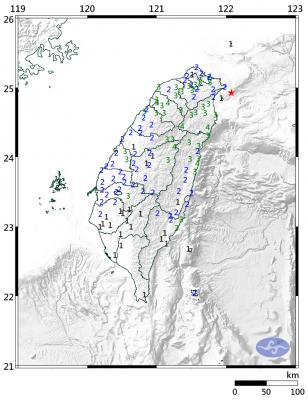
A magnitude 6.1 earthquake struck off the coast of Yilan County at 8:39pm tonight, the Central Weather Administration (CWA) said, with no immediate reports of damage or injuries. The epicenter was 38.7km east-northeast of Yilan County Hall at a focal depth of 98.3km, the CWA’s Seismological Center said. The quake’s maximum intensity, which gauges the actual physical effect of a seismic event, was a level 4 on Taiwan’s 7-tier intensity scale, the center said. That intensity level was recorded in Yilan County’s Nanao Township (南澳), Hsinchu County’s Guansi Township (關西), Nantou County’s Hehuanshan (合歡山) and Hualien County’s Yanliao (鹽寮). An intensity of 3 was
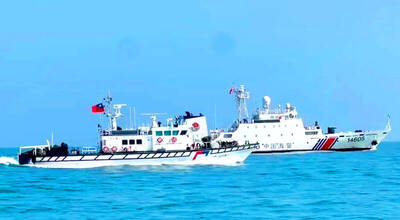
Instead of focusing solely on the threat of a full-scale military invasion, the US and its allies must prepare for a potential Chinese “quarantine” of Taiwan enforced through customs inspections, Stanford University Hoover fellow Eyck Freymann said in a Foreign Affairs article published on Wednesday. China could use various “gray zone” tactics in “reconfiguring the regional and ultimately the global economic order without a war,” said Freymann, who is also a nonresident research fellow at the US Naval War College. China might seize control of Taiwan’s links to the outside world by requiring all flights and ships entering or leaving Taiwan
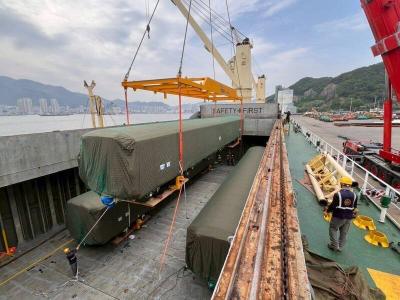
The first of 10 new high-capacity trains purchased from South Korea’s Hyundai Rotem arrived at the Port of Taipei yesterday to meet the demands of an expanding metro network, Taipei Rapid Transit Corp (TRTC) said yesterday. The train completed a three-day, 1,200km voyage from the Port of Masan in South Korea, the company said. Costing NT$590 million (US$18.79 million) each, the new six-carriage trains feature a redesigned interior based on "human-centric" transportation concepts, TRTC said. The design utilizes continuous longitudinal seating to widen the aisles and optimize passenger flow, while also upgrading passenger information displays and driving control systems for a more comfortable
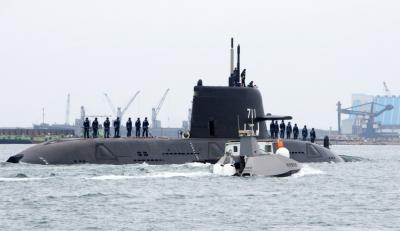
Taiwan's first indigenous defense submarine, the SS-711 Hai Kun (海鯤, or Narwhal), departed for its 13th sea trial at 7am today, marking its seventh submerged test, with delivery to the navy scheduled for July. The outing also marked its first sea deployment since President William Lai (賴清德) boarded the submarine for an inspection on March 19, drawing a crowd of military enthusiasts who gathered to show support. The submarine this morning departed port accompanied by CSBC Corp’s Endeavor Manta (奮進魔鬼魚號) uncrewed surface vessel and a navy M109 assault boat. Amid public interest in key milestones such as torpedo-launching operations and overnight submerged trials,


 RSS
RSS