

Representatives from the Democratic Progressive Party (DPP) and Japan’s ruling Liberal Democratic Party (LDP) today held their sixth annual “Diplomacy and Defense 2+2” dialogue at DPP headquarters in Taipei, with this year’s meeting to feature a record number of topics and attendees.
This year, the dialogue would be followed by the first session of the LDP’s “Taiwan Policy Review Project Team,” marking the first time the 2+2 dialogue has been expanded to a “4+4 policy meeting,” DPP Legislator Kuo Kuo-wen (郭國文) said.
Since both ruling parties no longer hold the legislative majority, it is important to continue these exchanges and build a substantive framework for bilateral cooperation, he added.
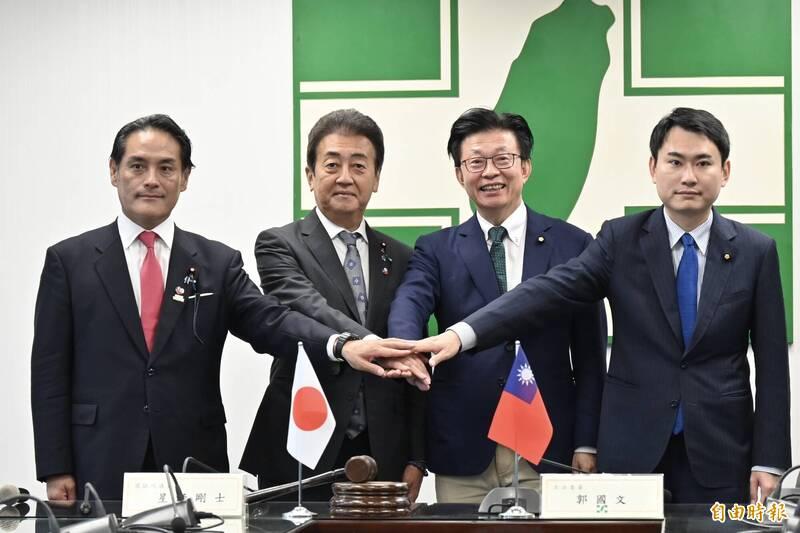
Photo: Tsung Chang-chin, Taipei Times
This year’s session is attended by Kuo and DPP Legislator Chen Kuan-ting (陳冠廷), while representing the LDP are Tsuyoshi Hoshino, chair of the party’s Committee on Foreign Affairs, and Kazuchika Iwata, director of the LDP’s National Defense Division.
The parties are to discuss disaster prevention, coast guard patrols and undersea cables, Kuo said in his opening remarks.
Today’s discussions would also incorporate national security and cultivating talent for Defense innovation Units, while featuring in-depth talks regarding trade matters, Chen said.
Taiwan and Japan are not only neighboring countries, but also have close and longstanding relations, Hoshino said.
Although some difficulties arose for the LDP this year, Hoshino said he still elected to visit Taiwan, as bilateral discussions and cooperation between the ruling parties are of the utmost importance.
Iwata said he hopes the session would promote further exchanges in economics and trade, disaster prevention and talent training.
However, most important is that Japan and Taiwan continue to work together to ensure peace and stability in Asia and the Indo-Pacific region, using this as a framework to promote further cooperation and exchanges, he added.
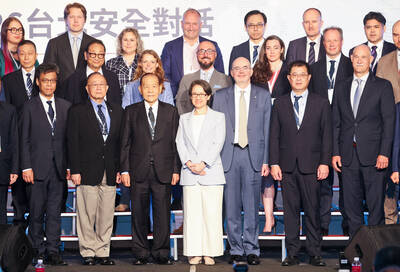
Taiwan’s growing defense preparations might be sending a stronger signal to the US than to Beijing, highlighting the need for Taipei to tailor its deterrence efforts to different audiences, a US security academic said yesterday. Stanford University Freeman Spogli Institute for International Studies fellow Oriana Skylar Mastro made the comment during a Taipei Security Dialogue panel examining lessons Taiwan could draw from the wars in Ukraine and the Middle East. Mastro said she was impressed by Taiwan’s increased defense spending, emphasis on asymmetric capabilities and efforts to prepare society for conflict, but questioned whom those initiatives were influencing. She said when she asked
A total of 400 foreign “high- level” professionals have been naturalized as Republic of China (Taiwan) citizens over the past decade as the government has eased nationality rules to attract talent from a wider range of fields, the Ministry of the Interior said yesterday. The 400th high-level professional, who works in the electronics industry, was approved for ROC citizenship on Aug. 26, the MOI said. The MOI quoted the newly naturalized citizen as saying that Taiwan is a leader in fields such as semiconductors, electronics manufacturing, artificial intelligence development and energy technology. He also said
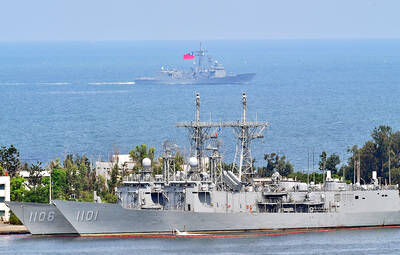
SIZE MATTERS: Large ships are politically attractive as visible symbols of national defense, but small surface combatants are more likely to survive an initial strike Taiwan needs to restructure its naval fleet from focusing on large warships, which are “sitting ducks” for China’s advanced tracking technology, to smaller, stealthy corvettes that are harder to detect but retain sufficient firepower to deter a Chinese invasion, a Taiwanese academic and a former US military commander said in an article published on Friday in the journal Foreign Affairs. Taiwan does not need a fleet capable of competing with the Chinese navy for traditional control of the Taiwan Strait, but rather “sea denial” capabilities that would prevent China from freely using the waterway, Taiwanese aerospace and security expert Holmes Liao
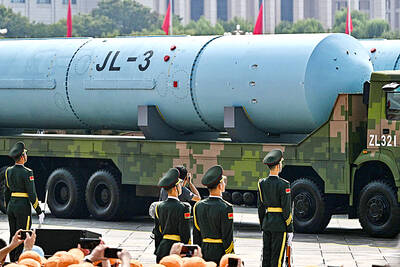
SUB-LAUNCHED SUBOPTIMAL: The JL-3, an upgraded version of the missile test-fired earlier in the summer, would have the range to strike at much of the country Refits to Chinese nuclear submarines to carry JL-3 intercontinental ballistic missiles would put much of the US in striking distance, Taiwanese defense analysts said in a report commissioned by the Mainland Affairs Council. Researchers from National Defense University’s Graduate Institute of China Military Affairs Studies said that the Chinese People’s Liberation Army Navy (PLAN) in July test-fired a missile with a training warhead. Chinese state media reported without elaborating that a PLAN nuclear-powered ballistic missile submarine (SSBN) launched a missile with a training warhead, which accurately hit the designated target area in the Pacific, the report said. The launch was a rare display


 RSS
RSS