


The National Police Agency (NPA) is holding this year’s International Forum on Police Cooperation: Combating Transnational Crime today and tomorrow, featuring the most attendees and countries in the event’s history.
A total of 2,713 people are attending online and in-person, representing 52 countries across five continents, the agency said.
The event features keynote speeches and four panel discussions on telecommunications fraud and human trafficking, illegal cash flows and money laundering, cybercrime, and drug-related crime.
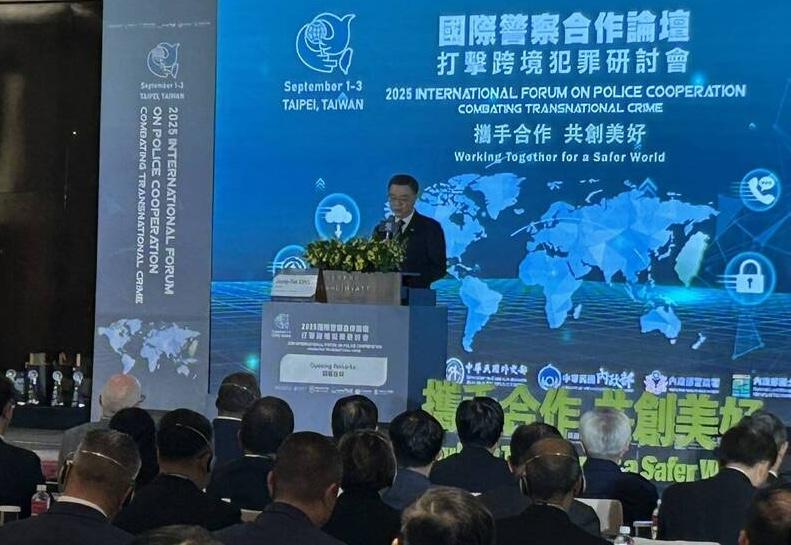
Photo: Chiu Chun-fu, Taipei Times
Attendees come from international organizations and law-enforcement agencies, plus senior representatives, diplomatic envoys stationed in Taiwan, and domestic officials and experts.
They include ministers or deputy ministers from three of Taiwan’s diplomatic allies and three top police chiefs.
About 263 participants from 40 countries are expected to attend in-person, with the remainder joining remotely.
In an age of globalization, crime knows no borders, Premier Cho Jung-tai (卓榮泰) said at the opening ceremony today.
Only with close international cooperation, intelligence-sharing and professional exchanges can law enforcement tackle crime networks and fortify national security, he said.
Taiwan not only holds international responsibility, but is willing and able to work with the world to ensure public safety, he added, calling on the international community to support Taiwan’s accession to Interpol to further this effort.
International Association of Chiefs of Police president Ken Walker, American Institute in Taiwan Director Raymond Greene and Minister of the Interior Liu Shyh-fang (劉世芳) were also in attendance this morning.
In terms of policy, Taiwan’s anti-drug efforts have entered the third stage, which centers international anti-narcotics cooperation, Cho said.
Last month, Taiwan and the US signed a memorandum of understanding to enhance two-way intelligence-sharing and jointly combat transnational drug trafficking, he said.
In March, Taiwan enforced new regulations requiring serial numbers to be printed on pill presses and key components used to manufacture drugs for export — similar to firearms control — to prevent equipment from flowing into the illegal market, Cho said.
This step makes Taiwan the first country in Asia to enforce such regulations, demonstrating its commitment to international anti-drug efforts, he added.
Criminals and drug-smuggling organizations often exploit the latest technologies, which triggers cross-border criminal activity worldwide, Liu said.
Domestic agencies and the NPA’s Criminal Investigation Bureau further launched a joint defense program to tackle cryptocurrency fraud that freezes suspicious accounts and returns stolen funds to the victims, Liu said.
In the first half of this year, the initiative returned more than NT$103.21 million (US$3.36 million) to 248 victims, she said.
Additional reporting by CNA

NATIONAL SECURITY: Authorities are working to confirm the identities of the military personnel involved and investigating possible illegal conduct and regulatory violations Authorities are probing possible national security implications after Kinmen police and immigration officers on Sunday found a Chinese woman allegedly posing as a tourist while engaging in prostitution involving more than 10 military personnel. The woman, surnamed Chen (陳), has since been deported, authorities said, adding that investigators are still working to confirm the identities of those implicated, as the records only listed code names and aliases. The case stemmed from a report received by the Kinmen District Prosecutors’ Office on Friday last week from the Jinhu Precinct of the Kinmen County Police Bureau. On Sunday, police, along with the National Immigration

GLOBALGIVING: ‘ Caving to external pressure is not acceptable for an organization that has cultivated justice reform and human rights for 30 years,’ one NGO said A slew of non-government organizations (NGOs) have withdrawn from the GlobalGiving fundraising platform after it announced it would use “Chinese Taipei” instead of “Taiwan” from next month. The Taiwan Good Rice Association wrote on Facebook on Friday that it was informed on April 28 via a teleconference call of the change, which was made because the platform wanted to operate in China. Taiwan Good Rice is to terminate all cooperative relationships with GlobalGiving in response to the platform’s “unilateral and non-negotiable” decision to remove references to Taiwan, the NGO said. “Taiwan is in the official name of Taiwan Good Rice Association and the

HEAVY WEATHER: Typhoon Jangmi is due to crash straight into the Ryukyus as airlines look to shift flights to larger aircraft or cancel flights to Okinawa entirely Taiwan’s international air carriers announced flight adjustments over the weekend as Typhoon Jangmi is forecast to hit the Ryukyu Islands today and tomorrow. The Central Weather Administration (CWA) upgraded Jangmi from a tropical storm to a typhoon at 8am yesterday, with the eye located 580km south of Naha city. It was moving north at 19kph. Today, China Airlines’ CI-120, CI-121, CI-122 and CI-123 flights between Taoyuan and Naha, Okinawa, have been canceled as well as CI-132 and CI-133 between Kaohsiung and Naha. EVA Air’s BR-112, BR-113, BR-186 and BR-185 flights between Taoyuan and Naha are also canceled. Low-cost carrier Tigerair Taiwan canceled IT-230,

Chinese Nationalist Party (KMT) Chairwoman Cheng Li-wun (鄭麗文) yesterday briefed her party’s Central Standing Committee regarding her scheduled visit to the US between Monday next week and June 16, saying that her purpose would be to persuade the US that the Republic of China (ROC) Constitution was a “one China” constitution that would foster stable and peaceful cross-strait relations. The ROC Constitution is the most important defense for all Taiwanese citizens, as it upholds our democracy and has contributed to our robust economy, which aligns with international and US interests, she said. “We would not be troublemakers and drag the US under,”


 RSS
RSS