


China’s parade tomorrow to celebrate the 80th anniversary of the end of World War II would be the country’s largest to date, and is aimed at flexing its military might, a Taiwanese official said.
China is expected to showcase new strategic weapons at the parade in Beijing’s Tiananmen Square to mark the anniversary of what it calls its victory in the “War of Resistance Against Japanese Aggression,” the national security official said, speaking on the condition of anonymity.
The massive display is aimed at boosting China’s regional and global influence, consolidating ties with authoritarian states, rewriting the historical narrative of World War II, and easing internal and external political pressure, they said.
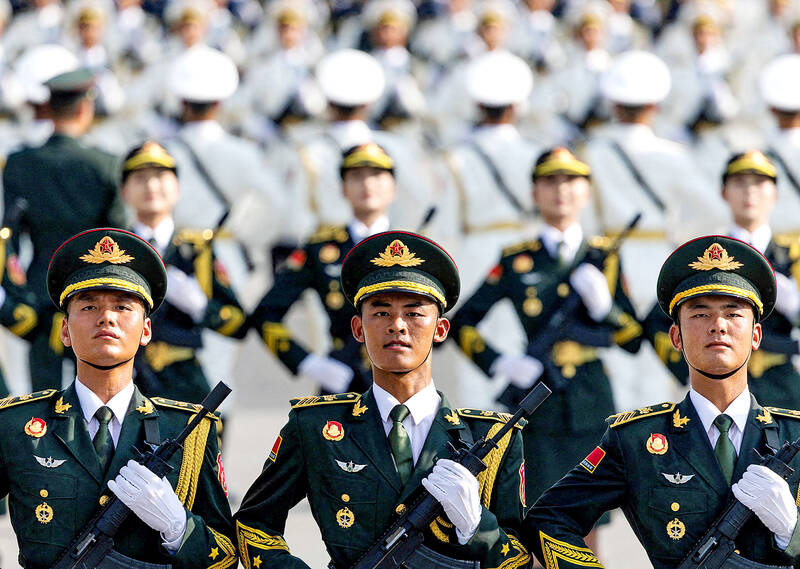
Photo: Reuters
Beijing is believed to have spent more than 36 billion yuan (US$5.05 billion) on the event, which would showcase Dongfeng-41 intercontinental ballistic missiles, Julang-3 submarine-launched ballistic missiles and Dongfeng-17 hypersonic missiles in an apparent show of force aimed at the US, they said.
The KJ-600 airborne early warning aircraft is also expected to make its debut at the parade, they added.
Troops have been rehearsing for the parade, expected to be one of the largest in years, since March in Yangfang, a “parade village” outside Beijing, they said.
China ordered nearby factories to be shut down for the month leading up to the parade to ensure clear skies, while on the day of the parade, commercial activities, tourism and food-delivery services would also likely be suspended, the official said.
The parade would comprise of three parts: a march showcasing the military’s reorganized structure, which would also involve troops from countries such as Russia and Belarus; a procession of advanced domestically developed weapons; and an aerial display featuring combat and support aircraft, with the KJ-600 likely appearing for the first time, they said.
The firepower segment would prominently showcase long-range and intercontinental missiles, underscoring China’s nuclear deterrence capabilities, they said.
The parade is to be the costliest to date, with training expenses alone totaling 800 million yuan, while fuel and maintenance for the 45 ground and air formations would cost 200 million yuan, they said.
The largest single expense for the event would be security, with about 4.6 billion yuan spent on police and security forces across Beijing, the official said.
Temporary factory closures lasting two to four weeks would require subsidies of about 29 billion yuan, while lost ticket revenue and suspended commercial activity would cost about 1.1 billion yuan, they added.

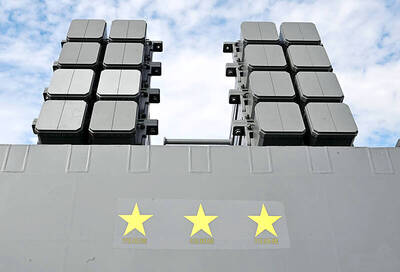
UPGRADE: The Kang Ding-class frigate is replacing its Chaparall missiles with Tien Chien II and Hua Yang VLS, which would provide it with long-range, 360° air defense Taiwan plans to produce 1,200 to 1,376 Hai Chien II missiles (海劍二, Sea Sword II) — also known as TC-2N — to serve as the standard air defense system of the navy’s surface combatant fleet, a source said yesterday. Last week, the Hai Chien II, the naval version of the Tien Kung II missile (天劍二, Sky Sword II), completed a live-fire test in waters off the National Chungshan Institute of Science and Technology’s Jiupeng facility (九鵬) in Pingtung County’s Manjhou Township (滿州). The MIM72 Chaparral and other dated air defense missiles that currently arm Taiwanese ships have inadequate range to combat Chinese

REASONS FOR TRAVEL: An assistant professor said that proposed amendments to penalize drivers if they used drugs overseas would not deter people from traveling People who operate a motor vehicle under the influence of marijuana would have their driver’s license revoked, even if they used the substance while overseas, the Ministry of Transportation and Communications said yesterday, citing proposed amendments to the Road Traffic Management and Penalty Act (道路交通管理處罰條例). The amendments would also authorize the government to revoke the licenses of people determined to have used Category 1 or Category 2 narcotics, even if they were not operating a vehicle while under the influence of drugs, as well as ban them from taking the license test for three years, the ministry said. People aged 18 or
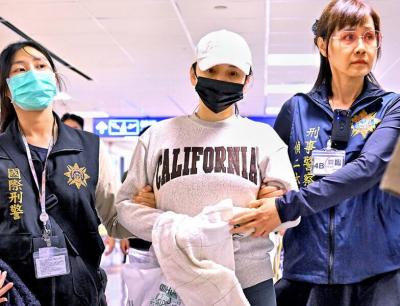
Johanne Liou (劉喬安), a Taiwanese woman who shot to unwanted fame during the Sunflower movement protests in 2014, returned to Taiwan last night after being deported from the US. She is to stand trial in Taiwan for charges involving embezzlement, fraud and drug crimes. The Criminal Investigation Bureau (CIB) said it took her into custody at Taiwan Taoyuan International Airport and would first question her before transferring her to the New Taipei District Prosecutors’ Office. She was arrested upon disembarking a flight from San Francisco that landed shortly before 7pm. Liou absconded to the US in 2019 after jumping bail
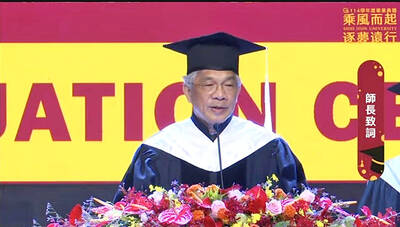
Shih Hsin University President Chen Ching-he (陳清河) yesterday issued a public apology for comments made in his commencement speech last week, stating that he has asked the school to suspend his duties and halt his wages for two months as a show of contrition. At the commencement ceremony on May 30, Chen said, “If you don’t manage your time well, or your own emotions, or your health, then I am telling every one of you — put a quick end to ‘you,’ because the world has no need for ‘you.’” The comments have sparked significant controversy online, and Chen through an open


 RSS
RSS