


President William Lai (賴清德) yesterday said that Taiwan is to work with Asian-Pacific partners to promote peace and sustainable development, while pledging stronger defense capabilities and economic security.
At this year’s general assembly of the Asian-Pacific Parliamentarians’ Union (APPU) in Taipei, Lai said that Taiwan would “demonstrate its determination to safeguard regional peace,” and that peace and stability across the Taiwan Strait are “indispensable to security and prosperity in the Indo-Pacific.”
Defense spending is to exceed 3 percent of GDP next year, under a Cabinet proposal pending legislative approval, and the government aims to raise the figure to 5 percent by 2030, he said.
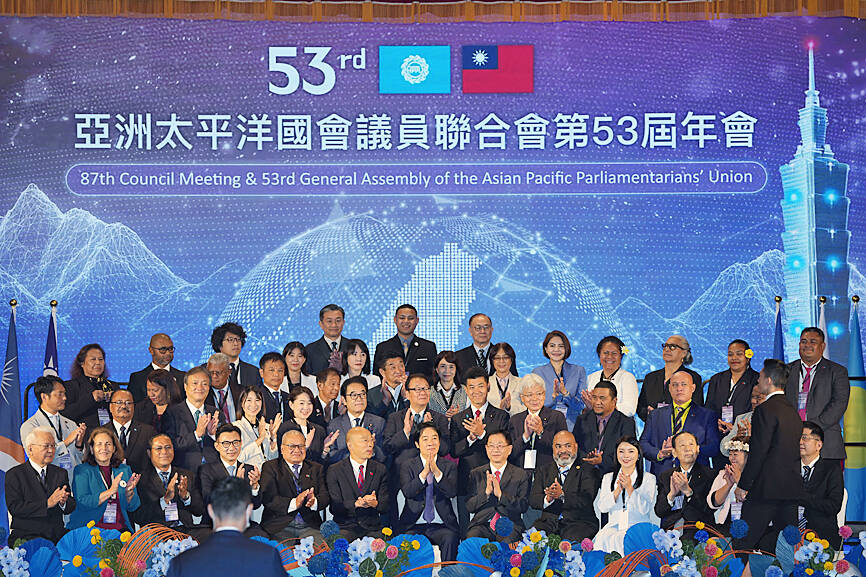
Photo: CNA
Taiwan is also boosting economic cooperation with the US, Japan and the EU, reversing its past reliance on China, Lai said.
The nation’s investment in China accounted for 7.5 percent of total outbound investment last year, down from 83.8 percent in 2010, he added.
Taiwan would also bolster exchanges with allies and like-minded partners through the APPU and other platforms, while remaining open to engagement with Beijing on equal terms, Lai said.
The assembly included Taiwanese lawmakers from across party lines and parliamentarians from Japan, Guam, the Marshall Islands, Palau, Tuvalu and the Northern Mariana Islands.
The group was founded by former Japanese prime minister Nobusuke Kishi in 1965 as the Asian Parliamentarians’ Union and later expanded to promote cooperation across the Asia-Pacific region.
Legislative Speaker Han Kuo-yu (韓國瑜) said that the APPU was “an important bridge” for inter-parliamentary exchange, adding that Taiwan looked forward to building closer, mutually beneficial partnerships with member states.
Han also urged parliamentarians to continue supporting Taiwan’s participation in international organizations and events, saying that its inclusion would bolster global capacity to address climate change, health crises and economic volatility.


Kenting National Park service technician Yang Jien-fon (楊政峰) won a silver award in World Grand Prix Photography Awards Spring Season for his photograph of two male rat snakes intertwined in combat. Yang’s colleagues at Kenting National Park said he is a master of nature photography who has been held back by his job in civil service. The awards accept entries in all four seasons across six categories: architectural and urban photography, black-and-white and fine art photography, commercial and fashion photography, documentary and people photography, nature and experimental photography, and mobile photography. Awards are ranked according to scores and divided into platinum, gold and

More than half of the bamboo vipers captured in Tainan in the past few years were found in the city’s Sinhua District (新化), while other districts had smaller catches or none at all. Every year, Tainan captures about 6,000 snakes which have made their way into people’s homes. Of the six major venomous snakes in Taiwan, the cobra, the many-banded krait, the brown-spotted pit viper and the bamboo viper are the most frequently captured. The high concentration of bamboo vipers captured in Sinhua District is puzzling. Tainan Agriculture Bureau Forestry and Nature Conservation Division head Chu Chien-ming (朱健明) earlier this week said that the
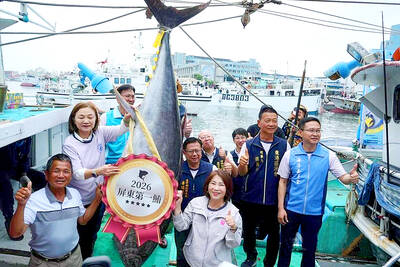
The first bluefin tuna of the season, brought to shore in Pingtung County and weighing 190kg, was yesterday auctioned for NT$10,600 (US$333.5) per kilogram, setting a record high for the local market. The auction was held at the fish market in Donggang Fishing Harbor, where the Siaoliouciou Island-registered fishing vessel Fu Yu Ching No. 2 delivered the “Pingtung First Tuna” it had caught for bidding. Bidding was intense, and the tuna was ultimately jointly purchased by a local restaurant and a local company for NT$10,600 per kilogram — NT$300 ,more than last year — for a total of NT$2.014 million. The 67-year-old skipper
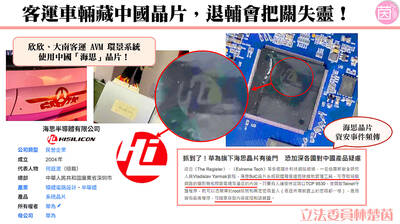
BREACH OF CONTRACT: The bus operators would seek compensation and have demanded that the manufacturer replace the chips with ones that meet regulations Two bus operators found to be using buses with China-made chips are to demand that the original manufacturers replace the systems and provide compensation for breach of contract, the Veterans Affairs Council said yesterday. Democratic Progressive Party Legislator Michelle Lin (林楚茵) yesterday said that Da Nan Bus Co and Shin-Shin Bus Co Ltd have fielded a total of 82 buses that are using Chinese chips. The bus models were made by Tron-E, while the systems provider was CYE Electronics, Lin said. Lin alleged that the buses were using chips manufactured by Huawei subsidiary HiSilicon Co, which presents a national security risk if the


 RSS
RSS