


The Ministry of Environment yesterday said it would approve a project to build a high-speed rail (HSR) extension from Taipei to Yilan County after the Railway Bureau alters plans for acquiring land and planting trees.
The environmental impact evaluation committee said after a meeting reviewing the preliminary report for the project that the bureau should obtain land use rights for proposed stations and special areas through expropriation and zoning to avoid disrupting the county government’s urban development plans.
The stations refer to railway platforms, parking garages and pick up areas, while special areas refer to the residential and commercial zones surrounding them, the committee said.
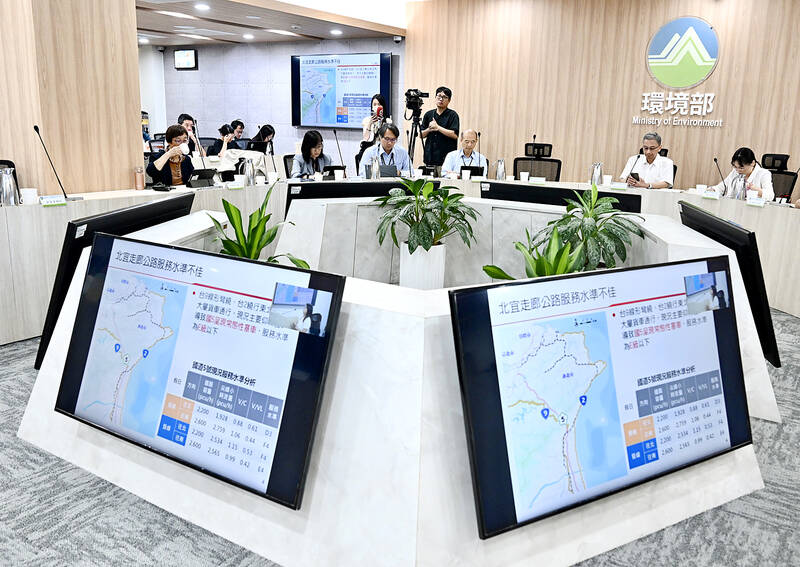
Photo: Lo Pei-de, Taipei Times
The bureau should provide a more detailed plan for acquiring the land necessary for the train stations, it said.
Some committee members suggested the bureau clarify mechanisms for evaluating the performance of operators and contractors, and a financial study on Taiwan Railway Corp, it said.
Trees to be planted as part of the project would not be included in calculating carbon credits to prevent double-counting, the committee said.
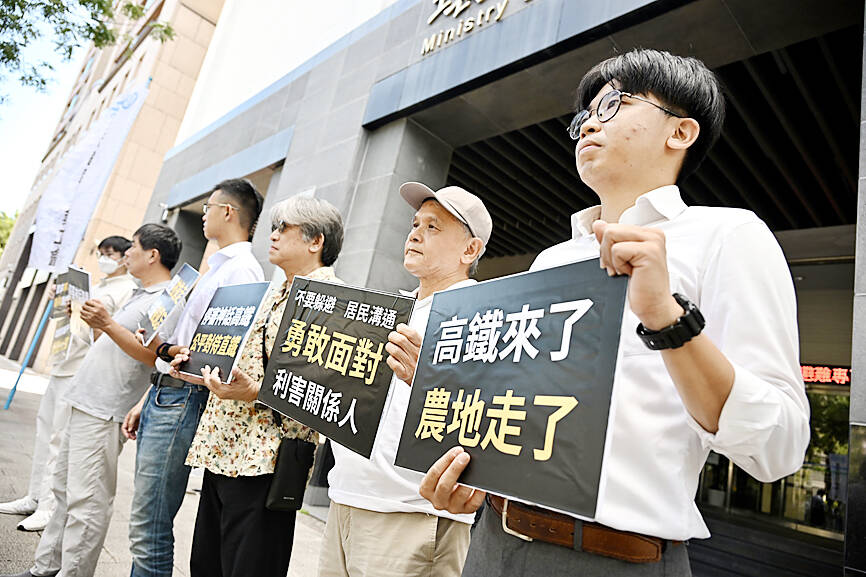
Photo: Lo Pei-de, Taipei Times
The proposed high-speed rail extension would link the HSR station in Taipei’s Nangang District (南港) to a location southeast of the Yilan County Government building, which would necessitate 59.6km of new construction, the Railway Bureau said.
The extension would be underground with six new stations and a maintenance facility near the planned Yilan Station, it said.
Taiwan High Speed Rail’s and Taiwan Railway Corp’s systems are complementary, with the HSR extension enabling same-day commuting between Taipei and Yilan County, bureau Deputy Director-General Yang Cheng-chun (楊正君) said.

Photo: THSRC
The bureau continues to collaborate with Taiwan Railway Corp on projects to electrify and lay a second track for the Hualien-Taitung line and improve the South Link Line in southern Taiwan, he said.
The proposed high-speed rail extension would likely be managed by Taiwan High-Speed Rail Corp, not a separate entity, he added.
On Monday, Taiwan Railway Union members, along with representatives of advocacy groups, protested outside the Ministry of the Environment, urging the government to focus on a direct railway line instead of the HSR extension.
The union members and advocates said that the extension could harm the financial viability of Taiwan Railway Corp, putting its workers at risk.
Separately, Taiwan High-Speed Rail Corp announced that its next-generation trains would be designated N700ST.
The trains are modeled after Japan’s N700S “Supreme” Shinkansen bullet trains.
The painting of the first N700ST train is to begin by the end of this year. The train’s nose would feature a bright white color scheme, with orange and black curved lines converging at the front and extending in parallel along the sides of the train.
The company said that the new trains are to begin arriving in Taiwan next year and are expected to enter service in 2027.
The new trains would increase capacity, providing passengers a better and more comfortable travel experience, it said.
In other news, starting next year, passengers without reserved seats would be assigned to designated non-reserved cabins during peak hours to reduce congestion on the trains, it said.

NATIONAL SECURITY: Authorities are working to confirm the identities of the military personnel involved and investigating possible illegal conduct and regulatory violations Authorities are probing possible national security implications after Kinmen police and immigration officers on Sunday found a Chinese woman allegedly posing as a tourist while engaging in prostitution involving more than 10 military personnel. The woman, surnamed Chen (陳), has since been deported, authorities said, adding that investigators are still working to confirm the identities of those implicated, as the records only listed code names and aliases. The case stemmed from a report received by the Kinmen District Prosecutors’ Office on Friday last week from the Jinhu Precinct of the Kinmen County Police Bureau. On Sunday, police, along with the National Immigration

REASONS FOR TRAVEL: An assistant professor said that proposed amendments to penalize drivers if they used drugs overseas would not deter people from traveling People who operate a motor vehicle under the influence of marijuana would have their driver’s license revoked, even if they used the substance while overseas, the Ministry of Transportation and Communications said yesterday, citing proposed amendments to the Road Traffic Management and Penalty Act (道路交通管理處罰條例). The amendments would also authorize the government to revoke the licenses of people determined to have used Category 1 or Category 2 narcotics, even if they were not operating a vehicle while under the influence of drugs, as well as ban them from taking the license test for three years, the ministry said. People aged 18 or

GLOBALGIVING: ‘ Caving to external pressure is not acceptable for an organization that has cultivated justice reform and human rights for 30 years,’ one NGO said A slew of non-government organizations (NGOs) have withdrawn from the GlobalGiving fundraising platform after it announced it would use “Chinese Taipei” instead of “Taiwan” from next month. The Taiwan Good Rice Association wrote on Facebook on Friday that it was informed on April 28 via a teleconference call of the change, which was made because the platform wanted to operate in China. Taiwan Good Rice is to terminate all cooperative relationships with GlobalGiving in response to the platform’s “unilateral and non-negotiable” decision to remove references to Taiwan, the NGO said. “Taiwan is in the official name of Taiwan Good Rice Association and the

HEAVY WEATHER: Typhoon Jangmi is due to crash straight into the Ryukyus as airlines look to shift flights to larger aircraft or cancel flights to Okinawa entirely Taiwan’s international air carriers announced flight adjustments over the weekend as Typhoon Jangmi is forecast to hit the Ryukyu Islands today and tomorrow. The Central Weather Administration (CWA) upgraded Jangmi from a tropical storm to a typhoon at 8am yesterday, with the eye located 580km south of Naha city. It was moving north at 19kph. Today, China Airlines’ CI-120, CI-121, CI-122 and CI-123 flights between Taoyuan and Naha, Okinawa, have been canceled as well as CI-132 and CI-133 between Kaohsiung and Naha. EVA Air’s BR-112, BR-113, BR-186 and BR-185 flights between Taoyuan and Naha are also canceled. Low-cost carrier Tigerair Taiwan canceled IT-230,


 RSS
RSS