


The annual "Sea and Air Precision Ammunition Firing Exercise" began yesterday, during which an innovative attack model involving drones launched from uncrewed surface vessels was successfully employed against a maritime target.
Hosted this year by the air force, the two-day drill is to run through today in Pingtung County’s Jiupeng Military Base.
According to the military, yesterday’s live-fire phase focused on the air force, with Indigenous Defense Fighters (IDFs) firing Sky Sword II missiles, F-16Vs launching AIM-120 advanced medium-range air-to-air missiles and AGM-65 Maverick missiles, and Mirage 2000s test-firing MICA missiles.
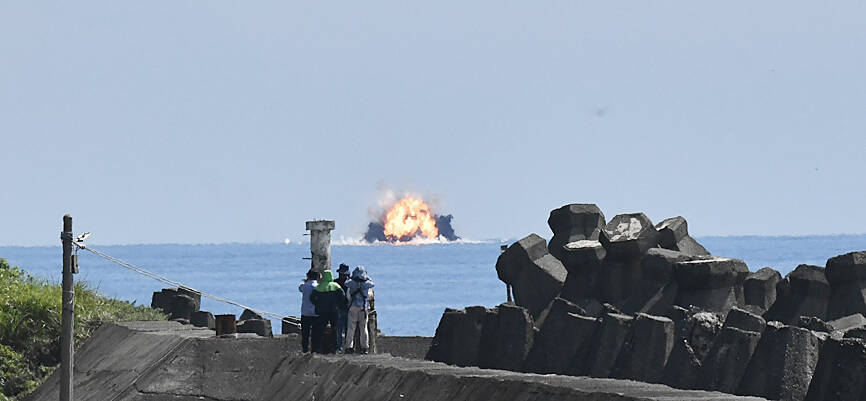
Photo: Tsai Tsung-hsien, Taipei Times
Naval vessels and the navy’s Hai Feng Shore-Based Anti-ship Missile Group are today set to fire Hsiung Feng anti-ship missiles and Standard Missile-1s, while additional live-fire tests are to involve Patriot, Sky Bow and Sky Sword I systems, the military said.
Certain "special weapons" would also be tested during the two-day event, it added.
One of the highlights of yesterday’s drill was the test of the "Kuai Chi" USV developed by Taiwan’s state-run weapons manufacturer National Chung-Shan Institute of Science and Technology.
Coordinated through the military’s command-and-control system, the vessel launched "Ching Feng" attack drones along with an undisclosed drone type in a swarm strike, successfully hitting its target at sea.
The military would consider procurement plans for the system following evaluation of the test results.

LOUD AND PROUD Taiwan might have taken a drubbing against Australia and Japan, but you might not know it from the enthusiasm and numbers of the fans Taiwan might not be expected to win the World Baseball Classic (WBC) but their fans are making their presence felt in Tokyo, with tens of thousands decked out in the team’s blue, blowing horns and singing songs. Taiwanese fans have packed out the Tokyo Dome for all three of their games so far and even threatened to drown out home team supporters when their team played Japan on Friday. They blew trumpets, chanted for their favorite players and had their own cheerleading squad who dance on a stage during the game. The team struggled to match that exuberance on the field, with
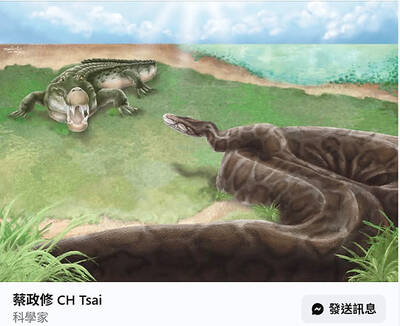
Taiwanese paleontologists have discovered fossil evidence that pythons up to 4m long inhabited Taiwan during the Pleistocene epoch, reporting their findings in the international scientific journal Historical Biology. National Taiwan University (NTU) Institute of Ecology and Evolutionary Biology associate professor Tsai Cheng-hsiu (蔡政修) led the team that discovered the largest snake fossil ever found in Taiwan. The single trunk vertebra was discovered in Tainan at the Chiting Formation, dated to between 400,000 and 800,000 years ago in the Middle Pleistocene, the paper said. The area also produced Taiwan’s first avian fossil, as well as crocodile, mammoth, saber-toothed cat and rhinoceros fossils, it said. Discoveries

Taiwanese paleontologists have discovered fossil evidence that pythons up to 4m long inhabited Taiwan during the Pleistocene epoch, reporting their findings in the international scientific journal Historical Biology. National Taiwan University (NTU) Institute of Ecology and Evolutionary Biology associate professor Tsai Cheng-hsiu (蔡政修) led the team that discovered the largest snake fossil ever found in Taiwan. A single trunk vertebra was discovered in Tainan at the Chiting Formation, dated to between 800,000 to 400,000 years ago in the Middle Pleistocene, the paper said. The area also produced Taiwan’s first avian fossil, as well as crocodile, mammoth, sabre-toothed cat and rhinoceros fossils, it said. Discoveries
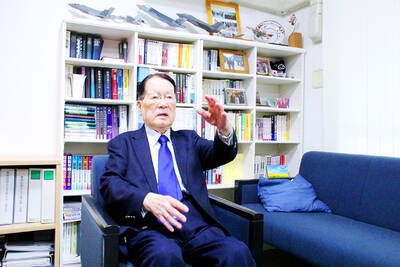
Whether Japan would help defend Taiwan in case of a cross-strait conflict would depend on the US and the extent to which Japan would be allowed to act under the US-Japan Security Treaty, former Japanese minister of defense Satoshi Morimoto said. As China has not given up on the idea of invading Taiwan by force, to what extent Japan could support US military action would hinge on Washington’s intention and its negotiation with Tokyo, Morimoto said in an interview with the Liberty Times (sister paper of the Taipei Times) yesterday. There has to be sufficient mutual recognition of how Japan could provide


 RSS
RSS