


Three executives of the Taiwan Disability Care Association, including its director-general, were indicted yesterday on charges of embezzling NT$110 million (US$3.68 million) in public charitable donations, breach of trust and bank loan fraud.
A man surnamed Hsiao (蕭) served as director-general of the association from its founding in 2011 until he became a wanted fugitive in a separate criminal case in 2021.
His wife, surnamed Chen (陳), then assumed the position, the Taipei Shilin District Prosecutors’ Office said in a statement.
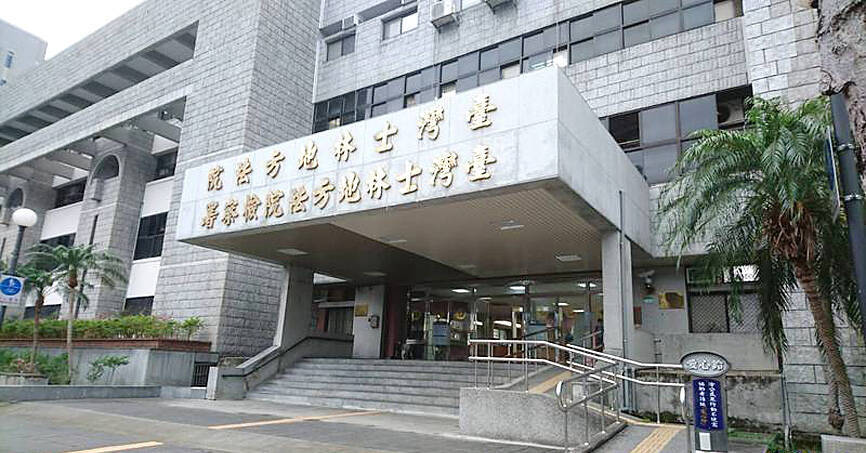
Photo: Wu Cheng-feng, Taipei Times
However, prosecutors said Hsiao continued to control the association’s finances and assets together with Chen, using the false surname Huang (黃), while posing as an assistant at the association. His sister, also listed as an executive director, took part in the group’s fundraising activities.
From 2019 to March, the three allegedly misappropriated public donations, transferring the funds to relatives’ accounts for personal use, including real-estate purchases, credit card payments and loan repayments.
The total amount embezzled reached NT$110 million, prosecutors said.
The investigation found that between 2019 and April this year, Hsiao and Chen promoted the association’s charitable work through its Web site and hired the Taiwan branches of a Singaporean and a Malaysian company to conduct street advocacy and telemarketing campaigns to solicit donations.
As a result, the association received NT$250 million in donations, but only about NT$10 million was spent on basic operating expenses and public welfare projects, prosecutors said.
Between 2021 and this year, the association paid NT$130 million — 79 percent of its reported revenue — to the two companies, exceeding the legal limit on fundraising expenses.
Prosecutors said this meant that most donations were spent on marketing rather than on their intended charitable purposes, constituting a breach of trust.
Separately, in 2022 and 2023, Hsiao allegedly purchased two properties in New Taipei City’s Linkou District (林口) under his sister’s name.
He also allegedly transferred NT$2.1 million in association funds to her account, fabricated salary records and issued false tax withholding statements claiming she was an association engineer with an annual salary of NT$2.3 million, prosecutors said.
Using these false documents, Hsiao fraudulently obtained NT$52.16 million in bank loans, prosecutors said.
His sister, fully aware that the funds came from embezzled donations, allegedly helped him conceal assets purchased with illicit funds, prosecutors said.
She also registered seven of his personal vehicles under her name, prosecutors added.
The district prosecutors’ office indicted Hsiao, Chen and the sister on charges including embezzlement of public interest funds, document forgery, fraud, breach of trust, money laundering and harboring a fugitive.
The three remain in custody pending a Shilin District Court decision on whether to extend their detention.

Considering that most countries issue more than five denominations of banknotes, the central bank has decided to redesign all five denominations, the bank said as it prepares for the first major overhaul of the banknotes in more than 24 years. Central bank Governor Yang Chin-lung (楊金龍) is expected to report to the Legislative Yuan today on the bank’s operations and the redesign’s progress. The bank in a report sent to the legislature ahead of today’s meeting said it had commissioned a survey on the public’s preferences. Survey results showed that NT$100 and NT$1,000 banknotes are the most commonly used, while NT$200 and NT$2,000

The Centers for Disease Control (CDC) yesterday reported the first case of a new COVID-19 subvariant — BA.3.2 — in a 10-year-old Singaporean girl who had a fever upon arrival in Taiwan and tested positive for the disease. The girl left Taiwan on March 20 and the case did not have a direct impact on the local community, it said. The WHO added the BA.3.2 strain to its list of Variants Under Monitoring in December last year, but this was the first imported case of the COVID-19 variant in Taiwan, CDC Deputy Director-General Lin Ming-cheng (林明誠) said. The girl arrived in Taiwan on

South Korea is planning to revise its controversial electronic arrival card, a step Taiwanese officials said prompted them to hold off on planned retaliatory measures, a South Korean media report said yesterday. A Yonhap News Agency report said that the South Korean Ministry of Foreign Affairs is planning to remove the “previous departure place” and “next destination” fields from its e-arrival card system. The plan, reached after interagency consultations, is under review and aims to simplify entry procedures and align the electronic form with the paper version, a South Korean ministry official said. The fields — which appeared only on the electronic form

The Ministry of Foreign Affairs (MOFA) is suspending retaliation measures against South Korea that were set to take effect tomorrow, after Seoul said it is updating its e-arrival system, MOFA said today. The measures were to be a new round of retaliation after Taiwan on March 1 changed South Korea's designation on government-issued alien resident certificates held by South Korean nationals to "South Korea” from the "Republic of Korea," the country’s official name. The move came after months of protests to Seoul over its listing of Taiwan as "China (Taiwan)" in dropdown menus on its new online immigration entry system. MOFA last week


 RSS
RSS