


Up to 50,000 seedlings of the “red nine” (紅九) variety of the awkeotsang creeping fig have been successfully planted in areas at low altitudes across 30 hectares, the Agency of Rural Development and Soil and Water Conservation’s Taipei branch said on Friday amid a push to promote aiyu jelly products.
The fig, from which aiyu is made, is endemic to Taiwan, typically growing in mountainous areas at altitudes below 1,500m, the Ministry of Agriculture said.
Aiyu seeds are rubbed in water to produce pectin, which binds with minerals in the water to form aiyu jelly, a popular refreshment, the ministry said.
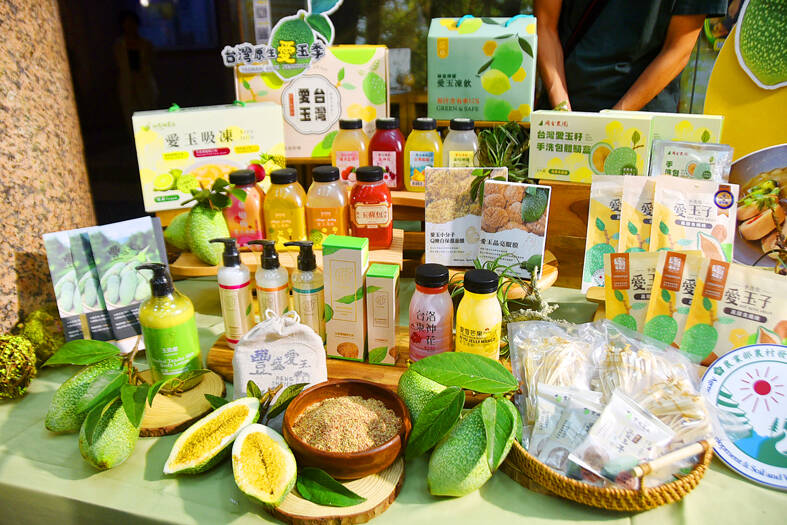
Photo: Wu Po-hsuan, Taipei Times
Planting aiyu in low-lying areas used to be difficult, as it is only pollinated by the fig wasp, or Wiebesia pumilae, it said.
However, with new techniques and varieties, the agency has been promoting cultivation of the figs in low-lying areas by assisting agricultural workers with seed selection, cultivation, harvesting, processing and marketing, it said.
Taipei branch Director-General Tsai Chin-lung (蔡金龍) said that 565 hectares of the figs in Taiwan provide an annual output of 616 tonnes of the fruit.
Chiayi County is the primary production region, while Nantou and Pingtung counties contribute most of the remainder, Tsai said.
There are more than 200 varieties of aiyu-producing fig in Taiwan, he said.
As part of the Taipei branch’s efforts to promote cultivation of the fruit in low-lying areas, it has been assisting growers to use vacant land in rural communities to grow them since 2017, he said.
Unlike grass jelly or agar jelly, aiyu jelly is solid at room temperature without having to be mixed with other materials, he said.
The branch is focused on promoting the red nine variety because it was selected by the Taiwan Forestry Research Institute, and it has production and quality advantages over other varieties, he said.
To help market the jelly, the branch collaborated with industry players to develop more aiyu products, including food and biotech products, Tsai said.
It also cooperated with orchard operators and department stores to organize aiyu jelly activities, he added.
Asked whether promoting cultivation of the figs would affect the planting areas of other crops, Tsai said the ministry continually calibrates allocation of agricultural resources by reducing cultivation of excessively produced crops and prioritizing vacant farmland.
The figs are endemic to Taiwan and are rarely grown elsewhere, making it a popular choice for agricultural operations when they want to switch from growing one crop to another in a field, he said.
However, it takes the seedlings three years to mature enough to be harvested and another two years to develop stable production, Tsai said, adding that the time factor might deter some growers.
High-quality aiyu seeds can sell for up to NT$1,200 per jin (600g), he said.
The branch also collaborated with industry players to explore different ways of exporting aiyu seeds, he said.
For example, an overseas online influencer placed an order of 2,000 bags of seeds in an agreement with Chyuan Fa Honey Co on a live commerce collaboration model, he said.

AGING: While Japan has 22 submarines, Taiwan only operates four, two of which were commissioned by the US in 1945 and 1946, and transferred to Taiwan in 1973 Taiwan would need at least 12 submarines to reach modern fleet capabilities, CSBC Corp, Taiwan chairman Chen Cheng-hung (陳政宏) said in an interview broadcast on Friday, citing a US assessment. CSBC is testing the nation’s first indigenous defense submarine, the Hai Kun (海鯤, Narwhal), which is scheduled to be delivered to the navy next month or in July. The Hai Kun has completed torpedo-firing tests and is scheduled to undergo overnight sea trials, Chen said on an SET TV military affairs program. Taiwan would require at least 12 submarines to establish a modern submarine force after assessing the nation’s operational environment and defense

A white king snake that frightened passengers and caused a stir on a Taipei MRT train on Friday evening has been claimed by its owner, who would be fined, Taipei Rapid Transit Corp (TRTC) said yesterday. A person on Threads posted that he thought he was lucky to find an empty row of seats on Friday after boarding a train on the Bannan (Blue) Line, only to spot a white snake with black stripes after sitting down. Startled, he jumped up, he wrote, describing the encounter as “terrifying.” “Taipei’s rat control plan: Release snakes on the metro,” one person wrote in reply, referring
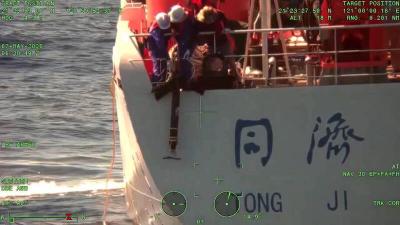
The coast guard today said that it had disrupted "illegal" operations by a Chinese research ship in waters close to the nation and driven it away, part of what Taipei sees a provocative pattern of China's stepped up maritime activities. The coast guard said that it on Thursday last week detected the Chinese ship Tongji (同濟號), which was commissioned only last year, 29 nautical miles (54km) southeast of the southern tip of Taiwan, although just outside restricted waters. The ship was observed lowering ropes into the water, suspected to be the deployment of scientific instruments for "illegal" survey operations, and the coast
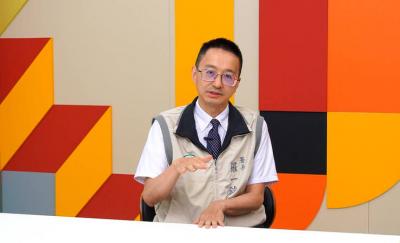
Taiwan’s two cases of hantavirus so far this year are on par with previous years’ case numbers, and the government is coordinating rat extermination work, so there should not be any outbreaks, Centers for Disease Control (CDC) Director-General Philip Lo (羅一鈞) said today in an interview with the Liberty Times (the Taipei Times’ sister newspaper). An increase in rat sightings in Taipei and New Taipei City has raised concerns about the spread of hantavirus, as rats can carry the disease. In January, a man in his 70s who lived in Taipei’s Daan District (大安) tested positive posthumously for hantavirus, Taiwan’s


 RSS
RSS