


The Legislative Yuan is leaning toward not looking into the dinner allegedly hosted by Chinese firm BYD Co (比亞迪) executives for aides to the Legislative Yuan speaker and deputy speaker as a contravention of the Lobbying Act (遊說法), according to a source within the legislature.
The Chinese-language Mirror Media magazine on Tuesday cited industry sources as saying that BYD plans to enter the Taiwan market by assembling vehicles in Thailand and selling them under the Denza brand through a local agent, adding that BYD’s local agent recently hosted a banquet attended by staffers from the office of Legislative Speaker Han Kuo-yu (韓國瑜) and Deputy Legislative Speaker Johnny Chiang (江啟臣), including Legislative Yuan General Affairs Department Director Liao Chiung-chih (廖炯志).
Taiwan bans direct imports of fully assembled vehicles from China. Locally assembled vehicles using Chinese components must meet strict localization thresholds to be approved for sale and registration.
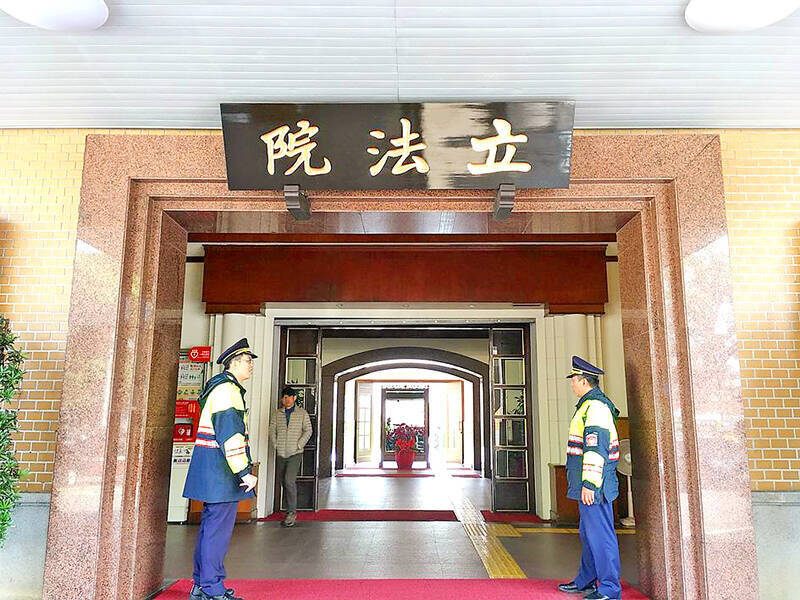
Photo: Lin Liang-sheng, Taipei Times
Democratic Progressive Party (DPP) caucus chief executive Rosalia Wu (吳思瑤) on Tuesday said that Liao, by attending the dinner, might have contravened the Ethics Guidelines for Civil Servants (公務員廉政倫理規範).
The Ministry of the Interior, the authority with jurisdiction over infractions of the Lobbying Act, said it would only become involved if the legislature deemed the incident an act of inappropriate lobbying and invoked Article 29 of the act.
A source from the Legislative Yuan on condition of anonymity said that the dinner did not meet the definition of lobbying, as an act of lobbying must touch upon specific details and must be registered with the legislature’s Lobbying Office.
They cited Liao’s response on Tuesday that he had no business dealings with the people at the dinner, and he did not breach ethics regulations.
DPP Legislator Michelle Lin (林楚茵) said that claiming the incident was just a dinner gathering was an act of self-delusion.
Chinese executives sought to lobby KMT legislators to pressure the Ministry of Economic Affairs to relax restrictions, which was an evident attempt to ensure that the legislative branch superseded the administrative branch, she said.
Separately yesterday, Citizens’ Congress Watch executive director Chang Hung-lin (張宏林) said that despite numerous laws aimed at deterring and preventing corruption, their enforcement was scarce.
He called on agencies to intensify their efforts to enforce and uphold the law.
Han should be severely criticized over the incident, as the legislative speaker and deputy speaker should not be involved in a case that might have a conflict of interest, nor should they be directly lobbied, Chang said.
The law states that both the lobbyist and the lobbied legislator are obligated to report the incident, he said, adding that both sides were at risk of contravening the law.
Additional reporting by CNA

LOUD AND PROUD Taiwan might have taken a drubbing against Australia and Japan, but you might not know it from the enthusiasm and numbers of the fans Taiwan might not be expected to win the World Baseball Classic (WBC) but their fans are making their presence felt in Tokyo, with tens of thousands decked out in the team’s blue, blowing horns and singing songs. Taiwanese fans have packed out the Tokyo Dome for all three of their games so far and even threatened to drown out home team supporters when their team played Japan on Friday. They blew trumpets, chanted for their favorite players and had their own cheerleading squad who dance on a stage during the game. The team struggled to match that exuberance on the field, with
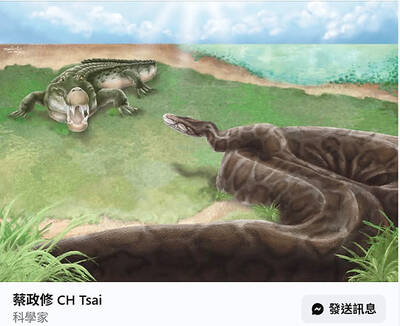
Taiwanese paleontologists have discovered fossil evidence that pythons up to 4m long inhabited Taiwan during the Pleistocene epoch, reporting their findings in the international scientific journal Historical Biology. National Taiwan University (NTU) Institute of Ecology and Evolutionary Biology associate professor Tsai Cheng-hsiu (蔡政修) led the team that discovered the largest snake fossil ever found in Taiwan. The single trunk vertebra was discovered in Tainan at the Chiting Formation, dated to between 400,000 and 800,000 years ago in the Middle Pleistocene, the paper said. The area also produced Taiwan’s first avian fossil, as well as crocodile, mammoth, saber-toothed cat and rhinoceros fossils, it said. Discoveries

Taiwanese paleontologists have discovered fossil evidence that pythons up to 4m long inhabited Taiwan during the Pleistocene epoch, reporting their findings in the international scientific journal Historical Biology. National Taiwan University (NTU) Institute of Ecology and Evolutionary Biology associate professor Tsai Cheng-hsiu (蔡政修) led the team that discovered the largest snake fossil ever found in Taiwan. A single trunk vertebra was discovered in Tainan at the Chiting Formation, dated to between 800,000 to 400,000 years ago in the Middle Pleistocene, the paper said. The area also produced Taiwan’s first avian fossil, as well as crocodile, mammoth, sabre-toothed cat and rhinoceros fossils, it said. Discoveries

Whether Japan would help defend Taiwan in case of a cross-strait conflict would depend on the US and the extent to which Japan would be allowed to act under the US-Japan Security Treaty, former Japanese minister of defense Satoshi Morimoto said. As China has not given up on the idea of invading Taiwan by force, to what extent Japan could support US military action would hinge on Washington’s intention and its negotiation with Tokyo, Morimoto said in an interview with the Liberty Times (sister paper of the Taipei Times) yesterday. There has to be sufficient mutual recognition of how Japan could provide


 RSS
RSS