


The US Department of State on Tuesday dismissed speculation that a planned trip to South America with stopovers in the US by President William Lai (賴清德) was canceled, saying there were no plans and therefore nothing was canceled.
Speaking at a news conference, state department spokesperson Tammy Bruce said that Lai’s travel plans were “hypothetical” because they were never announced by Taiwan.
“There have been no plans — travel plans for the president. There’s been, as a result, nothing canceled,” Bruce said.
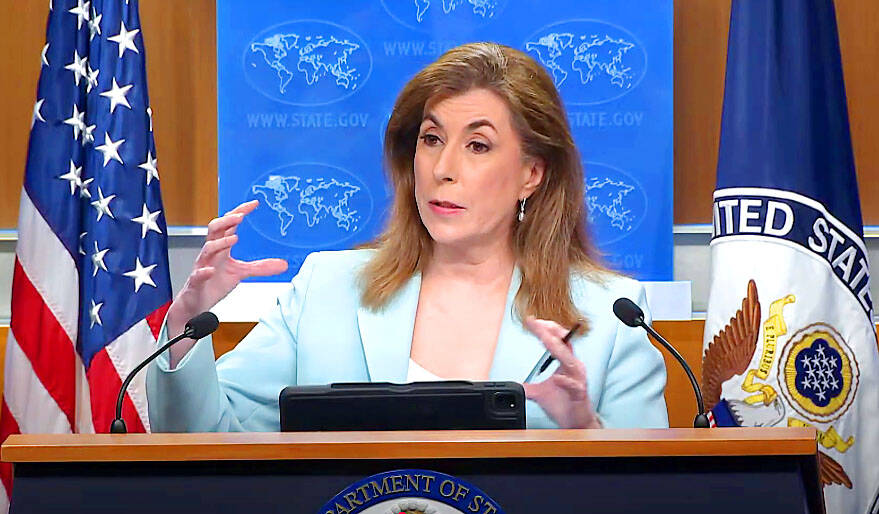
Photo: screen grab from The Associated Press YouTube Channel
Her remarks came after the Financial Times on Monday reported that Lai’s planned visit to diplomatic allies Paraguay, Guatemala and Belize next month were delayed or canceled, as US President Donald Trump blocked a stopover in New York due to protests from China.
Citing three unnamed sources, the Financial Times said that Trump was concerned that Lai’s trip would affect ongoing trade talks between the two powers.
“I can tell you, though, a reiteration that transits by high-level Taiwan officials, including presidents, are fully consistent with our longstanding policy and practice,” Bruce said. “This has not changed.”
Presidential Office spokeswoman Karen Kuo (郭雅慧) in a statement on Monday said that due to typhoon disaster recovery efforts in southern Taiwan, US-Taiwan reciprocal tariff measures and regional developments, there was no immediate plan for Lai to travel.
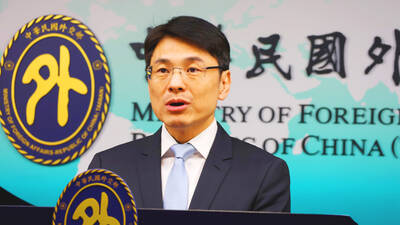
Ministry of Foreign Affairs spokesman Hsiao Kuang-wei (蕭光偉) on Tuesday reiterated that Lai had no overseas travel plans.
Former US House of Representatives speaker Nancy Pelosi on Facebook on Monday said that if the report about Trump’s denial of Lai’s stopover were true, it showed the administration could be bullied by China into silence when it came to Taiwan.
“For decades, members in the House and Senate of both parties have upheld a bipartisan commitment to supporting Taiwan’s democracy, in accordance with the Taiwan Relations Act,” Pelosi said.
“Our relationship with Taiwan is in the interest of global and regional security, in the interest of our economy by enabling commerce through the Taiwan Strait and in our moral interest by supporting democracy over autocracy,” she said.
Meanwhile, US Secretary of the Treasury Scott Bessent, who just wrapped up a new round of trade talks with China in Stockholm yesterday, told CNBC that Lai’s travel plans had nothing to do with the US-China negotiations.
Separately, one person with knowledge of the discussions told The Associated Press that the US “had asked Taipei to rearrange the transit — not go through New York.”
Another person with knowledge of the discussions said that Beijing had sensed that it could ask Trump not to allow Lai to transit through the US because of his perceived “desperation” to meet Chinese President Xi Jinping (習近平).
Both people spoke on condition of anonymity because they are in current sensitive discussions with administration officials.
By the end of last week it was clear that the Trump administration was discussing the likely transit by Lai, although it was unclear if the administration had blocked it, one of the people said.
It was also unclear if the Trump administration would be open to allowing Lai to transit through a city other than New York.
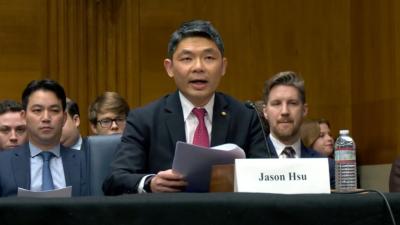
Jason Hsu (許毓仁), a senior fellow at the Hudson Institute and a former legislator, said that Taiwan always consults with the US on transits and called it “abnormal” for Washington not to agree when such stopovers are permitted under the Taiwan Relations Act.
Beijing has routinely protested any transit through the US by Taiwanese leaders.
While such transits have been routine by previous presidents and under previous US administrations, the person familiar with the discussions said Beijing considers Lai an exception because it views him as being more aggressive in seeking independence.
American Enterprise Institute senior fellow Zack Cooper said that while recent US administrations have not allowed Taiwan to be used in negotiations with Beijing, “this decision raises questions about whether the Trump administration is reconsidering that approach.”
Hsu said that in preventing Lai’s stopover “the Trump administration appears to be accommodating China’s red lines.”
Democrats on the US House Foreign Affairs Committee on Tuesday said that Trump is folding to Beijing.
US Representative Raja Krishnamoorthi called it “another example of the Trump administration caving to China in hopes of reaching a trade deal.”
“Presidents of both parties have allowed Taiwan officials to transit through the US in the past, and now should be no different,” he said in a statement.

Taiwan has received more than US$70 million in royalties as of the end of last year from developing the F-16V jet as countries worldwide purchase or upgrade to this popular model, government and military officials said on Saturday. Taiwan funded the development of the F-16V jet and ended up the sole investor as other countries withdrew from the program. Now the F-16V is increasingly popular and countries must pay Taiwan a percentage in royalties when they purchase new F-16V aircraft or upgrade older F-16 models. The next five years are expected to be the peak for these royalties, with Taiwan potentially earning
STAY IN YOUR LANE: As the US and Israel attack Iran, the ministry has warned China not to overstep by including Taiwanese citizens in its evacuation orders The Ministry of Foreign Affairs (MOFA) yesterday rebuked a statement by China’s embassy in Israel that it would evacuate Taiwanese holders of Chinese travel documents from Israel amid the latter’s escalating conflict with Iran. Tensions have risen across the Middle East in the wake of US and Israeli airstrikes on Iran beginning Saturday. China subsequently issued an evacuation notice for its citizens. In a news release, the Chinese embassy in Israel said holders of “Taiwan compatriot permits (台胞證)” issued to Taiwanese nationals by Chinese authorities for travel to China — could register for evacuation to Egypt. In Taipei, the ministry yesterday said Taiwan
Taiwan is awaiting official notification from the US regarding the status of the Agreement on Reciprocal Trade (ART) after the US Supreme Court ruled US President Donald Trump's global tariffs unconstitutional. Speaking to reporters before a legislative hearing today, Premier Cho Jung-tai (卓榮泰) said that Taiwan's negotiation team remains focused on ensuring that the bilateral trade deal remains intact despite the legal challenge to Trump's tariff policy. "The US has pledged to notify its trade partners once the subsequent administrative and legal processes are finalized, and that certainly includes Taiwan," Cho said when asked about opposition parties’ doubts that the ART was
If China chose to invade Taiwan tomorrow, it would only have to sever three undersea fiber-optic cable clusters to cause a data blackout, Jason Hsu (許毓仁), a senior fellow at the Hudson Institute and former Chinese Nationalist Party (KMT) legislator, told a US security panel yesterday. In a Taiwan contingency, cable disruption would be one of the earliest preinvasion actions and the signal that escalation had begun, he said, adding that Taiwan’s current cable repair capabilities are insufficient. The US-China Economic and Security Review Commission (USCC) yesterday held a hearing on US-China Competition Under the Sea, with Hsu speaking on


 RSS
RSS