


The Ministry of Labor plans to allow families of critically ill people to hire migrant workers from other employment categories to increase the supply of caregivers, a ministry official said yesterday.
The measure is to be introduced to avoid possible negative effects on such families after the launch of a new policy that waives Barthel Index evaluations for Taiwanese aged 80 or older who want to hire live-in foreign caregivers.
The Legislative Yuan last year passed an amendment to the Employment Service Act (就業服務法), allowing people aged 80 or older to hire live-in foreign caregivers without undergoing health evaluations based on the Barthel Index — a clinical scale used to assess a person's ability to perform daily activities.

Photo: CNA
The exemption also applies to households with members aged 70 to 79 who have been diagnosed with Stage 2 cancer or above.
The amendment was promulgated, but while the changes are expected to benefit an additional 100,000 households by enabling them to apply for caregivers, it might affect the families of critically ill people — those who are bed-ridden and have ailments or diseases such as dementia.
The concern is that caregivers could choose to take care of people who do not have a critical illness.
With that in mind, the ministry is drafting accompanying measures that are expected to be implemented by the end of this month, said Su Yu-kuo (蘇裕國), a division chief at the ministry's Workforce Development Agency.
To expand the pool of available caregivers, the labor ministry would allow families of people with critical conditions to hire migrant workers from across different job categories, Su said, adding that the existing rule requires job transfers to be within the same employment category.
Workers from the manufacturing, agricultural or construction sectors who wish to switch to live-in caregiving would first have to complete 20 hours of supplementary training — either in person or online, Su said.
As long as the training is completed and both parties agree, the transfer can proceed, he added.
Under the ministry's proposed measures, people with mild diseases would no longer need to go through the Ministry of Health and Welfare's long-term care service platform to apply for caregivers, Su said.
Instead, employers could post a seven-day job advertisement on the TaiwanJobs Web site to proceed to the next step, Su said, adding that related measures are expected to launch between now and next month.

FUKUOKA SITUATION: Japanese media reported that the pathogen is expected to be identified by the summer, while the CDC downplayed the idea that it was hMPV A “mysterious cold-like illness” reported in Japan’s Fukuoka Prefecture does not seem to be a new disease, but Japanese authorities have been asked about the situation, the Centers for Disease Control (CDC) said yesterday. The Fukuoka Prefectural Medical Association on Wednesday told a news conference that a “mystery cold” that has become a hot topic on social media is “highly likely to be caused by some kind of viral infection,” Japan’s KBC News reported. “Many people are experiencing symptoms starting with a sore throat, followed by a runny nose, phlegm and a severe cough,” KBC News reported, citing association officials. Health authorities are

Nvidia Corp CEO Jensen Huang (黃仁勳) arrived in Taiwan yesterday ahead of upcoming AI and technology events, saying he plans to meet with clients and Taiwan Semiconductor Manufacturing Co Chairman C.C. Wei (魏哲家) during his visit. After landing at Taipei Songshan Airport, Huang posed for photos with fans and handed out Yakult drinks to reporters and supporters waiting at the scene, saying he has “a lot to do” during the trip. Asked about reports that Nvidia’s planned headquarters site in Taipei’s Beitou Shilin Technology Park could break ground on May 27, Huang said that if the company holds an event, he would

The Ministry of Finance this afternoon announced the winning numbers for the March-April uniform invoice lottery. The winning number for the NT$10 million (US$318,060) special prize is 19531471, and the winning number for the NT$2 million grand prize is 85941329. Three numbers were drawn for the NT$200,000 first prize: 07225810, 20231230 and 83518781. Those with receipts matching the last seven digits of any of the first-prize numbers will win the NT$40,000 second prize, while those matching the last six digits will win the NT$10,000 third prize. Those whose receipts match the last five digits of the first-prize numbers can claim the NT$4,000 fourth prize,
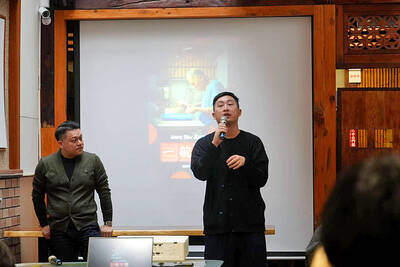
Taiwan Travelogue (臺灣漫遊錄), which earlier this week became the first Taiwanese novel to win the International Booker Prize, is to be adapted into a television series through a Taiwan-Japan coproduction, producer Chang Chen-yu (張辰漁) said yesterday. Chang, a producer at World Softest Production Film Co, wrote on Facebook that the company had been searching for projects with international appeal that retain a strong Taiwanese identity after colleagues and Japanese partners strongly recommended the novel. After reading the book, Chang said he immediately decided to pursue the screen rights. “A great story has the power to transcend time and borders, and connect countless people,”


 RSS
RSS