


The Ministry of Agriculture has bred a disease-resistant, high-production strain of bees and made the strain and breeding method available to the private sector, promoting the sustainable development of the beekeeping industry.
The Miaoli District Agricultural Research and Extension Station has been researching bee strains for five years, aiming to address declining honey yields due to weakened strains and pests.
The station introduced its new breakthrough bee strain at a news conference at the ministry in Taipei yesterday.
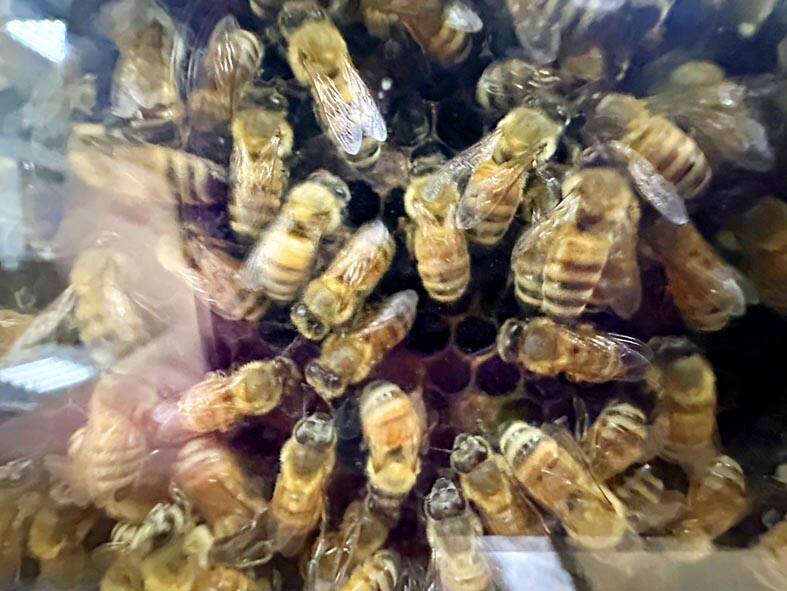
Photo: Yang Yuan-ting, Taipei Times
Domestic bee colonies primarily rely on beekeepers to help them reproduce within their own colony, but inbreeding has gradually weakened strains, station director Lu Hsiu-ying (呂秀英) said.
Coupled with the increasing difficulty of pest and disease control amid climate change, honey production has declined, Lu said.
After five generations of hybridization, the station bred a new disease-resistant, high-production strain of bees, helping the beekeeping industry to improve bee genetics and overcome the effects of climate change, she said.
To develop the strain, researchers bred bees that were good at keeping hives clean with bees that were strong honey gatherers, said Wu Tzu-hsien (吳姿嫻), director of the station’s beekeeping division.
After five generations of careful selection and crossbreeding, they produced a strain that combines both traits, Wu said.
Bees that tend toward cleanliness regularly clear out waste and dead bees, which makes the hive healthier and more resistant to diseases, she said.
To measure hygienic behavior, the station used liquid nitrogen to freeze bee pupae in the hive, then checked 24 hours later to see how much had been cleaned out, Wu said.
It also marked larvae and introduced a disease that affects them, then checked their survival rate to assess a colony’s disease resistance, she said.
The station measured the honey harvested during the longan flowering period to breed strains with high honey production, she added.
It put colonies close to longan trees then measured the weight of honeycombs before and after spinning out the honey to calculate the amount collected, she said.
The new strain of bees showed a hygienic ability of 90 percent, up from 70 percent, a 40 percent improvement in larvae survival and a 30 percent improvement in honey production, Wu said.
The station’s techniques are available under a nonexclusive license, so beekeepers can use it freely to improve their own breeding skills, helping to improve domestic bee quality and honey production, Lu said.
The station would use the technique to develop breeding farms and provide high-quality bees for beekeepers, helping the industry to face modern challenges and grow sustainably, she said.
The fee for the bee breeding technology is NT$130,000 and it is available to individuals, companies and other organizations, the station said.
The package includes 30 specially selected queen bees, six frames of carefully bred bee brood and a guide to the hybrid trait preservation technique, it said.
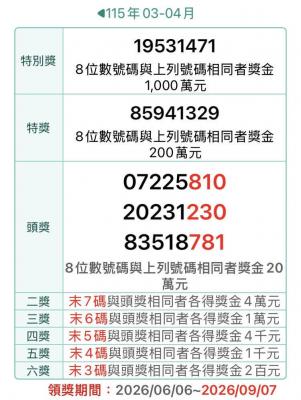
The Ministry of Finance this afternoon announced the winning numbers for the March-April uniform invoice lottery. The winning number for the NT$10 million (US$318,060) special prize is 19531471, and the winning number for the NT$2 million grand prize is 85941329. Three numbers were drawn for the NT$200,000 first prize: 07225810, 20231230 and 83518781. Those with receipts matching the last seven digits of any of the first-prize numbers will win the NT$40,000 second prize, while those matching the last six digits will win the NT$10,000 third prize. Those whose receipts match the last five digits of the first-prize numbers can claim the NT$4,000 fourth prize,

SIX SUBSIDIES: The monthly allowance for older farmers is to increase to NT$10,000, and NT$5,000 is to be given to homemakers under the national pension system, Lai said The government is to implement major welfare policies for disadvantaged groups, including raising the monthly allowance for older farmers to NT$10,000 and providing homemakers with NT$5,000 per month, President William Lai (賴清德) said yesterday. Lai made the remarks during a visit to Wangling Temple in Chiayi County, saying that the planned increases were being introduced amid economic growth and an increase in tax revenue. Touting a policy, in which the government plans to provide a monthly allowance of NT$5,000 for every child under the age of 18 in a bid to address Taiwan’s low birthrate, Lai said that if received for the
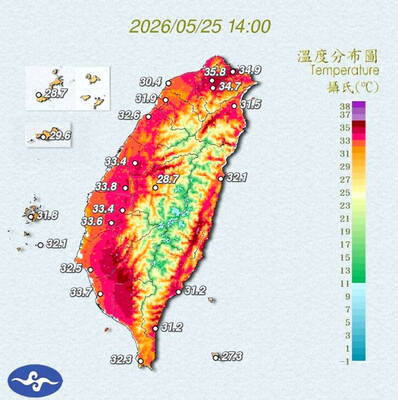
STAY COOL: The HPA recommended that people stay hydrated, use air-conditioning or fans while indoors, wear loose-fitting clothes and walk in the shade while outdoors Employers must implement measures such as installing cooling equipment, and providing drinking water and rest breaks for outdoor workers starting from Monday next week, the Taipei Department of Labor said on Sunday. Employers who fail to comply could face fines of NT$30,000 to NT$300,000 under the Occupational Safety and Health Act (職業安全衛生法), the department said. Businesses in Taipei employing fewer than 100 workers, as well as registered self-employed workers with labor insurance coverage, could receive on-site assessments and guidance from occupational safety consultants to help them apply for central government subsidies to implement or improve heat-protection measures, it said. Under the Ministry of
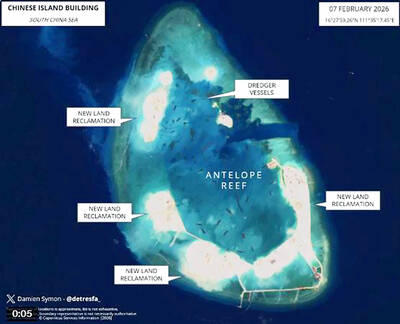
ISOLATION: The outposts would serve as support and backup bases, forcing US forces to either face China head-on or reroute, increasing travel time and operational costs China’s outposts in the South China Sea could be used to delay and constrain foreign forces during a conflict in the Taiwan Strait, giving Beijing a critical window to carry out amphibious landing and blockade operations, a report said. The Chinese Communist Party’s (CCP) forward operating bases on islands and reclaimed features in the South China Sea could delay foreign forces long enough for the Chinese People’s Liberation Army (PLA) to secure a key 48-to-72-hour window in the Taiwan Strait, a report commissioned by the Mainland Affairs Council found. The report, conducted by the Institute for National Defense and Security Research, examined


 RSS
RSS