


COVID-19 cases have decreased each week for the past five weeks, but more than 100 severe cases, including at least 30 deaths, were reported each week, so people with a higher risk of developing severe complications should pay special attention to possible symptoms, the Centers for Disease Control (CDC) said yesterday.
CDC Epidemic Intelligence Center Deputy Director Lee Chia-lin (李佳琳) said there were 29,007 hospital visits for COVID-19 in the seven days to Saturday, with case numbers trending downward.
However, 114 severe cases and 32 deaths were reported in the week, with 81.2 percent of those who died not being up-to-date with COVID-19 vaccines, Lee said.
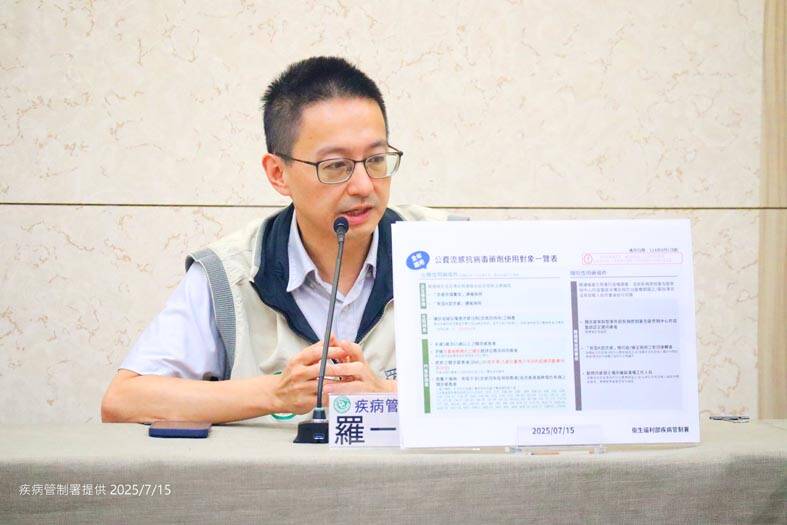
Photo courtesy of CDC
Virus surveillance data showed that the NB.1.8.1 subvariant of SARS-CoV-2 was the dominant strain among local and imported cases in the past four weeks, she said, adding that the WHO’s latest data showed the positivity rate was increasing, rising to 4.05 percent near the end of last month.
The XFG subvariant has become the dominant strain globally, the WHO’s data showed, she said.
CDC Deputy Director-General Philip Lo (羅一鈞) said that while reported COVID-19 cases have been falling for the past five weeks, the number of severe cases and deaths remains high, so people at higher risk of developing severe illness should test for COVID-19 as soon as possible after symptoms arise and consult a doctor to receive antiviral medication.
CDC physician Lin Yung-ching (林詠青) said that the youngest person who died of the disease last week was a man in his 40s who had been bedridden due to chronic illness of the nervous system and had a history of heart disease.
He died of COVID-19 that developed into pneumonia and sepsis four days after being hospitalized, Lin said.
Signs of likely severe illness from COVID-19 infection include shortness of breath, difficulty breathing, purple or bluish lips or nail beds due to low blood oxygen, difficulty eating or drinking, reduced urine output, rapid heartbeat exceeding 100 beats per minute without a fever, persistent chest pressure or pain, loss of consciousness and low blood pressure.
Some signs of severe illness in children are different from adults, such as persistent fever for more than 48 hours, a fever with a body temperature exceeding 39°C and chills or cold sweat, persistent tiredness after a fever, shortness of breath or chest tightness or pain after a fever, repeated vomiting, headache or stomachache, and not eating or urinating for more than 12 hours, Lin said.
Adults and children with the symptoms should seek medical attention as soon as possible, he said.
Children showing severe symptoms of convulsions, unsteady gait, altered consciousness, persistent sleepiness, difficulty breathing or funnel chest, white or purplish lips, low blood oxygen levels, mottled skin and cold limbs, cold sweat and a body temperature of 41°C or more should be rushed to the hospital immediately for emergency treatment, he said.
Meanwhile, 78,503 hospital visits for flu-like illness were reported last week, remaining at a relatively low level, while four new cases — three local and one imported — of mpox were also reported, Lee said.
The mpox cases were all unvaccinated men in their 30s, with no associations among them, she said.
The hospital visits for flu-like illness last week were the lowest weekly number this year and observations suggest there is unlikely to be a wave of infections this summer, Lo said.
The CDC on Aug. 1 would expand eligibility of public-funded antiviral influenza medication, he said, referencing the guidelines of the WHO and the US Centers for Disease Control and Prevention, as well as suggestions by the Infectious Disease Society of Taiwan and the Pediatric Infectious Diseases Society of Taiwan.
Added to the expanded eligibility are women within two weeks after child delivery and children and adolescents aged 18 or younger who have a body mass index (BMI) at or above the 95th percentile for a child’s age and gender, he said.
Lo said that pregnant women and people with obesity — defined as having a BMI at or above 30 — previously were eligible, but studies suggest that postpartum women, as well as obese children and adolescents, also have an elevated risk of developing severe illness from flu infection, so the eligibility was expanded.
Obesity in children and adolescents is defined according to age and sex — with the 95th percentile of BMI ranging between 15.5 and 25.6 — to allow physicians to more easily prescribe medication, he said.

SECURITY: Starlink owner Elon Musk has taken pro-Beijing positions, and allowing pro-China companies to control Taiwan’s critical infrastructure is risky, a legislator said Starlink was reluctant to offer services in Taiwan because of the nation’s extremely high penetration rates in 4G and 5G services, the Ministry of Digital Affairs said yesterday. The ministry made the comments at a meeting of the legislature’s Transportation Committee, which reviewed amendments to Article 36 of the Telecommunications Management Act (電信管理法). Article 36 bans foreigners from holding more than 49 percent of shares in public telecommunications networks, while shares foreigners directly and indirectly hold are also capped at 60 percent of the total, unless specified otherwise by law. The amendments, sponsored by Chinese Nationalist Party (KMT) Legislator Ko

The eastern extension of the Taipei MRT Red Line could begin operations as early as late June, the Taipei Department of Rapid Transit Systems said yesterday. Taipei Rapid Transit Corp said it is considering offering one month of free rides on the new section to mark its opening. Construction progress on the 1.4km extension, which is to run from the current terminal Xiangshan Station to a new eastern terminal, Guangci/Fengtian Temple Station, was 90.6 percent complete by the end of last month, the department said in a report to the Taipei City Council's Transportation Committee. While construction began in October 2016 with an
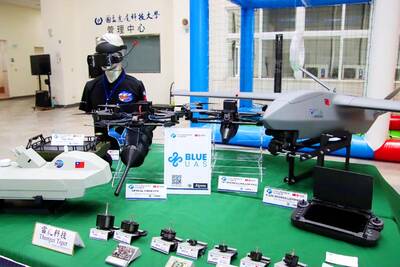
NON-RED SUPPLY: Boosting the nation’s drone industry is becoming increasingly urgent as China’s UAV dominance could become an issue in a crisis, an analyst said Taiwan’s drone exports to Europe grew 41.7-fold from 2024 to last year, with demand from Ukraine’s fight against Russian aggression the most likely driver of growth, a study showed. The Institute for Democracy, Society and Emerging Technology (DSET) in a statement on Wednesday said it found that many of Taiwan’s uncrewed aerial vehicle (UAV) sales were from Poland and the Czech Republic. These countries likely transferred the drones to Ukraine to aid it in its fight against the Russian invasion that started in 2022, it said. Despite the gains, Taiwan is not the dominant drone exporter to these markets, ranking second and fourth

The New Taipei City Art Museum this weekend plans to celebrate its first anniversary with a two-day extravaganza featuring live concerts and a large-scale synchronized fireworks and drone display, the New Taipei City Cultural Affairs Department said. The two-day celebrations are to take place in the museum’s outdoor park, with markets and live performances by singers including Ann Bai (白安), Bii (畢書盡) and the Cosmos People (宇宙人), the department said. The highlight on both evenings would be the "Echoes of Light" show, an aerial spectacle combining fireworks and drone performances designed around the concept of "dual stages in the sky," it


 RSS
RSS