


An investigation by National Taiwan Normal University (NTNU) found that a coach on the women’s soccer team forced players to donate blood or risk losing academic credits, the Ministry of Education said yesterday.
The ministry recommended a two-year dismissal for the coach and said it would monitor NTNU’s handling of the situation.
In November last year, Democratic Progressive Party (DPP) Legislator Chen Pei-yu (陳培瑜) said that a coach on the NTNU women’s soccer team was forcing players to cooperate with a sports science research project.
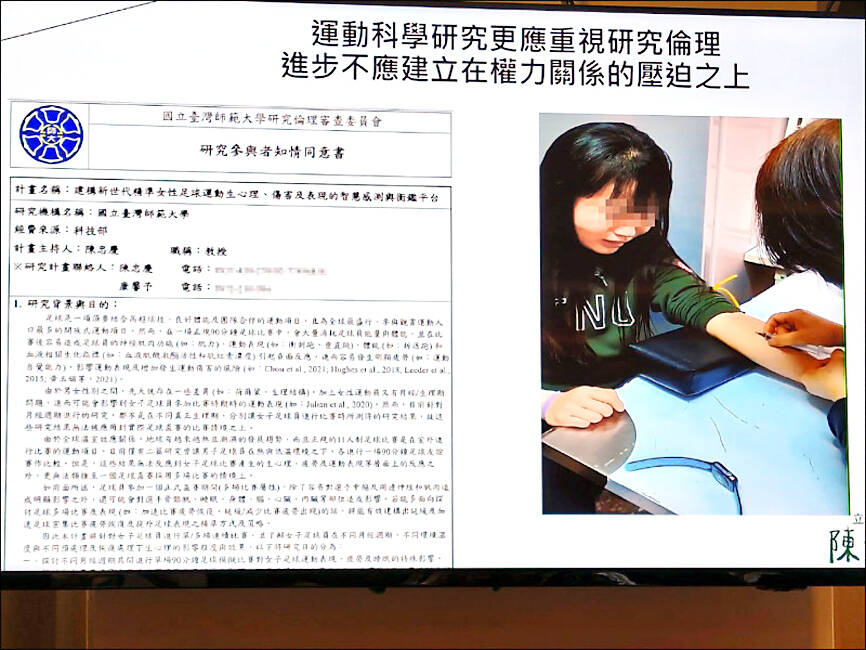
Photo: screen grab from the Internet
The research project was led by the National Science and Technology Council.
Citing a complaint from a player, Chen at the time said that athletes were forced to give blood three times a day for 14 days, with the coach threatening to withhold graduation credits if they refused to cooperate.
Initially, blood samples were taken by those with no medical training, Chen said, adding that some athletes were required to withdraw from training for up to six months.
In a news statement issued on Sunday evening, NTNU said that the school had completed its investigation.
The university removed the coach from administrative and coaching positions in December last year, it said, adding that the coach would no longer be allowed to lead teams.
Department staff provided the athletes with a signed letter of apology from the coach in May, it added.
NTNU filed a report on Nov. 29 last year and launched an investigation in accordance with its bullying prevention guidelines, the ministry said in a written statement yesterday.
The university also offered students consultation and counseling resources, the ministry added.
Due to the case’s complexity, the investigation was extended by one month, it said.
The ministry said that the NTNU Campus Anti-bullying Committee concluded that the coach had engaged in bullying behavior toward the students, adding that further action would be determined by the university’s teacher evaluation committee.
The ministry said that it would continue to monitor the school’s review and actions, adding that it would request a re-examination and hold officials responsible if the school were to fail to abide by the Teachers’ Act (教師法).
An ethics committee in May found that the research project contravened the Human Subjects Research Act (人體研究法), with the university and personnel failing to provide proper oversight.
If serious contraventions of the act are confirmed, the project’s researchers and NTNU could face administrative penalties.

NATIONAL SECURITY: Authorities are working to confirm the identities of the military personnel involved and investigating possible illegal conduct and regulatory violations Authorities are probing possible national security implications after Kinmen police and immigration officers on Sunday found a Chinese woman allegedly posing as a tourist while engaging in prostitution involving more than 10 military personnel. The woman, surnamed Chen (陳), has since been deported, authorities said, adding that investigators are still working to confirm the identities of those implicated, as the records only listed code names and aliases. The case stemmed from a report received by the Kinmen District Prosecutors’ Office on Friday last week from the Jinhu Precinct of the Kinmen County Police Bureau. On Sunday, police, along with the National Immigration

GLOBALGIVING: ‘ Caving to external pressure is not acceptable for an organization that has cultivated justice reform and human rights for 30 years,’ one NGO said A slew of non-government organizations (NGOs) have withdrawn from the GlobalGiving fundraising platform after it announced it would use “Chinese Taipei” instead of “Taiwan” from next month. The Taiwan Good Rice Association wrote on Facebook on Friday that it was informed on April 28 via a teleconference call of the change, which was made because the platform wanted to operate in China. Taiwan Good Rice is to terminate all cooperative relationships with GlobalGiving in response to the platform’s “unilateral and non-negotiable” decision to remove references to Taiwan, the NGO said. “Taiwan is in the official name of Taiwan Good Rice Association and the

HEAVY WEATHER: Typhoon Jangmi is due to crash straight into the Ryukyus as airlines look to shift flights to larger aircraft or cancel flights to Okinawa entirely Taiwan’s international air carriers announced flight adjustments over the weekend as Typhoon Jangmi is forecast to hit the Ryukyu Islands today and tomorrow. The Central Weather Administration (CWA) upgraded Jangmi from a tropical storm to a typhoon at 8am yesterday, with the eye located 580km south of Naha city. It was moving north at 19kph. Today, China Airlines’ CI-120, CI-121, CI-122 and CI-123 flights between Taoyuan and Naha, Okinawa, have been canceled as well as CI-132 and CI-133 between Kaohsiung and Naha. EVA Air’s BR-112, BR-113, BR-186 and BR-185 flights between Taoyuan and Naha are also canceled. Low-cost carrier Tigerair Taiwan canceled IT-230,

Chinese Nationalist Party (KMT) Chairwoman Cheng Li-wun (鄭麗文) yesterday briefed her party’s Central Standing Committee regarding her scheduled visit to the US between Monday next week and June 16, saying that her purpose would be to persuade the US that the Republic of China (ROC) Constitution was a “one China” constitution that would foster stable and peaceful cross-strait relations. The ROC Constitution is the most important defense for all Taiwanese citizens, as it upholds our democracy and has contributed to our robust economy, which aligns with international and US interests, she said. “We would not be troublemakers and drag the US under,”


 RSS
RSS