


Retired U.S. Navy Rear Admiral Mark Montgomery on Friday called for bilateral military exercises between the United States and Taiwan, saying Taiwan must also train for Chinese economic warfare, both of which are missing from this year’s Han Kuang military drills.
Speaking at a panel on Taiwan’s defense readiness held by Hudson Institute, a US think tank based in Washington DC., Montgomery said the Han Kuang exercise, currently underway through July 18, focuses only on a full- scale Chinese invasion but neglects more likely scenarios, such as cyber-driven economic attacks targeting Taiwan’s financial, energy and communications systems.
He emphasized that the absence of U.S.-Taiwan joint drills is a major flaw, blaming it on U.S. reluctance.
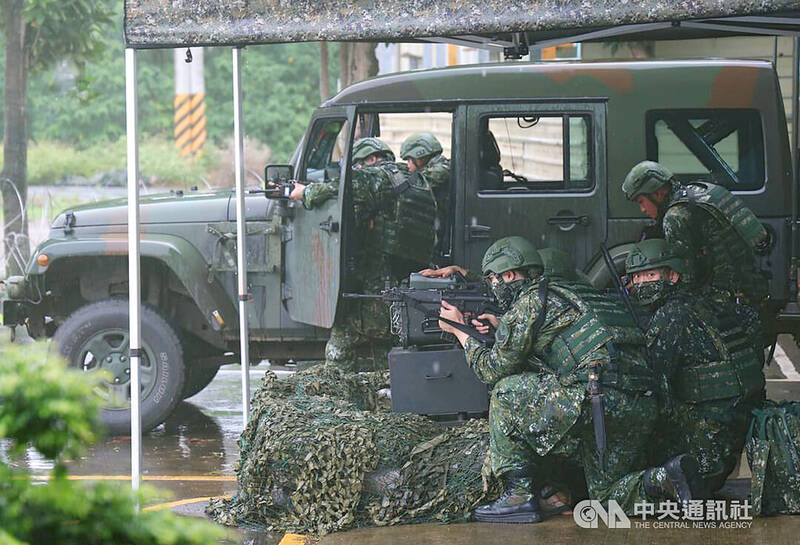
Photo: CNA
“There is only one really big country in the world, and it’s not China, it’s the United States, and we need to act like it when we deal with them,” he said.
Montgomery warned that without joint exercises, the two sides lack the ability to coordinate in a real conflict.
Taiwan and the U.S. are not ready to fight together,” he said, adding that interoperability, shared equipment, and synchronized tactics are essential and currently lacking.

Photo: CNA
Fellow panelist and Hudson researcher Bryan Clark agreed. Joining remotely, he stressed that defending Taiwan requires minimizing U.S. casualties through coordinated action, firepower and unmanned systems.
“We can only do that if we start to do these exercises together and build the command and control and communications interoperability between the two countries so that if we don’t do that, we’re simply setting ourselves up for escalation followed by capitulation,” he said.
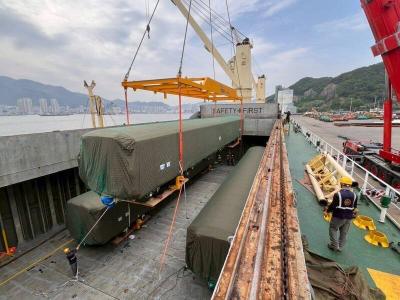
The first of 10 new high-capacity trains purchased from South Korea’s Hyundai Rotem arrived at the Port of Taipei yesterday to meet the demands of an expanding metro network, Taipei Rapid Transit Corp (TRTC) said yesterday. The train completed a three-day, 1,200km voyage from the Port of Masan in South Korea, the company said. Costing NT$590 million (US$18.79 million) each, the new six-carriage trains feature a redesigned interior based on "human-centric" transportation concepts, TRTC said. The design utilizes continuous longitudinal seating to widen the aisles and optimize passenger flow, while also upgrading passenger information displays and driving control systems for a more comfortable
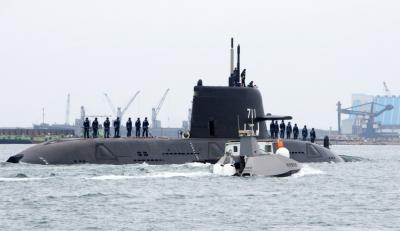
Taiwan's first indigenous defense submarine, the SS-711 Hai Kun (海鯤, or Narwhal), departed for its 13th sea trial at 7am today, marking its seventh submerged test, with delivery to the navy scheduled for July. The outing also marked its first sea deployment since President William Lai (賴清德) boarded the submarine for an inspection on March 19, drawing a crowd of military enthusiasts who gathered to show support. The submarine this morning departed port accompanied by CSBC Corp’s Endeavor Manta (奮進魔鬼魚號) uncrewed surface vessel and a navy M109 assault boat. Amid public interest in key milestones such as torpedo-launching operations and overnight submerged trials,
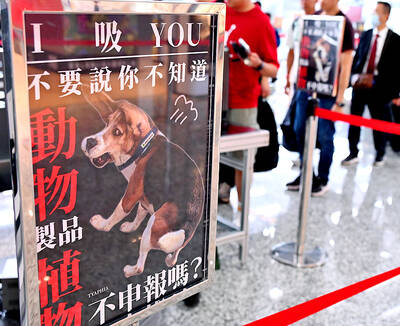
Quarantine awareness posters at Taiwan Taoyuan International Airport have gone viral for their use of wordplay. Issued by the airport branch of the Animal and Plant Health Inspection Agency, the posters feature sniffer dogs making a range of facial expressions, paired with advisory messages built around homophones. “We update the messages for holidays and campaign needs, periodically refreshing materials to attract people’s attention,” quarantine officials said. “The aim is to use the dogs’ appeal to draw focus to quarantine regulations.” A Japanese traveler visiting Taiwan has posted a photo on X of a poster showing a quarantine dog with a
SECURITY RISK: A university student sent a general alarm signal to THSRC’s control center on April 5, causing four operating trains to temporarily halt services The Ministry of Transportation and Communications yesterday pledged to submit a report on ways to harden the communication security of railway systems after a university student hacked into Taiwan High Speed Rail Corp’s (THSRC) radio communications system and disrupted operations of four high-speed rail trains last month. Investigation by the police and prosecutors found that the university student and radio enthusiast, surnamed Lin (林), first used a software-defined radio (SDR) filter to analyze THSRC signals, downloaded the data to a computer, cracked the parameters and then programmed the codes into his radio devices. Lin then sent a general alarm signal to


 RSS
RSS