


The Democratic Progressive Party’s (DPP) Department of China Affairs today condemned China’s Vice Minister of Foreign Affairs Hua Chunying’s (華春瑩) latest comments on UN Resolution 2758, adding that the people of Taiwan would not accept China’s “blatant and egregious” bullying.
German Minister for Foreign Affairs Johann Wadephul, meanwhile, yesterday discussed Taiwan with visiting Chinese Foreign Minister Wang Yi (王毅), invoking the UN Charter, which prohibits the use of force to resolve international disputes, to refute China’s misuse and misinterpretation of Resolution 2758, Representative to Germany Shieh Jhy-wey (謝志偉) said in a social media post.
Hua addressed the Third Forum on Developing Countries and International Law in Beijing on Thursday last week.
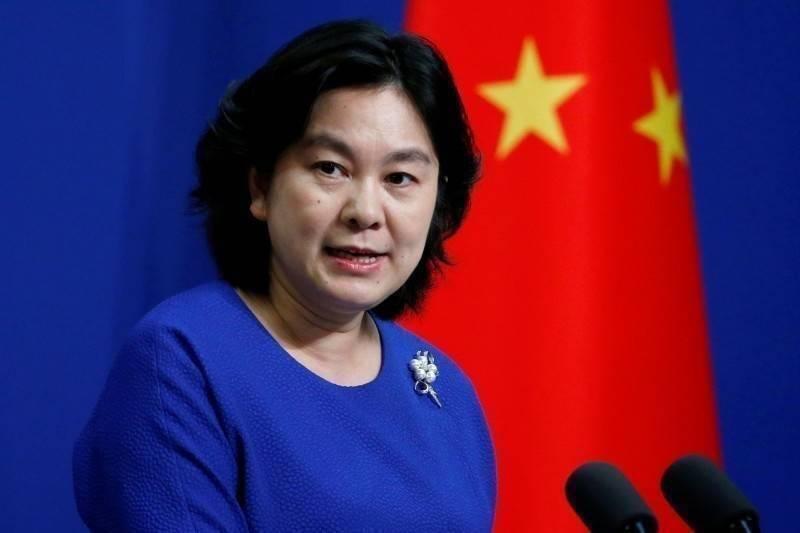
Photo: Reuters
Any individual or any country that attempts to distort or hollow out UN Resolution 2758 is “violating China’s territorial integrity and sovereignty” in a “flagrant provocation of post-war international order,” Hua said.
Resolution 2758, passed in 1971, states that the People’s Republic of China (PRC) is the only legitimate government of China, a move which enabled it to replace the Republic of China (ROC), Taiwan’s official name, as a permanent member of the UN Security Council.
China continues to misinterpret, misuse and distort Resolution 2758 to serve its political agenda, the DPP Department of China Affairs said today.
Resolution 2758 covers the PRC’s right to represent China in the UN, and was used to replace the ROC under former ROC president Chiang Kai-shek (蔣介石), which then claimed to represent China, on the Security Council, it said.
It does not, however, make any claims concerning Taiwan’s sovereignty or state that Taiwan, or any other individuals, cannot be represented in the UN, it added.
Moreover, the resolution does not restrict any country's sovereign right to engage in relations with Taiwan, nor does it exclude Taiwan from participating in the UN or other international bodies, the department said.
China is attempting to manipulate the international community and spread the false narrative that “Taiwan is part of China,” by using phrases such as “violating China’s sovereignty” and “defending international law,” it said.
The PRC wishes to limit Taiwan’s space in the international community, block its participation in international bodies and eliminate its sovereign status, it added.
Taiwan has the right to self-identification and a sense of international responsibility, the DPP said, adding that Taiwan would continue to uphold the values of democracy, freedom and human rights, while contributing to global freedom, rule of law and sustainable development.
It would continue to participate in global forums and initiatives to fulfil its responsibilities and commitments to the international community, it said.
In other news, Shieh said in a post on Facebook that Wadephul, Germany’s Federal Minister for Foreign Affairs, yesterday met with visiting Chinese Foreign Minister Wang.
At the eighth round of China-Germany Strategic Dialogue on Diplomacy and Security in Berlin, Wadephul said, “The UN Charter prohibits the use of force to resolve disputes, which also applies to the Taiwan Strait,” Shieh said in the post.
Shieh said that after many years working as a representative in Germany, he was relieved and grateful to finally hear those words.
Germany publicly refuted China’s misinterpretation and misuse of Resolution 2758 by invoking the UN Charter, he added.
Although Germany maintains a “one China” policy, Shieh quoted Wadepuhl as saying that “if tensions in Taiwan or the South China Sea were to escalate out of control, it would affect the interests of the entire world, including Europe and Germany.”
“Any changes to the status quo in the Taiwan Strait may only occur peacefully and with mutual agreement from both sides,” he added.
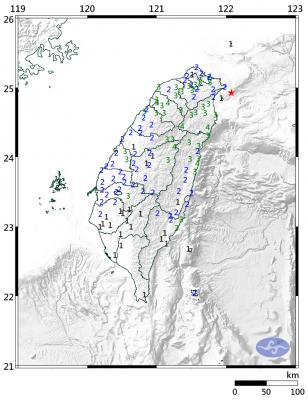
A magnitude 6.1 earthquake struck off the coast of Yilan County at 8:39pm tonight, the Central Weather Administration (CWA) said, with no immediate reports of damage or injuries. The epicenter was 38.7km east-northeast of Yilan County Hall at a focal depth of 98.3km, the CWA’s Seismological Center said. The quake’s maximum intensity, which gauges the actual physical effect of a seismic event, was a level 4 on Taiwan’s 7-tier intensity scale, the center said. That intensity level was recorded in Yilan County’s Nanao Township (南澳), Hsinchu County’s Guansi Township (關西), Nantou County’s Hehuanshan (合歡山) and Hualien County’s Yanliao (鹽寮). An intensity of 3 was
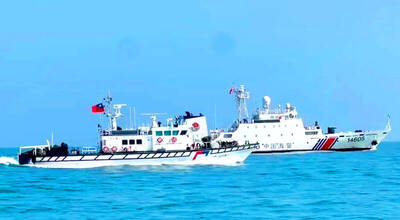
Instead of focusing solely on the threat of a full-scale military invasion, the US and its allies must prepare for a potential Chinese “quarantine” of Taiwan enforced through customs inspections, Stanford University Hoover fellow Eyck Freymann said in a Foreign Affairs article published on Wednesday. China could use various “gray zone” tactics in “reconfiguring the regional and ultimately the global economic order without a war,” said Freymann, who is also a nonresident research fellow at the US Naval War College. China might seize control of Taiwan’s links to the outside world by requiring all flights and ships entering or leaving Taiwan
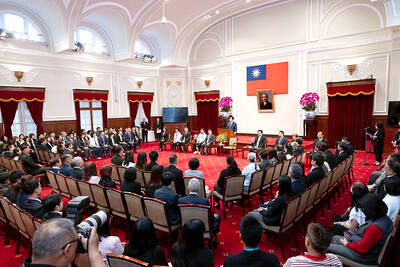
The next minimum wage hike is expected to exceed NT$30,000, President William Lai (賴清德) said yesterday during an award ceremony honoring “model workers,” including migrant workers, at the Presidential Office ahead of Workers’ Day today. Lai said he wished to thank the awardees on behalf of the nation and extend his most sincere respect for their hard work, on which Taiwan’s prosperity has been built. Lai specifically thanked 10 migrant workers selected for the award, saying that although they left their home countries to further their own goals, their efforts have benefited Taiwan as well. The nation’s industrial sector and small businesses lay
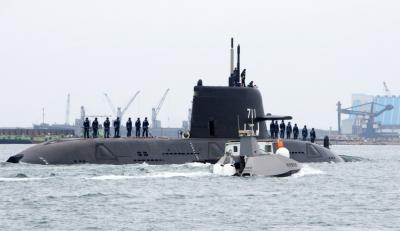
Taiwan's first indigenous defense submarine, the SS-711 Hai Kun (海鯤, or Narwhal), departed for its 13th sea trial at 7am today, marking its seventh submerged test, with delivery to the navy scheduled for July. The outing also marked its first sea deployment since President William Lai (賴清德) boarded the submarine for an inspection on March 19, drawing a crowd of military enthusiasts who gathered to show support. The submarine this morning departed port accompanied by CSBC Corp’s Endeavor Manta (奮進魔鬼魚號) uncrewed surface vessel and a navy M109 assault boat. Amid public interest in key milestones such as torpedo-launching operations and overnight submerged trials,


 RSS
RSS