


China's first domestically built aircraft carrier today sailed into Hong Kong, just days after the territory marked 28 years under Chinese rule and five years under Beijing's National Security Law.
Commissioned in 2019, the more than 300m Shandong is China's second aircraft carrier and key to the country's regional ambitions under Chinese President Xi Jinping (習近平), who has overseen a massive naval buildup that has rattled neighbors in the region.
Beijing earlier announced the Shandong and its escort vessels — which include the destroyer Zhanjiang and frigate Yuncheng — would visit Hong Kong for five days.
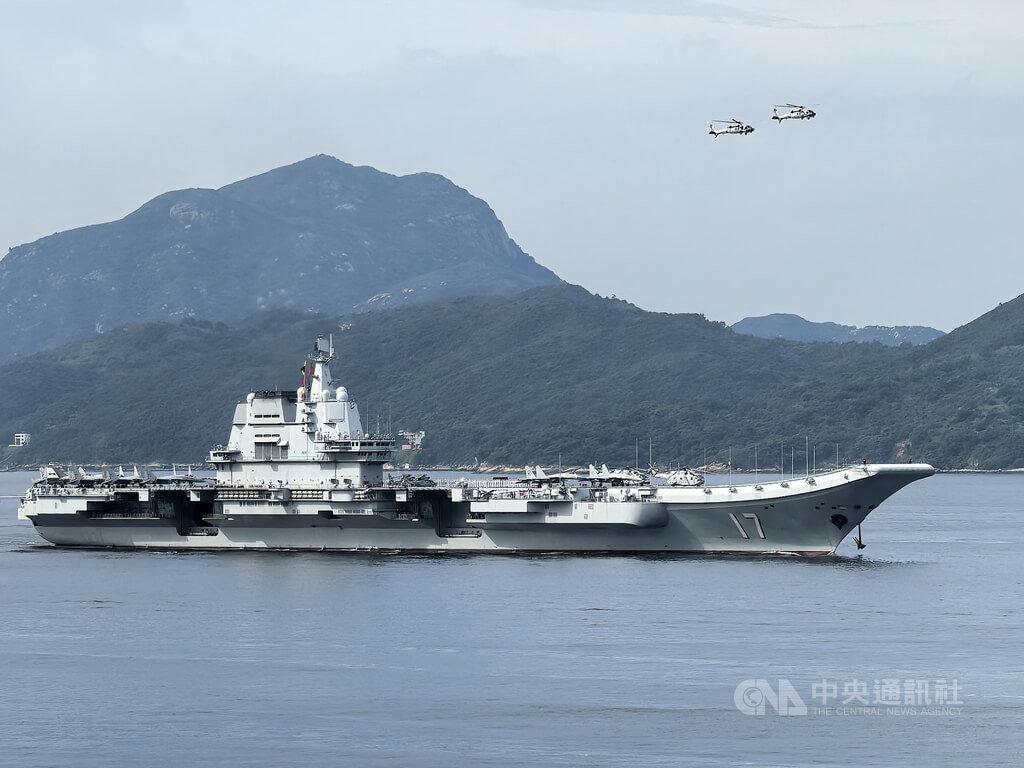
Photo: CNA
“During the visit, open-ship-day activities and cultural exchanges will be held to help Hong Kong compatriots have a more direct and in-depth understanding of the development of China's national defense and military building in the new era,” the Chinese Ministry of National Defense said in an English-language statement released on Saturday last week.
Hong Kong lawmakers praised the event as a “living patriotic lesson” highlighting China’s military and industrial advancements, the China Daily reported today.
The flotilla was spotted early this morning sailing off the southern coast of Hong Kong Island.
The Shandong is the second Chinese aircraft carrier to visit Hong Kong, following the Liaoning's visit in 2017.
The two carriers last month carried out operations in the Western Pacific simultaneously for the first time, and crossed the second island chain, also for the first time, national security officials said on Monday.
Japanese authorities said the dual-carrier exercise reflected Beijing's intentions to improve operational capabilities in distant areas.
In December last year, the US Department of Defense said in a report that numerically China has the largest navy in the world, with a battle force of more than 370 ships and submarines.
Chong Ja Ian (莊嘉穎), an associate professor at the National University of Singapore, said that China's latest exercises suggest "both aircraft carriers are ready to engage in more sophisticated operations," but some unknowns remain, including the operational tempo they can bear.
In April, the Shandong took part in drills testing the Chinese navy's ability to "blockade" Taiwan, the Chinese People's Liberation Army's Eastern Theater Command said.
It was also reportedly present in Philippine waters in April during a joint US-Philippine military exercise, worsening tensions between Manila and Beijing.
Additional reporting by Hollie Younger

Considering that most countries issue more than five denominations of banknotes, the central bank has decided to redesign all five denominations, the bank said as it prepares for the first major overhaul of the banknotes in more than 24 years. Central bank Governor Yang Chin-lung (楊金龍) is expected to report to the Legislative Yuan today on the bank’s operations and the redesign’s progress. The bank in a report sent to the legislature ahead of today’s meeting said it had commissioned a survey on the public’s preferences. Survey results showed that NT$100 and NT$1,000 banknotes are the most commonly used, while NT$200 and NT$2,000

The Centers for Disease Control (CDC) yesterday reported the first case of a new COVID-19 subvariant — BA.3.2 — in a 10-year-old Singaporean girl who had a fever upon arrival in Taiwan and tested positive for the disease. The girl left Taiwan on March 20 and the case did not have a direct impact on the local community, it said. The WHO added the BA.3.2 strain to its list of Variants Under Monitoring in December last year, but this was the first imported case of the COVID-19 variant in Taiwan, CDC Deputy Director-General Lin Ming-cheng (林明誠) said. The girl arrived in Taiwan on

South Korea is planning to revise its controversial electronic arrival card, a step Taiwanese officials said prompted them to hold off on planned retaliatory measures, a South Korean media report said yesterday. A Yonhap News Agency report said that the South Korean Ministry of Foreign Affairs is planning to remove the “previous departure place” and “next destination” fields from its e-arrival card system. The plan, reached after interagency consultations, is under review and aims to simplify entry procedures and align the electronic form with the paper version, a South Korean ministry official said. The fields — which appeared only on the electronic form

The Ministry of Foreign Affairs (MOFA) is suspending retaliation measures against South Korea that were set to take effect tomorrow, after Seoul said it is updating its e-arrival system, MOFA said today. The measures were to be a new round of retaliation after Taiwan on March 1 changed South Korea's designation on government-issued alien resident certificates held by South Korean nationals to "South Korea” from the "Republic of Korea," the country’s official name. The move came after months of protests to Seoul over its listing of Taiwan as "China (Taiwan)" in dropdown menus on its new online immigration entry system. MOFA last week


 RSS
RSS