


The armed forces are to practice decentralized command, dispersion, joint warfare and civil-military cooperation in this year’s annual Han Kuang military exercise, set to take place next week, the Ministry of National Defense (MND) said yesterday.
The 41st Han Kuang drills, scheduled from Wednesday next week through July 18, would mobilize more than 22,000 reservists, which is unprecedented in length and scale.
The exercise aims to enhance Taiwan’s ability to maintain a high operational tempo in the face of wartime uncertainties and to practice synchronizing actions in a joint warfare environment, the ministry told a news conference
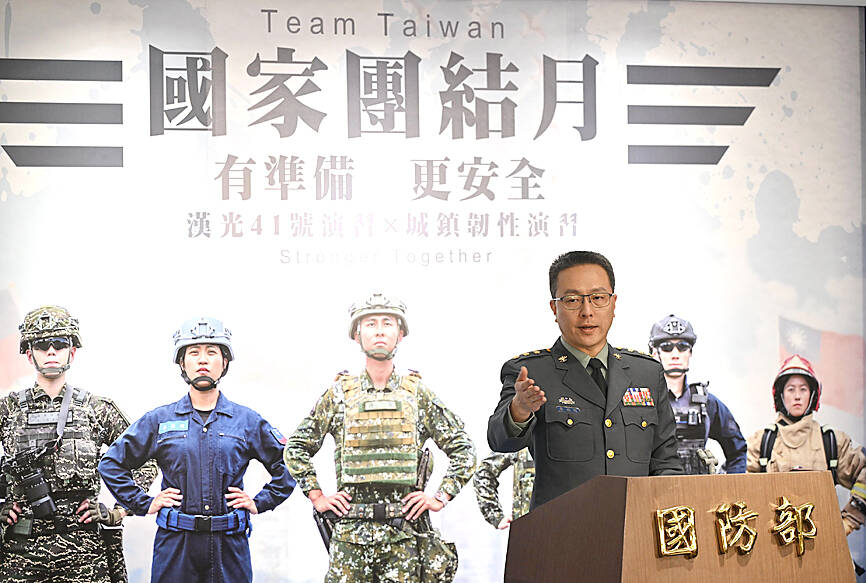
Photo: Chang Chia-ming, Taipei Times
Commanders and officers would be tested with time-sensitive decisionmaking to improve the military’s response under realistic battlefield conditions, the ministry said.
Existing command structures across defense zones would be evaluated for their effectiveness in facilitating combined arms operations and joint warfare, it said.
Units taking part in the drills would practice fighting as dispersed units and, should the need arise, making independent decisions without waiting for orders, it added.
Taiwanese forces must learn to fight with speed and agility as dispersed units to ensure their resilience against China’s likely use of long-range fire, infiltrators and saboteurs, the ministry said.
Commanders are expected to practice delegating authority to ensure Taiwanese forces can fight without waiting for orders should they face unexpected situations or lose contact with the chain of command, the ministry said.
For the exercise, each military service is expected to plan operations according to the actual strength of the units at hand, it said.
Commanders and staff officers are expected to adapt their course of action based on the state of their units, taking into account factors such as attrition and supply consumption, as predicted by a computer-based tabletop exercise conducted in April, the ministry said.
The armed forces reserve’s 35th Tung Hsin exercise would be held from Saturday through July 18 to partly overlap with the 41st Han Kuang exercise, it said, adding that the 206th brigade is to be mobilized in its entirety.
The military would use the drills as an opportunity to gauge the speed with which reservists could be mobilized to form units or replenish frontline strength, it said.
The command structure and local government emergency response centers would establish channels of communication to facilitate civil-military cooperation in tasks such as asset denial, ensuring secrecy and maintaining continued medical services, among other tasks, it said.
Military service members are to be educated in the rules of engagement and laws governing warfare to maintain the nation’s legitimacy during a military conflict, it said.
Addressing soldiers in a video ahead of the Han Kuang exercises, President William Lai (賴清德) said that in the past few years, Taiwan has been constantly preparing for a “war without gun smoke,” such as Chinese infiltration and disinformation attacks.
“However, there is no need to worry because the democratic, free and prosperous Taiwan of today is the result of the Taiwanese people’s courage, conviction and action in fighting their way through various challenges, and the unity and resilience of Taiwanese have been demonstrated,” he said.
Additional reporting by Reuters

FUKUOKA SITUATION: Japanese media reported that the pathogen is expected to be identified by the summer, while the CDC downplayed the idea that it was hMPV A “mysterious cold-like illness” reported in Japan’s Fukuoka Prefecture does not seem to be a new disease, but Japanese authorities have been asked about the situation, the Centers for Disease Control (CDC) said yesterday. The Fukuoka Prefectural Medical Association on Wednesday told a news conference that a “mystery cold” that has become a hot topic on social media is “highly likely to be caused by some kind of viral infection,” Japan’s KBC News reported. “Many people are experiencing symptoms starting with a sore throat, followed by a runny nose, phlegm and a severe cough,” KBC News reported, citing association officials. Health authorities are

Nvidia Corp CEO Jensen Huang (黃仁勳) arrived in Taiwan yesterday ahead of upcoming AI and technology events, saying he plans to meet with clients and Taiwan Semiconductor Manufacturing Co Chairman C.C. Wei (魏哲家) during his visit. After landing at Taipei Songshan Airport, Huang posed for photos with fans and handed out Yakult drinks to reporters and supporters waiting at the scene, saying he has “a lot to do” during the trip. Asked about reports that Nvidia’s planned headquarters site in Taipei’s Beitou Shilin Technology Park could break ground on May 27, Huang said that if the company holds an event, he would

The Ministry of Finance this afternoon announced the winning numbers for the March-April uniform invoice lottery. The winning number for the NT$10 million (US$318,060) special prize is 19531471, and the winning number for the NT$2 million grand prize is 85941329. Three numbers were drawn for the NT$200,000 first prize: 07225810, 20231230 and 83518781. Those with receipts matching the last seven digits of any of the first-prize numbers will win the NT$40,000 second prize, while those matching the last six digits will win the NT$10,000 third prize. Those whose receipts match the last five digits of the first-prize numbers can claim the NT$4,000 fourth prize,
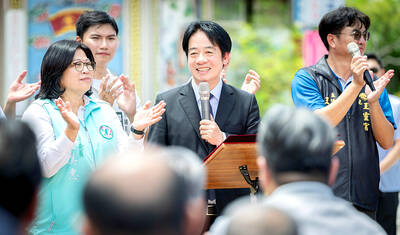
SIX SUBSIDIES: The monthly allowance for older farmers is to increase to NT$10,000, and NT$5,000 is to be given to homemakers under the national pension system, Lai said The government is to implement major welfare policies for disadvantaged groups, including raising the monthly allowance for older farmers to NT$10,000 and providing homemakers with NT$5,000 per month, President William Lai (賴清德) said yesterday. Lai made the remarks during a visit to Wangling Temple in Chiayi County, saying that the planned increases were being introduced amid economic growth and an increase in tax revenue. Touting a policy, in which the government plans to provide a monthly allowance of NT$5,000 for every child under the age of 18 in a bid to address Taiwan’s low birthrate, Lai said that if received for the


 RSS
RSS