


Two of China’s People’s Liberation Army (PLA) aircraft carriers, the Liaoning and the Shandong, have carried out operations in the Western Pacific simultaneously for the first time, also marking the first time Chinese aircraft carriers have crossed the second island chain, national security officials said today.
The move signals China’s ability to demonstrate control, establish strategic presence and block maritime and air traffic across the island chains to pressure all parties in the region, they said.
China’s increased military presence in the Indo-Pacific region has drawn attention from the US, Japan, South Korea and Taiwan.
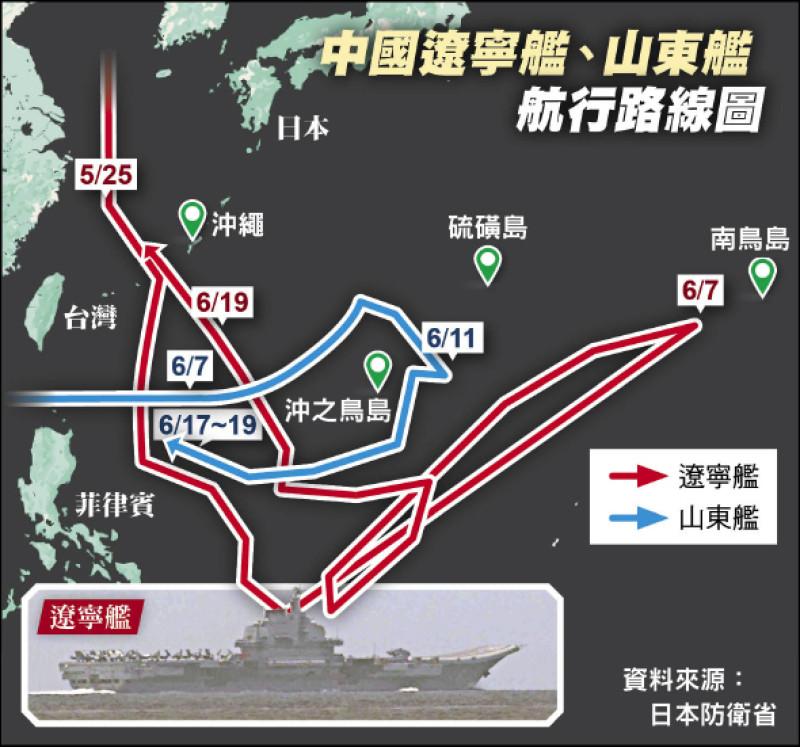
Graphic by Taipei Times
On June 7, Japan’s Ministry of Defense reported a sighting of the Liaoning in the waters near Minamitori, the Pacific island marking Japan’s easternmost territory.
Two days later, the Shandong was spotted north of Okinotorishima, Japan’s southernmost island, entering Japan’s Exclusive Economic Zone (EEZ) and just 1,200 to 1,700 kilometers from Tokyo.
Since May 19, the two carriers have been exerting pressure across the island chains, with each carrier fleet progressively joined by more warships and supply vessels, officials said.
The Liaoning has been conducting military exercises in the Yellow Sea and the East China Sea, including aircraft takeoff and landing drills, maritime patrols, tailing and monitoring activities and simulated attacks on foreign aircraft and ships, they said.
On June 6 and 7, Japan protested after a PLA aircraft came dangerously close to a Japanese anti-submarine aircraft, they added.
Meanwhile, the Shandong carrier group carried out military drills from the northeast of the Philippines to the southwest islands of Japan, before returning to its home port via the Philippines’ Balintang Channel and the South China Sea, they said.
The scope of these latest deployments and exercises far exceed the need of access/area-denial (A2/AD) operations or homeland defense, officials said.
This signals the PLA wishes to expand its military presence and strategic reach into the third island chain, they said.
Beijing seeks to establish dominance following the Shangri-La Dialogue, held May 30 to June 1, after which the US, the EU and multiple nations have repeatedly warned of the increased threat from China’s expanding military presence in the Indo-Pacific region, they added.
The deliberate choice of location, from the East China Sea to the Yellow Sea, from the South China Sea to beyond the second island chain, aims to force neighboring countries to reconsider their policies towards China, including their security cooperation alliances, they said.
Beijing strongly opposes any alliances between democratic nations, exemplified by China’s combat readiness patrols on June 19 and 20 in response to navy vessels from countries including the UK conducting freedom of navigation operations in the Taiwan Strait on June 12 and 18, they said.
China's retaliation included over 70 aircraft conducting military intimidation of Taiwan and strongly-worded statements issued by the People’s Republic of China’s (PRC) Ministry of National Defense, they added.
The PLA’s latest drills also coincide with heightened tension in the Middle East, showing China is keen to project military power in the Indo-Pacific region to alleviate pressure on its allies, including Iran, the officials said.
South Korea has recently expressed concern over large Chinese installations in the Yellow Sea, while Japan has also protested China’s constructions in the East China Sea along the China-Japan maritime border, they said.
China has recently accelerated its policies to treat the Yellow Sea, East China Sea, South China Sea and the Taiwan Strait as part of its own territory, which is only set to continue, officials warned.

The military has spotted two Chinese warships operating in waters near Penghu County in the Taiwan Strait and sent its own naval and air forces to monitor the vessels, the Ministry of National Defense (MND) said. Beijing sends warships and warplanes into the waters and skies around Taiwan on an almost daily basis, drawing condemnation from Taipei. While the ministry offers daily updates on the locations of Chinese military aircraft, it only rarely gives details of where Chinese warships are operating, generally only when it detects aircraft carriers, as happened last week. A Chinese destroyer and a frigate entered waters to the southwest
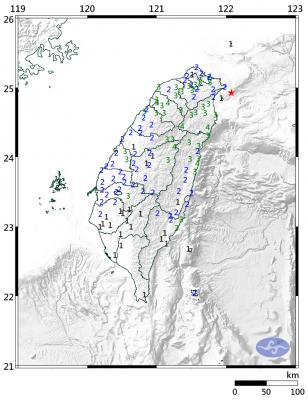
A magnitude 6.1 earthquake struck off the coast of Yilan County at 8:39pm tonight, the Central Weather Administration (CWA) said, with no immediate reports of damage or injuries. The epicenter was 38.7km east-northeast of Yilan County Hall at a focal depth of 98.3km, the CWA’s Seismological Center said. The quake’s maximum intensity, which gauges the actual physical effect of a seismic event, was a level 4 on Taiwan’s 7-tier intensity scale, the center said. That intensity level was recorded in Yilan County’s Nanao Township (南澳), Hsinchu County’s Guansi Township (關西), Nantou County’s Hehuanshan (合歡山) and Hualien County’s Yanliao (鹽寮). An intensity of 3 was
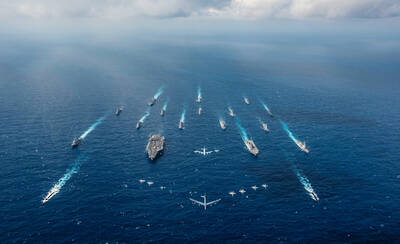
Japanese Prime Minister Sanae Takaichi’s comment last year on Tokyo’s potential reaction to a Taiwan-China conflict has forced Beijing to rewrite its invasion plans, a retired Japanese general said. Takaichi told the Diet on Nov. 7 last year that a Chinese naval blockade or military attack on Taiwan could constitute a “survival-threatening situation” for Japan, potentially allowing Tokyo to exercise its right to collective self-defense. Former Japan Ground Self-Defense Force general Kiyofumi Ogawa said in a recent speech that the remark has been interpreted as meaning Japan could intervene in the early stages of a Taiwan Strait conflict, undermining China’s previous assumptions
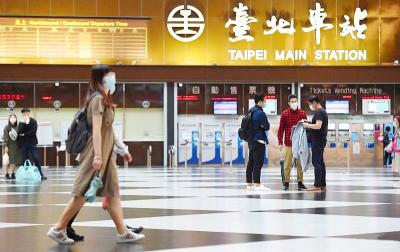
Taiwan Railways Corp (TRC) today announced that Shin Kong Mitsukoshi has been selected as the preferred bidder to operate the Taipei Railway Station shopping mall, replacing the current operator, Breeze Development Co Ltd. Among eight qualified firms that delivered presentations and were evaluated by a review committee, Shin Kong Mitsukoshi was ranked first, while Breeze was named the runner-up, the rail company said in a statement. Contract negotiations are to proceed in accordance with regulations, it said, adding that if negotiations with the top bidder fail, it could invite the second-ranked applicant to enter talks. Breeze in a statement today expressed doubts over


 RSS
RSS