


The likelihood of China invading Taiwan uncontested is "very, very small" because the Taiwan Strait is under constant surveillance by multiple countries, a US general has said.
General Ronald Clark, commanding officer of the US Army's largest service component command, US Army Pacific (USARPAC), made the remarks during a dialogue hosted Friday by the Washington-based think tank, the Center for Strategic and International Studies (CSIS).
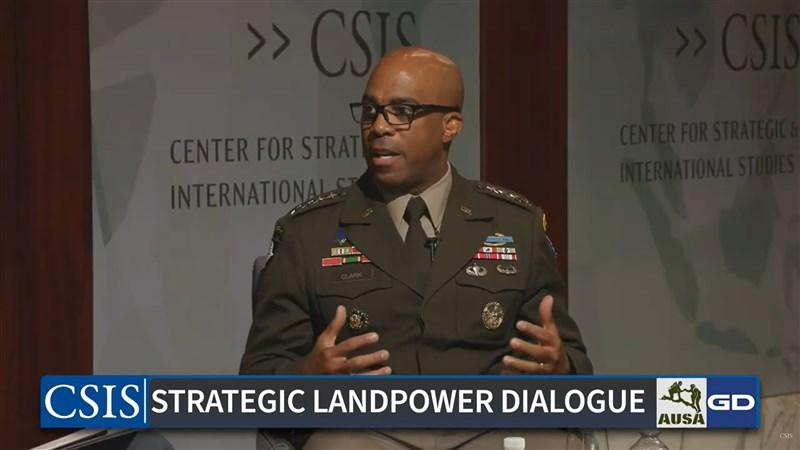
Photo: screen grab from CSIS YouTube channel
Asked by the event host about what the Chinese military has learned from its US counterpart over the years, Clark said the first lesson would be that the skill and will of American service members are "unmatched."
The second lesson, Clark said, is specifically targeted at the Taiwan issue "because that's where we spend a lot of our time thinking about how to counter cross-strait invasion, which is the most dangerous course of action," in particular, "how hard that [cross-strait invasion] is."
The US Army runs its Warfighter program at the division and corps levels to counter a wet gap crossing, namely, a military maneuver involving creating means to cross a body of water.
In the case of Taiwan, wet gap crossing refers to a military operation in which People's Liberation Army (PLA) troops and equipment are moved across the Taiwan Strait.
"We're talking about an adversary [China] that has to cross an 80-mile wet gap that's being watched by an unblinking eye, multiple countries working together to deter them from that activity."
The chances of being able to conduct "an uncontested or successful wet gap crossing of that scale" are "very, very small," he said.
"So our efforts to continue to make that problem set more difficult for the Chinese is where we spend a lot of our time," the US Army general added.
The US is building partnerships across the region with allies and partners in conducting Taiwan Strait transits, he said.
"They're working closely together to build the interoperability necessary to contest their [China's] aggressive, belligerent and coercive activities across the region.
It's us focusing on our people to ensure that our teammates understand the importance of their mission, and that we're in this thing together," Clark said.
Clark assumed command of USARPAC on Nov. 8 last year.
The US Army Pacific is headquartered at Fort Shafter, Hawaii, with elements of the command forward-deployed and stationed throughout the Indo-Pacific, according to information on USARPAC's website.
The US military, sometimes joined by allies, makes regular, almost monthly transits through the Taiwan Strait in what it calls "freedom of navigation" sailings.
Canada, the UK, France, Germany and Japan have also made similar Taiwan Strait transits by warships and/or warplanes. Most recently, the British Royal Navy's HMS Spey transited through the Taiwan Strait on June 18.
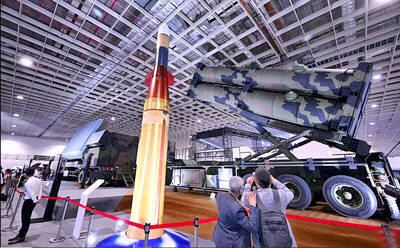
Taiwan is to commence mass production of the Tien Kung (天弓, “Sky Bow”) III, IV and V missiles by the second quarter of this year if the legislature approves the government’s NT$1.25 trillion (US$39.78 billion) special defense budget, an official said yesterday. Commenting on condition of anonymity, a defense official with knowledge of the matter said that the advanced systems are expected to provide crucial capabilities against ballistic and cruise missiles for the proposed “T-Dome,” an advanced, multi-layered air defense network. The Tien Kung III is an air defense missile with a maximum interception altitude of 35km. The Tien Kung IV and V
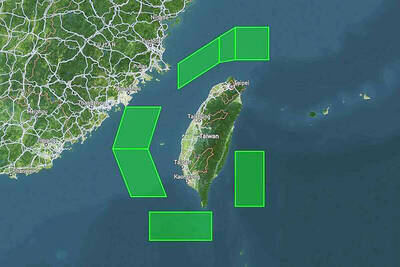
The disruption of 941 flights in and out of Taiwan due to China’s large-scale military exercises was no accident, but rather the result of a “quasi-blockade” used to simulate creating the air and sea routes needed for an amphibious landing, a military expert said. The disruptions occurred on Tuesday and lasted about 10 hours as China conducted live-fire drills in the Taiwan Strait. The Civil Aviation Administration (CAA) said the exercises affected 857 international flights and 84 domestic flights, affecting more than 100,000 travelers. Su Tzu-yun (蘇紫雲), a research fellow at the government-sponsored Institute for National Defense and Security Research, said the air
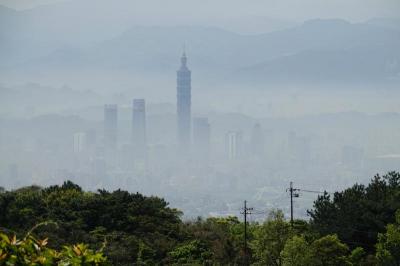
A strong continental cold air mass is to bring pollutants to Taiwan from tomorrow, the Ministry of Environment said today, as it issued an “orange” air quality alert for most of the country. All of Taiwan except for Hualien and Taitung counties is to be under an “orange” air quality alert tomorrow, indicating air quality that is unhealthy for sensitive groups. In China, areas from Shandong to Shanghai have been enveloped in haze since Saturday, the ministry said in a news release. Yesterday, hourly concentrations of PM2.5 in these areas ranged from 65 to 160 micrograms per cubic meter (mg/m³), and pollutants were
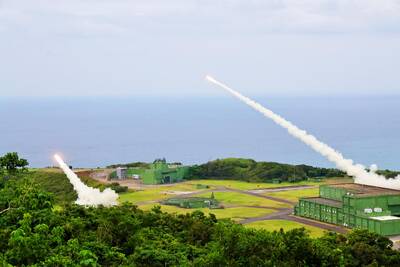
Taiwan lacks effective and cost-efficient armaments to intercept rockets, making the planned “T-Dome” interception system necessary, two experts said on Tuesday. The concerns were raised after China’s military fired two waves of rockets during live-fire drills around Taiwan on Tuesday, part of two-day exercises code-named “Justice Mission 2025.” The first wave involved 17 rockets launched at 9am from Pingtan in China’s Fujian Province, according to Lieutenant General Hsieh Jih-sheng (謝日升) of the Office of the Deputy Chief of the General Staff for Intelligence at the Ministry of National Defense. Those rockets landed 70 nautical miles (129.6km) northeast of Keelung without flying over Taiwan,


 RSS
RSS