


Police yesterday vowed to provide protection for citizen group leader Wu Bo-wei (吳柏瑋) and volunteers in New Taipei City collecting signatures to recall a Chinese Nationalist Party (KMT) lawmaker, after they allegedly received death threats.
National Police Agency Director-General Chang Jung-hsin (張榮興) confirmed the threats targeting Wu and activists campaigning to oust KMT Legislator Lo Ming-tsai (羅明才), elected from New Taipei City’s 11th electoral constituency including Sindian (新店), Shenkeng (深坑), Shiding (石碇), Pinglin (坪林) and Wulai (烏來) districts.
“We shall not permit such intimidation targeting people collecting signatures,” Chang said, adding that police must offer protection for people who are threatened and set up communication channels to respond swiftly to possible incidents.
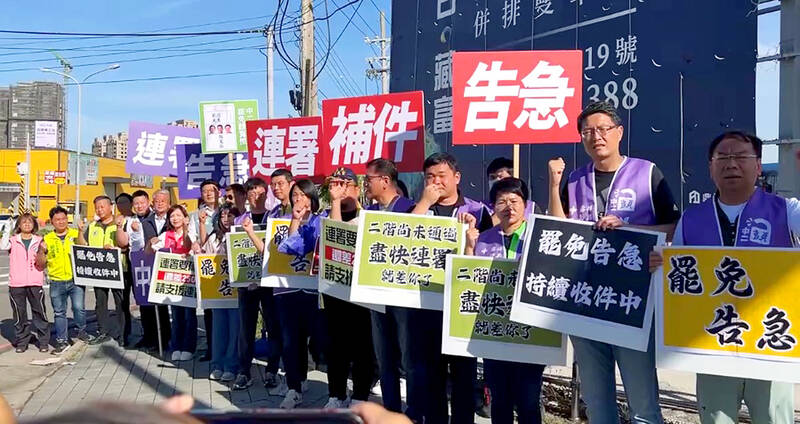
Photo courtesy of the civic group for recalling Yen Kuan-heng
‘NO SUICIDE’ NOTE
Wu, accompanied by volunteers and pan-green politicians, yesterday said the signature drive targeting Lo reached second-stage threshold and submitted the signatures to a Central Election Commission office in New Taipei City.
Campaign spokeswoman Chi Chi (琪琪) said they had earlier submitted the signatures they collected, but election officials disqualified some of them.
Chi said they needed 564 more signatures and collected 2,035 additional signatures.
Wu said he did not leave his home in the past week and worked from there, as he was scared after receiving death threats.
He also said he issued a “no suicide” note to state that he was targeted by gangsters.
TAICHUNG PETITION
Meanwhile, volunteers in Taichung taking part in signature drives to recall KMT legislators Yen Kuan-heng (顏寬恒), Yang Chiung-ying (楊瓊瓔) and Johnny Chiang (江啟臣) from the city’s second, third and eight electoral constituencies respectively, were pushing yesterday to meet the second-stage threshold before tomorrow’s deadline.
They said they needed to collect additional signatures after they had earlier submitted signatures, but the local Central Election Commission office annulled some of them, giving the campaign extra time for its signature drive.

Actor Darren Wang (王大陸) was sentenced to six months in prison, commutable to a fine, by the New Taipei District Court today for contravening the Personal Data Protection Act (個人資料保護法) in a case linked to an alleged draft-dodging scheme. Wang allegedly paid NT$3.6 million (US$114,380) to an illegal group to help him evade mandatory military service through falsified medical documents, prosecutors said. He transferred the funds to Chen Chih-ming (陳志明), the alleged mastermind of a draft-evasion ring, although he lost contact with him as he was already in detention on fraud charges, they said. Chen is accused of helping a

SECURITY: Starlink owner Elon Musk has taken pro-Beijing positions, and allowing pro-China companies to control Taiwan’s critical infrastructure is risky, a legislator said Starlink was reluctant to offer services in Taiwan because of the nation’s extremely high penetration rates in 4G and 5G services, the Ministry of Digital Affairs said yesterday. The ministry made the comments at a meeting of the legislature’s Transportation Committee, which reviewed amendments to Article 36 of the Telecommunications Management Act (電信管理法). Article 36 bans foreigners from holding more than 49 percent of shares in public telecommunications networks, while shares foreigners directly and indirectly hold are also capped at 60 percent of the total, unless specified otherwise by law. The amendments, sponsored by Chinese Nationalist Party (KMT) Legislator Ko

The eastern extension of the Taipei MRT Red Line could begin operations as early as late June, the Taipei Department of Rapid Transit Systems said yesterday. Taipei Rapid Transit Corp said it is considering offering one month of free rides on the new section to mark its opening. Construction progress on the 1.4km extension, which is to run from the current terminal Xiangshan Station to a new eastern terminal, Guangci/Fengtian Temple Station, was 90.6 percent complete by the end of last month, the department said in a report to the Taipei City Council's Transportation Committee. While construction began in October 2016 with an
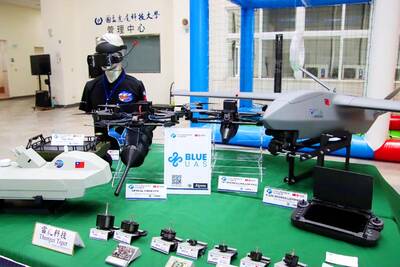
NON-RED SUPPLY: Boosting the nation’s drone industry is becoming increasingly urgent as China’s UAV dominance could become an issue in a crisis, an analyst said Taiwan’s drone exports to Europe grew 41.7-fold from 2024 to last year, with demand from Ukraine’s fight against Russian aggression the most likely driver of growth, a study showed. The Institute for Democracy, Society and Emerging Technology (DSET) in a statement on Wednesday said it found that many of Taiwan’s uncrewed aerial vehicle (UAV) sales were from Poland and the Czech Republic. These countries likely transferred the drones to Ukraine to aid it in its fight against the Russian invasion that started in 2022, it said. Despite the gains, Taiwan is not the dominant drone exporter to these markets, ranking second and fourth


 RSS
RSS