

Two newborns died from enterovirus complications, and one new severe case was reported last week, the Centers for Disease Control (CDC) said yesterday.
A total of 6,009 hospital visits for enterovirus were reported last week, CDC Epidemic Intelligence Center Director Guo Hung-wei (郭宏偉) said.
Seven severe enterovirus infections, including five deaths, have been reported this year, and six of the severe infection cases were infected with echovirus 11 — the dominant strain circulating — as well as four of the five people who died, he said.
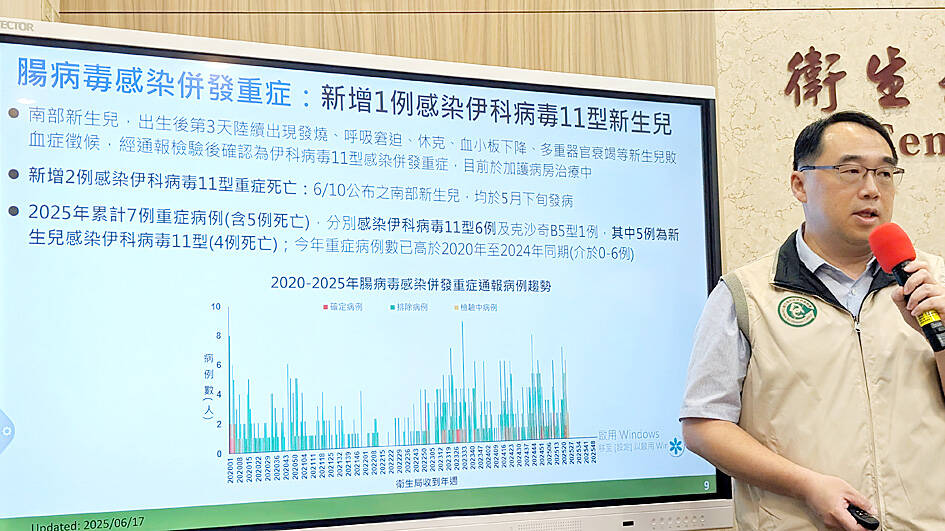
Photo: CNA
The latest severe case is a newborn, CDC physician Lin Yung-ching (林詠青) said.
The baby was hospitalized for hypoxemia after caesarean section and on the third day admitted to an intensive care unit for a fever, difficulty breathing and neonatal sepsis, Lin said, adding that the baby tested positive for echovirus 11.
The baby is still being treated in the intensive care unit, he said. The two enterovirus-related deaths were the two severe cases reported last week, he said.
One of the dead is a six-day-old girl who died of acute liver failure, septic shock and multiple organ failure, and the other is a three-day-old boy who died of septic shock, meningitis and multiple organ failure, he said.
Echovirus 11 can cause severe illness in newborns, and its progression can be “swift and furious,” sometimes with fatal outcomes, Taiwan Society of Neonatology chairperson Yang San-nan (楊生湳) said.
As enteroviruses can be transmitted from mother to child during pregnancy or at birth, pregnant women should avoid visiting crowded and poorly ventilated venues in the last two weeks of their pregnancy, he said.
Adults infected with enteroviruses usually have mild or no symptoms, so it can be easily neglected or mistaken as allergic rhinitis, he said.
Pregnant women should remain vigilant and consult with their obstetrician before giving birth if they have suspected symptoms, he said.
After child delivery, even if a mother is infected, she should breastfeed her newborn — unless her doctor says otherwise — as antibodies in breast milk can help protect the baby from enterovirus infections, he said.
Family, relatives, friends and healthcare providers should thoroughly wash their hands with soap for about 20 seconds before approaching a newborn, he said.
Those with symptoms should avoid approaching them, he added.
If the newborn develops a fever, lethargy, reduced milk intake or other symptoms of severe illness, caregivers should seek medical attention, he said, adding that prevention is much better than getting treatment after infection, he said.
Families with a newborn should avoid visitors, not allow friends and relatives to hug and kiss the child, and self-isolate or take protective measures if they develop symptoms, CDC Deputy Director-General Philip Lo (羅一鈞) said.
They should also avoid bringing newborns to crowded places, and regularly disinfect their environment, including children’s toys and daily necessities — especially before August, he said.
Enterovirus activity has not entered an epidemic level, but the CDC has established a response working group, he said.
The group is to hold a meeting with physicians today to discuss if treatment guidelines can be improved, and a specialists’ meeting tomorrow with medical associations and agencies, he said.
Meanwhile, 66,951 hospital visits for COVID-19 were reported last week, along with 38 deaths and 144 severe cases, Guo said.
Although the number of cases has reduced slightly, COVID-19 activity remains relatively high, he said.
Three new cases of malaria — three Taiwanese men who traveled to African countries in April and last month — were reported, he said, adding that 11 imported cases have been reported this year, the most in the same period in 19 years.
People who are traveling to African countries or high malaria-risk areas should visit a clinic to get malaria prevention medication four to six weeks before their travel, and take the drug before and during their trip, he said.
They should avoid mosquito bites and seek medical attention if they develop symptoms after their trip, he added.

A Hualien pomelo farmer refused to sell to China after the country announced it would permit more Taiwanese pomelo imports, prompting widespread support from Taiwanese consumers, who rallied to buy his fruit. China’s Taiwan Affairs Office last month said that China’s General Administration of Customs registered an additional 79 Taiwanese pomelo orchards and packing facilities in Hualien County, allowing more Taiwanese producers to export pomelos to China. “I am a Hualien fruit farmer and I refuse to sell to China,” Liu Tzu-hao (劉子豪) from Ruisui Township (瑞穗) said in an online post. Liu is a well-known farmer in the community and has served

A Chinese military drone was spotted conducting reconnaissance off Taitung County as President William Lai (賴清德) visited Pingtung County this morning to inspect a drill of the armed forces’ precision-strike capabilities, prompting the military to closely monitor its actions. Today was the final day of a three-day military exercise at Jioupeng Base (九鵬基地) to test the joint combat capabilities of the armed forces and coast guard. The exercise began on Wednesday simulating air defense interception and yesterday tested long-range strike capabilities and new air defense weapons. This morning, the military conducted a final exercise involving air defense, anti-ship and drone operations. Military sources said

UPDATE: The submarine would need to undergo combined systems testing and crew training for navy personnel before it is ready for mission, an expert said Taiwan’s first domestically built submarine, the Hai Kun (Narwhal, 海鯤), could be delivered to the navy as early as next month, military expert and Taiwan Association for Security and Development chairman Chi Tung-yun (紀東昀) said yesterday. The submarine was yesterday morning observed departing for its 21st sea trial and its 15th submerged test. The vessel missed the initial delivery deadline of November last year due to “testing delays,” its primary contractor, shipbuilder CSBC Corp, Taiwan, said in June. The contractor also cited “political pressure from China” in procuring critical equipment. All testing operations are in the final stages, with the

OCT. 31: The antiviral drugs Tamiflu and Eraflu have been distributed to about 4,000 medical facilities nationwide for people in seven groups who develop flu-like symptoms As the domestic influenza epidemic enters its peak season and continues to escalate, the Centers for Disease Control (CDC) yesterday announced that publicly funded influenza antiviral drugs for seven eligible groups have been extended to Oct. 31, allowing those who develop flu-like symptoms to receive the medication without undergoing a rapid influenza test. The CDC has extended the expanded use of flu antiviral drugs to seven groups: healthcare and influenza-prevention personnel; residents and staff at nursing homes, long-term care facilities and similar institutions; kindergarten and daycare workers and home-based caregivers; students from kindergarten through high school, vocational high school and the


 RSS
RSS