


A coalition of Taiwan-based think tanks yesterday launched a tabletop war simulation, with high-ranking military officers from Taiwan, the US and Japan participating.
Nine retired generals and eight retired lieutenant generals are role players in the two-day exercise, which simulates a Chinese invasion of Taiwan proper and its outlying islands, the organizers told a news conference in Taipei.
Among them are retired US admiral Michael Mullen, a former chairman of the US Joint Chiefs of Staff; retired US admiral Dennis Blair, a former Pacific commander; and retired Japanese general Shigeru Iwasaki, a former chief of staff of the Japan Self-Defense Forces.
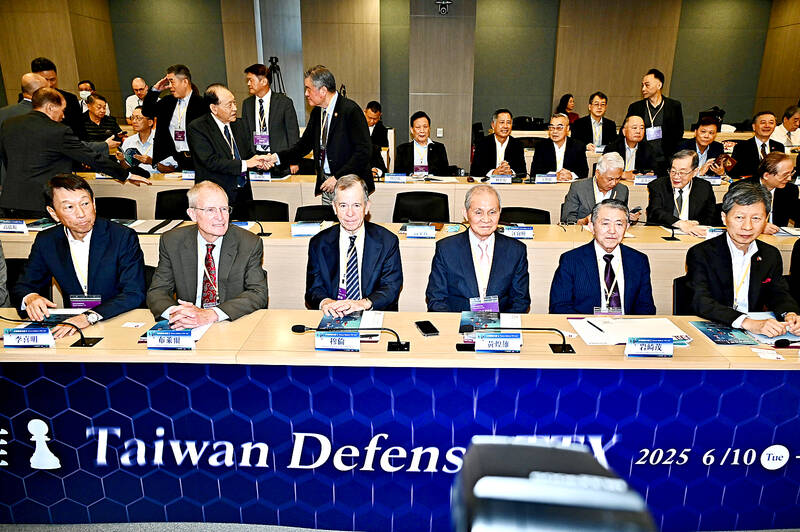
Photo: Tu Chien-jung, Taipei Times
Previous simulations by non-governmental organizations have focused on decisionmaking at the highest level, Taipei School of Economics and Political Science Foundation chairman Huang Huang-hsiung (黃煌雄) said.
The exercise yesterday and today divides a cross-strait contingency into four phases centered on the Chinese People’s Liberation Army’s (PLA) intimidation, coercion, punishment and invasion of Taiwan, Huang said.
The purpose of the exercise is to scientifically and rigorously test Taiwan’s defensive strategies, and raise international awareness of the cross-strait situation, Huang said, adding that predicting the outcome of a hypothetical conflict was not among the goals.
The foreign former military officers were asked to participate to realistically simulate decisions that the US and Japanese militaries would make in a conflict with China, said retired navy admiral Lee Hsi-min (李喜明), a former chief of the general staff.
Mullen in 2022 led a delegation to Taiwan to visit then-president Tsai Ing-wen (蔡英文) shortly after Russia invaded Ukraine, Lee said.
Blair helped design the Han Kuang exercises and observed them from 2003 to 2006, he added.
Lee said that Iwasaki, who was a general in the Japan Air Self-Defense Force, is a strong advocate of Taiwan and is his mentor.
The war games have been eight months in the making, Council on Strategic and Wargaming Strategies director-general Huang Chieh-cheng (黃介正) said.
The simulation features four groups playing the parts of Taiwan, the US, Japan and China, in addition to a control group, he said.
It would cover a series of events starting with China being pushed to escalate cross-strait tensions by economic setbacks and social unarrest, leading to the outbreak of military conflict, he said.
The exercise assumes Taiwan has obtained the asymmetric capabilities it has planned, and that fighting would take place on Taiwan proper and outlying islands, he added.
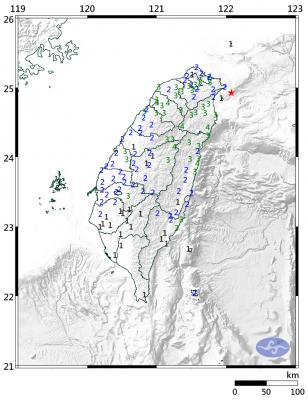
A magnitude 6.1 earthquake struck off the coast of Yilan County at 8:39pm tonight, the Central Weather Administration (CWA) said, with no immediate reports of damage or injuries. The epicenter was 38.7km east-northeast of Yilan County Hall at a focal depth of 98.3km, the CWA’s Seismological Center said. The quake’s maximum intensity, which gauges the actual physical effect of a seismic event, was a level 4 on Taiwan’s 7-tier intensity scale, the center said. That intensity level was recorded in Yilan County’s Nanao Township (南澳), Hsinchu County’s Guansi Township (關西), Nantou County’s Hehuanshan (合歡山) and Hualien County’s Yanliao (鹽寮). An intensity of 3 was
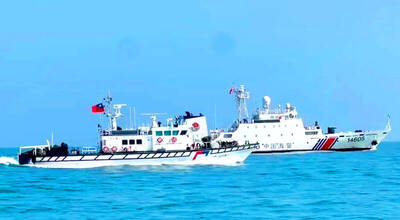
Instead of focusing solely on the threat of a full-scale military invasion, the US and its allies must prepare for a potential Chinese “quarantine” of Taiwan enforced through customs inspections, Stanford University Hoover fellow Eyck Freymann said in a Foreign Affairs article published on Wednesday. China could use various “gray zone” tactics in “reconfiguring the regional and ultimately the global economic order without a war,” said Freymann, who is also a nonresident research fellow at the US Naval War College. China might seize control of Taiwan’s links to the outside world by requiring all flights and ships entering or leaving Taiwan
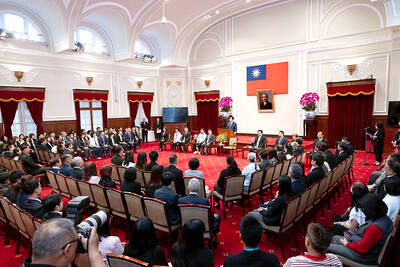
The next minimum wage hike is expected to exceed NT$30,000, President William Lai (賴清德) said yesterday during an award ceremony honoring “model workers,” including migrant workers, at the Presidential Office ahead of Workers’ Day today. Lai said he wished to thank the awardees on behalf of the nation and extend his most sincere respect for their hard work, on which Taiwan’s prosperity has been built. Lai specifically thanked 10 migrant workers selected for the award, saying that although they left their home countries to further their own goals, their efforts have benefited Taiwan as well. The nation’s industrial sector and small businesses lay
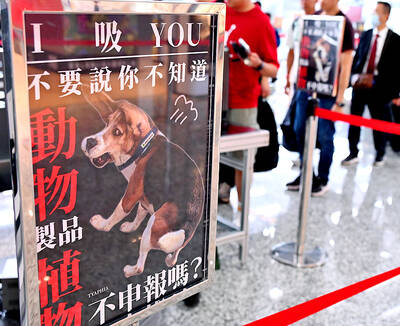
Quarantine awareness posters at Taiwan Taoyuan International Airport have gone viral for their use of wordplay. Issued by the airport branch of the Animal and Plant Health Inspection Agency, the posters feature sniffer dogs making a range of facial expressions, paired with advisory messages built around homophones. “We update the messages for holidays and campaign needs, periodically refreshing materials to attract people’s attention,” quarantine officials said. “The aim is to use the dogs’ appeal to draw focus to quarantine regulations.” A Japanese traveler visiting Taiwan has posted a photo on X of a poster showing a quarantine dog with a


 RSS
RSS