


Guatemala is set to enter into a strategic partnership with Japan, becoming the second diplomatic ally of Taiwan to do so after Paraguay made a similar move last month, a source said on Sunday.
The anticipated announcement follows a trend among Taiwan’s diplomatic allies — such as Paraguay and Palau — who have been gradually forming a multilateral strategic alliance, the source said.
“The trend reflects US-Japan efforts to help Taiwan strengthen diplomatic ties and expand its international presence, and serves as a strategic counterbalance to China,” they said.
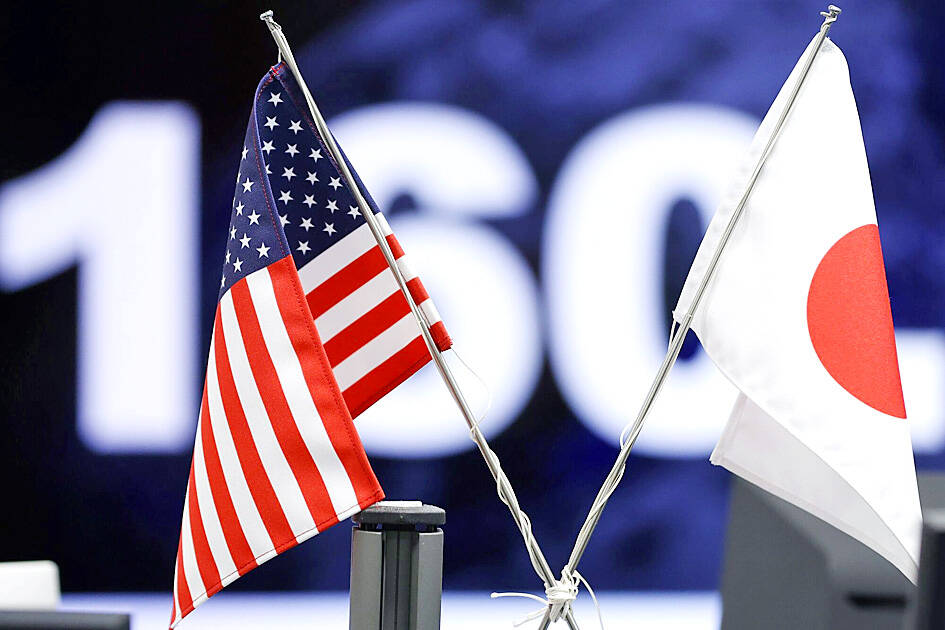
Photo: Bloomberg
Guatemalan President Bernardo Arevalo arrived in Taiwan on a state visit on Thursday, and was expected to follow that trip with a visit to Japan to meet with Japanese Prime Minister Shigeru Ishiba, they said.
“It is expected that the two sides would announce a strategic partnership following that meeting,” they added.
When US Secretary of State Marco Rubio visited Guatemala earlier this year, he emphasized Washington’s support for deepening Taiwan-US-Guatemala ties into a more comprehensive partnership, the source said.
“That signifies that Taiwan-Guatemala ties would move beyond bilateral cooperation, shifting toward a new quadrilateral framework,” they said.
The Ministry of Foreign Affairs on Friday rejected Beijing’s criticism of Taiwan’s evolving diplomatic ties, stating that the “Republic of China (Taiwan) is a sovereign and independent nation committed to maintaining cross-strait peace, despite China’s provocations and attempts to undermine regional stability.”
Taiwan’s relations with its diplomatic allies are based on mutual respect, equality and reciprocity — principles that no foreign government has the right to interfere with, it said.
Taiwan National Security Institute deputy secretary-general Marco Ho Cheng-hui (何澄輝) said that China has long sought to exert political influence in Latin America.
“Latin America is the US’ backyard and we have seen China attempt to get a foothold there through strategic projects such as the Chancay Port in Peru, and plans for a transcontinental railway,” he said.
“Beijing is even trying to gain political influence over key infrastructure such as the Panama Canal via Hong Kong investments, all of which pose strategic threats to the US,” he added.
Rubio, who is of Cuban descent, has made Latin America a key focus as part of a policy direction toward solidifying ties with Taiwan’s allies and preventing them from severing relations under pressure or inducements from China, the source said.
“This helps Taiwan avoid diplomatic isolation, and also reinforces US strategic influence in the region,” he said.
As part of its evolving strategic policy, the US aims to convey to countries that China is “not their only option,” and is touting Japan’s position as one of the world’s largest overseas investors, he said.
“Japan has long-standing investment foundations and industrial advantages in Latin America, and is a favored partner for many nations,” he said.
“Therefore, Japan has become the US’ most trusted ally in the Indo-Pacific region, with Washington encouraging Tokyo to take on even greater responsibility,” he added.

Actor Darren Wang (王大陸) was sentenced to six months in prison, commutable to a fine, by the New Taipei District Court today for contravening the Personal Data Protection Act (個人資料保護法) in a case linked to an alleged draft-dodging scheme. Wang allegedly paid NT$3.6 million (US$114,380) to an illegal group to help him evade mandatory military service through falsified medical documents, prosecutors said. He transferred the funds to Chen Chih-ming (陳志明), the alleged mastermind of a draft-evasion ring, although he lost contact with him as he was already in detention on fraud charges, they said. Chen is accused of helping a

SECURITY: Starlink owner Elon Musk has taken pro-Beijing positions, and allowing pro-China companies to control Taiwan’s critical infrastructure is risky, a legislator said Starlink was reluctant to offer services in Taiwan because of the nation’s extremely high penetration rates in 4G and 5G services, the Ministry of Digital Affairs said yesterday. The ministry made the comments at a meeting of the legislature’s Transportation Committee, which reviewed amendments to Article 36 of the Telecommunications Management Act (電信管理法). Article 36 bans foreigners from holding more than 49 percent of shares in public telecommunications networks, while shares foreigners directly and indirectly hold are also capped at 60 percent of the total, unless specified otherwise by law. The amendments, sponsored by Chinese Nationalist Party (KMT) Legislator Ko

The eastern extension of the Taipei MRT Red Line could begin operations as early as late June, the Taipei Department of Rapid Transit Systems said yesterday. Taipei Rapid Transit Corp said it is considering offering one month of free rides on the new section to mark its opening. Construction progress on the 1.4km extension, which is to run from the current terminal Xiangshan Station to a new eastern terminal, Guangci/Fengtian Temple Station, was 90.6 percent complete by the end of last month, the department said in a report to the Taipei City Council's Transportation Committee. While construction began in October 2016 with an

NON-RED SUPPLY: Boosting the nation’s drone industry is becoming increasingly urgent as China’s UAV dominance could become an issue in a crisis, an analyst said Taiwan’s drone exports to Europe grew 41.7-fold from 2024 to last year, with demand from Ukraine’s fight against Russian aggression the most likely driver of growth, a study showed. The Institute for Democracy, Society and Emerging Technology (DSET) in a statement on Wednesday said it found that many of Taiwan’s uncrewed aerial vehicle (UAV) sales were from Poland and the Czech Republic. These countries likely transferred the drones to Ukraine to aid it in its fight against the Russian invasion that started in 2022, it said. Despite the gains, Taiwan is not the dominant drone exporter to these markets, ranking second and fourth


 RSS
RSS