


None of the Chinese Nationalist Party (KMT)-proposed recall petitions are expected to be ready by their deadlines, a source within the party said yesterday, which would leave the party completely on the defensive against the Democratic Progressive Party’s (DPP) recall campaigns.
KMT lawmakers hold a narrow plurality in the 113-seat legislature and have teamed up with the Taiwan People’s Party’s (TPP) legislators and two independents to form an opposition majority of 62 to 51.
In January, DPP caucus whip Ker Chien-ming (柯建銘) called for a mass recall of KMT lawmakers.

Photo: Huang Tzu-yang, Taipei Times
Since then, citizen groups have begun recall campaigns against KMT lawmakers.
However, since the Pingtung District Prosecutors’ Office on May 14 searched the KMT’s Pingtung County chapter after allegations that some signatures on a petition targeting DPP Legislator Saidhai Tahovecahe were of dead people, no one was willing to take over the signature-gathering process, the source said.
KMT headquarters and the local chapter were unable to get the process moving again, the source said.
On the other hand, campaigners seeking the recall of KMT lawmakers said their petition drives have yielded positive results nationwide, they said.
The KMT is entirely on the defensive in the recall process and must focus on convincing the public to vote against the bids, they said.
The KMT should refrain from framing the recall campaign as a conflict between the pan-blue and pan-green camps, because then the KMT would, without a doubt, fare poorly in the voting, the source said.
The party should broaden its appeal, they said, adding that the party should change its message to entice people who oppose the DPP’s policies and ideals, as well as TPP supporters and others.
KMT legislators Tu Chuan-chi (涂權吉) in Taoyuan, Yeh Yuan-chih (葉元之) in New Taipei City and Huang Chien-pin (黃健賓) in Taitung County are in the “most danger” of losing their seats, the source said.
Signature submissions for second-stage recall petitions targeting Saidhai Tahovecahe and DPP Legislator Asenay Daliyalrep were due yesterday, while those targeting DPP legislators Tsai Chi-chang (蔡其昌) and Ho Hsin-chun (何欣純) are due on Friday, Central Election Commission records showed.
Deadlines for petitions against DPP lawmakers Rosalia Wu (吳思瑤) and Wu Pei-yi (吳沛憶) are on Saturday, Su Chiao-hui (蘇巧慧), Wu Chi-ming (吳琪銘), Chang Hung-lu (張宏陸) on June 8, and Wang Ting-yu (王定宇) and Lin Chun-hsien (林俊憲) on June 10, the records showed.
Deadlines for forms in the bids to remove DPP lawmakers Hsu Chih-chieh (許智傑) and Huang Jie (黃捷) are on June 14, Lee Kun-cheng (李坤城) on June 23 and Chen Chun-yu (陳俊宇) on June 24, they showed.
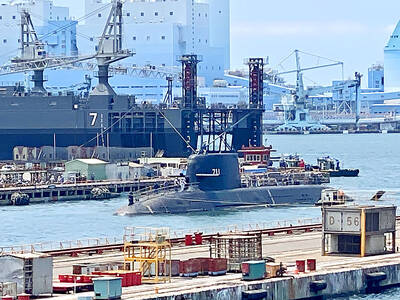
AGING: While Japan has 22 submarines, Taiwan only operates four, two of which were commissioned by the US in 1945 and 1946, and transferred to Taiwan in 1973 Taiwan would need at least 12 submarines to reach modern fleet capabilities, CSBC Corp, Taiwan chairman Chen Cheng-hung (陳政宏) said in an interview broadcast on Friday, citing a US assessment. CSBC is testing the nation’s first indigenous defense submarine, the Hai Kun (海鯤, Narwhal), which is scheduled to be delivered to the navy next month or in July. The Hai Kun has completed torpedo-firing tests and is scheduled to undergo overnight sea trials, Chen said on an SET TV military affairs program. Taiwan would require at least 12 submarines to establish a modern submarine force after assessing the nation’s operational environment and defense

Yangmingshan National Park authorities yesterday urged visitors to respect public spaces and obey the law after a couple was caught on a camera livestream having sex at the park’s Qingtiangang (擎天崗) earlier in the day. The Shilin Police Precinct in Taipei said it has identified a suspect and his vehicle registration number, and would summon him for questioning. The case would be handled in accordance with public indecency charges, it added. The couple entered the park at about 11pm on Thursday and began fooling around by 1am yesterday, the police said, adding that the two were unaware of the park’s all-day live
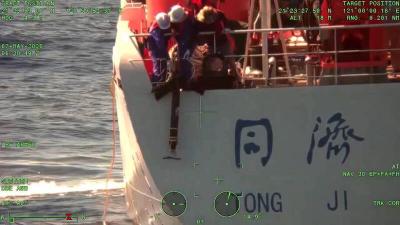
The coast guard today said that it had disrupted "illegal" operations by a Chinese research ship in waters close to the nation and driven it away, part of what Taipei sees a provocative pattern of China's stepped up maritime activities. The coast guard said that it on Thursday last week detected the Chinese ship Tongji (同濟號), which was commissioned only last year, 29 nautical miles (54km) southeast of the southern tip of Taiwan, although just outside restricted waters. The ship was observed lowering ropes into the water, suspected to be the deployment of scientific instruments for "illegal" survey operations, and the coast

A former soldier and an active-duty army officer were yesterday indicted for allegedly selling classified military training materials to a Chinese intelligence operative for a total of NT$79,440. The Taipei District Prosecutors’ Office indicted Chen Tai-yin (陳泰尹) and Lee Chun-ta (李俊達) for contravening the National Security Act (國家安全法) and the Anti-Corruption Act (貪污治罪條例). Chen left the military in September 2013 after serving alongside then-staff sergeant Lee, now an army lieutenant, at the 21st Artillery Command of the army’s Sixth Corps from 2011 to 2013, according to the indictment. Chen met a Chinese intelligence operative identified as “Wang” (王) through a friend in November


 RSS
RSS