


Taiwan should prioritize the acquisition of precision weaponry and ammunition from Washington, as well as lobby for the US to establish local production lines, as a Chinese invasion of Taiwan would be a war of attrition across multiple fronts, Taiwan Security Association deputy secretary-general Ho Cheng-hui (何澄輝) said yesterday.
Ho’s comments came after Reuters published a report citing US officials as saying that the administration of US President Donald Trump sought to exceed the amount of weapons sales to Taiwan compared with his first term.
According to the report, the first Trump administration approved sales of about US$18.3 billion of weapons to Taiwan, compared with about US$8.4 billion during former US president Joe Biden’s term.
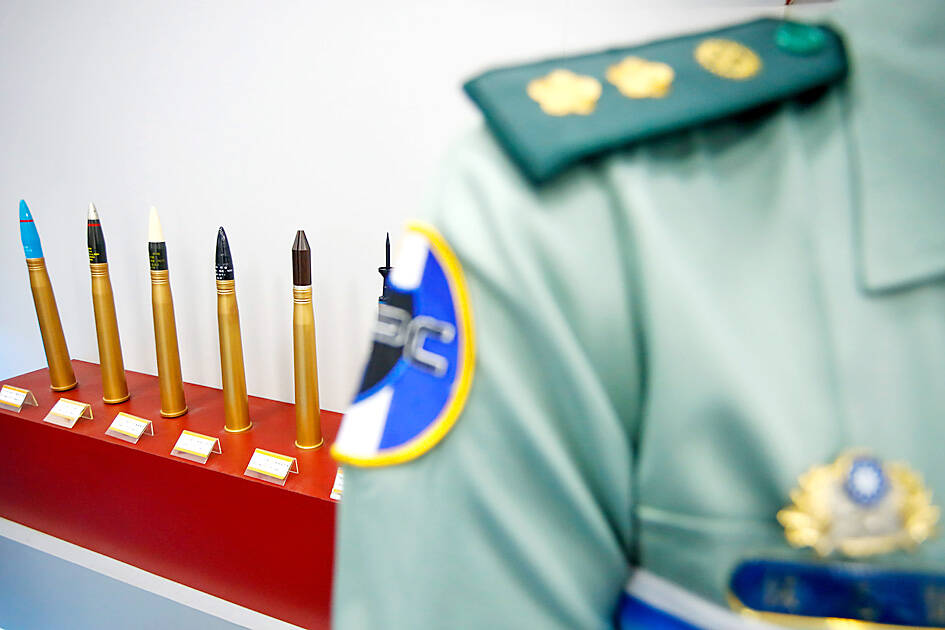
Photo: Daniel Ceng Shou Yi, EPA-EFE
According to the report, US officials said that Trump and his administration were committed to “enhancing hard deterrence” for Taiwan.
“That’s where the president is. That’s where all of us are,” the report quoted one US official as saying.
China is likely to make an invasion of Taiwan a war of attrition to deplete Taiwan and its allies’ ammunition stores, especially precision weaponry, Ho said.
Taiwan should prioritize the expansion of all ammunition production capabilities, such as ammunition for the M114 155mm howitzer, the Type 63 120mm mortar, and the M142 High Mobility Artillery Rocket System (HIMARS), Ho said, adding that Taiwan should also increase the capacity of its reserves for such ammunition.
The inventory of MGM-140 Army Tactical Missile Systems (ATACMS) from the US, at 84, is severely insufficient to prevent China from conducting landing operations, Ho said.
Taiwan should purchase more ATACMS, or should consider purchasing the Precision Strike Missile (PrSM) short-ranged ballistic missiles being developed to replace the ATACMS, he said.
Ho also urged Taipei to work with the US to establish ammunition manufacturing lines in Taiwan, citing a 2020 agreement between Lockheed Martin and the Aerospace Industrial Development Corp to establish an F-16 maintenance center in Taichung.
Ensuring local production of ammunition would strengthen Taiwan’s defense resilience, Ho said.
Upgrades to tactical communications and information systems should also be prioritized, with a focus on anti-drone capabilities, electronic warfare equipment and expanding tactical radar coverage, Ho said.
Ho said that purchases of F-35s and AEGIS-equipped ships should not be the immediate focus, as such platforms require five years to a decade to become useful, while increasing Taiwan’s number of HIMARS and locally produced Thunderbolt-2000 wheeled multiple launch rocket systems would provide immediate combat capabilities for a war of attrition.
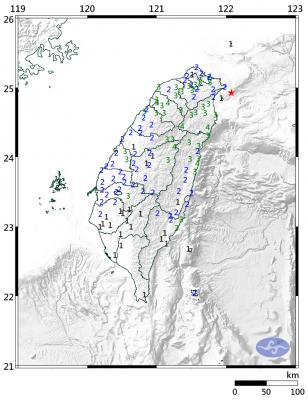
A magnitude 6.1 earthquake struck off the coast of Yilan County at 8:39pm tonight, the Central Weather Administration (CWA) said, with no immediate reports of damage or injuries. The epicenter was 38.7km east-northeast of Yilan County Hall at a focal depth of 98.3km, the CWA’s Seismological Center said. The quake’s maximum intensity, which gauges the actual physical effect of a seismic event, was a level 4 on Taiwan’s 7-tier intensity scale, the center said. That intensity level was recorded in Yilan County’s Nanao Township (南澳), Hsinchu County’s Guansi Township (關西), Nantou County’s Hehuanshan (合歡山) and Hualien County’s Yanliao (鹽寮). An intensity of 3 was
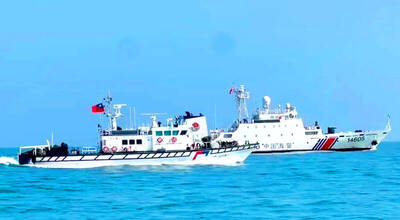
Instead of focusing solely on the threat of a full-scale military invasion, the US and its allies must prepare for a potential Chinese “quarantine” of Taiwan enforced through customs inspections, Stanford University Hoover fellow Eyck Freymann said in a Foreign Affairs article published on Wednesday. China could use various “gray zone” tactics in “reconfiguring the regional and ultimately the global economic order without a war,” said Freymann, who is also a nonresident research fellow at the US Naval War College. China might seize control of Taiwan’s links to the outside world by requiring all flights and ships entering or leaving Taiwan
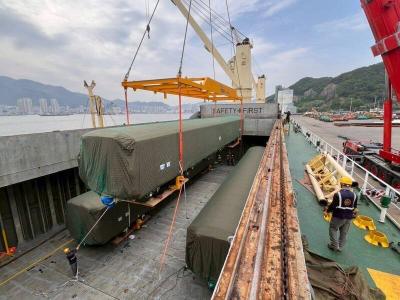
The first of 10 new high-capacity trains purchased from South Korea’s Hyundai Rotem arrived at the Port of Taipei yesterday to meet the demands of an expanding metro network, Taipei Rapid Transit Corp (TRTC) said yesterday. The train completed a three-day, 1,200km voyage from the Port of Masan in South Korea, the company said. Costing NT$590 million (US$18.79 million) each, the new six-carriage trains feature a redesigned interior based on "human-centric" transportation concepts, TRTC said. The design utilizes continuous longitudinal seating to widen the aisles and optimize passenger flow, while also upgrading passenger information displays and driving control systems for a more comfortable
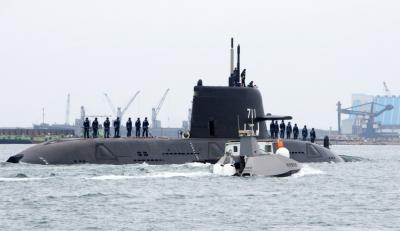
Taiwan's first indigenous defense submarine, the SS-711 Hai Kun (海鯤, or Narwhal), departed for its 13th sea trial at 7am today, marking its seventh submerged test, with delivery to the navy scheduled for July. The outing also marked its first sea deployment since President William Lai (賴清德) boarded the submarine for an inspection on March 19, drawing a crowd of military enthusiasts who gathered to show support. The submarine this morning departed port accompanied by CSBC Corp’s Endeavor Manta (奮進魔鬼魚號) uncrewed surface vessel and a navy M109 assault boat. Amid public interest in key milestones such as torpedo-launching operations and overnight submerged trials,


 RSS
RSS