


Chinese-hosted competitions open to students in Taiwan and China are often a facade to create opportunities for “united front” rhetoric, the Mainland Affairs Council (MAC) said yesterday.
Education providers should be careful when events waive costs, or arrange visits to events or locations that might facilitate “united front” rhetoric, the MAC said.
People who have participated in Chinese-hosted cross-strait competitions told reporters that writing, photography and video contests are often “fixed” in favor of Taiwanese entrants, who are given awards and sent on tours that “glorify China.”
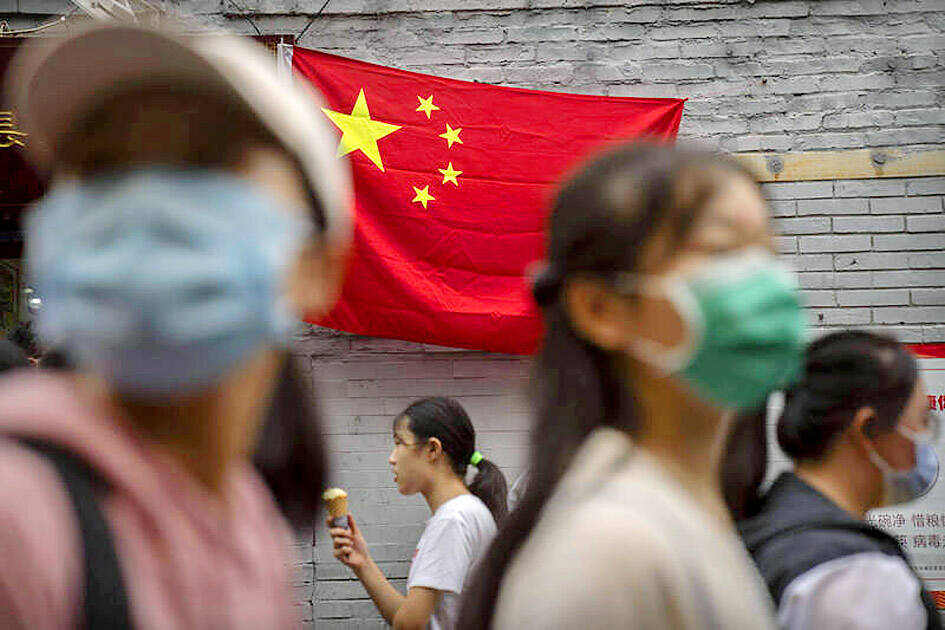
Photo: AP
They are “brainwashing events” that seek to influence participants’ views of China in the name of academic exchanges, a former participant said on condition of anonymity.
The events were likely masterminded by branch offices of China’s Taiwan Affairs Office, the source said.
The experience would easily sway some Taiwanese students, as they would be amazed at the facade of China’s technological achievements, they said.
However, if they look deeper, they would find that while digital transactions in China are convenient, there are issues of personal information security, the source said.
There is a significant Chinese presence on social media platforms such as Douyin, Threads, WeChat and Line that tries to attract Taiwanese students to visit China, a Liberty Times (sister paper of the Taipei Times) investigation showed.
On Threads alone, there are two to five posts a day, with some listing the itinerary of trips and some stating that the visit is free, the Liberty Times reported.
The hotels that Taiwanese groups stay in on such trips are not cheap, with some being five-star hotels, it reported.
Many itineraries include visits to tourist hotspots and say that participants only need to pay their airfare to and from China, it reported.
For example, a workshop for making luosifen (螺螄粉, a noodle soup) from July 4 to 10 has only one day dedicated to making the dish, with the other days spent traveling, the report said.
The event’s description said that anyone under the age of 40 who held a “Taiwan compatriot permit” (台胞證) could attend the workshop, with everyone receiving a luosifen-making certificate, the newspaper reported.
Videos on social media showed Taiwanese studying in China who stated their opposition to Taiwanese independence, it reported, adding that the aim was to whitewash China’s image and undermine Taiwanese autonomy.

Considering that most countries issue more than five denominations of banknotes, the central bank has decided to redesign all five denominations, the bank said as it prepares for the first major overhaul of the banknotes in more than 24 years. Central bank Governor Yang Chin-lung (楊金龍) is expected to report to the Legislative Yuan today on the bank’s operations and the redesign’s progress. The bank in a report sent to the legislature ahead of today’s meeting said it had commissioned a survey on the public’s preferences. Survey results showed that NT$100 and NT$1,000 banknotes are the most commonly used, while NT$200 and NT$2,000

The Centers for Disease Control (CDC) yesterday reported the first case of a new COVID-19 subvariant — BA.3.2 — in a 10-year-old Singaporean girl who had a fever upon arrival in Taiwan and tested positive for the disease. The girl left Taiwan on March 20 and the case did not have a direct impact on the local community, it said. The WHO added the BA.3.2 strain to its list of Variants Under Monitoring in December last year, but this was the first imported case of the COVID-19 variant in Taiwan, CDC Deputy Director-General Lin Ming-cheng (林明誠) said. The girl arrived in Taiwan on

South Korea is planning to revise its controversial electronic arrival card, a step Taiwanese officials said prompted them to hold off on planned retaliatory measures, a South Korean media report said yesterday. A Yonhap News Agency report said that the South Korean Ministry of Foreign Affairs is planning to remove the “previous departure place” and “next destination” fields from its e-arrival card system. The plan, reached after interagency consultations, is under review and aims to simplify entry procedures and align the electronic form with the paper version, a South Korean ministry official said. The fields — which appeared only on the electronic form

The Ministry of Foreign Affairs (MOFA) is suspending retaliation measures against South Korea that were set to take effect tomorrow, after Seoul said it is updating its e-arrival system, MOFA said today. The measures were to be a new round of retaliation after Taiwan on March 1 changed South Korea's designation on government-issued alien resident certificates held by South Korean nationals to "South Korea” from the "Republic of Korea," the country’s official name. The move came after months of protests to Seoul over its listing of Taiwan as "China (Taiwan)" in dropdown menus on its new online immigration entry system. MOFA last week


 RSS
RSS