


President William Lai (賴清德) failed his first-year performance review, a Chinese Nationalist Party (KMT)-affiliated think tank said yesterday, citing its survey on the eve of Lai’s inauguration anniversary today.
Lai scored 51.2 points and Premier Cho Jung-tai (卓榮泰) scored 51.4 points in their first year in office, the National Policy Foundation said.
KMT Chairman Eric Chu (朱立倫) said at a news conference the foundation held that the past year was “a year of national misfortune and people’s distress,” as the nation was dragged into turmoil and the cross-strait tension escalated.
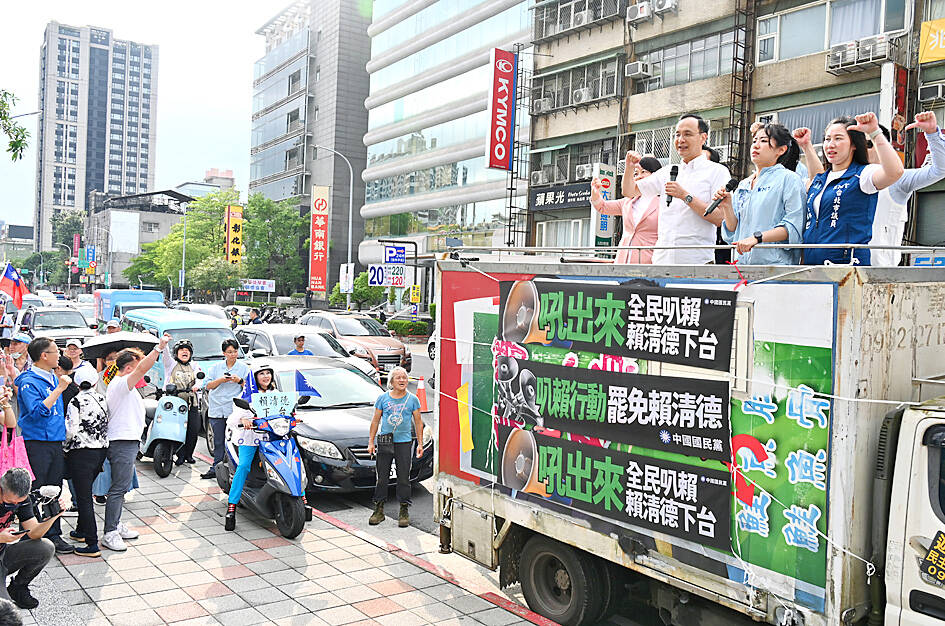
Photo: Tien Yu-hua, Taipei Times
Political infighting has been rampant, as the ruling Democratic Progressive Party (DPP) “abused” the judicial system to persecute members of opposition parties and create “green terror,” he said.
“Green terror” refers to the DPP’s color and judicial investigations against members of the opposition parties, likening the investigations to the White Terror era, when then-KMT government oppressed domestic dissent.
Referring to Lai’s resent analogy of cross-strait relations as “a small company [Taiwan]” and “a big company [China],” Chu criticized Lai for replacing cross-strait “unification” with “mergers and acquisitions.”
“So, framing it as ‘hostile mergers’ is not illegal, but calling it ‘forceful unification’ deserves to be expelled,” he said, adding that Lai’s analogy is tantamount to suggesting that he would “sell Taiwan’s sovereignty” once he “gets a good deal.”
Chu added that he was surprised to hear that Lai said he had made efforts over the past year to facilitate communications between the governing and opposition parties, but failed.
“We [the KMT] have been saying many times how we have been waiting for his phone calls, and for him to start a dialogue between the governing and opposition parties,” he said. “All we got after the long wait was confrontation. The door was shut, and there was no opportunity to communicate, but a mass recall to eradicate opposition parties.”
Lai has been extremely incompetent in external affairs, he said, adding that Lai “gave away” Taiwan Semiconductor Manufacturing Co’s (TSMC) business to the US even before the tariff war started.
Chu also cited US President Donald Trump’s adviser David Sacks as saying that Washington would consider allowing TSMC to set up a new plant in the United Arab Emirates.
“So, Lai has decided to relinquish the decisionmaking power over TSMC to the US,” Chu said, adding that TSMC has become “USMC.”
Taiwanese elected the president to prioritize the nation’s interests and make it thrive, but all Lai did was to surrender and butter up Washington, Chu added.
KMT Legislator Ko Chih-en (柯志恩), who heads the foundation, said the survey showed that 28.5 percent approved the government’s efforts to combat scams while 44.8 percent disapproved.
The survey showed 53.8 percent were dissatisfied with judicial justice while 21.6 percent said it has improved.
The survey showed 44.5 percent were dissatisfied with the government’s performance on the economy, while 18.8 percent said it improved.
On Taiwan-US relations, 37.2 percent said they were dissatisfied, and 32.2 percent were satisfied; 53.8 percent disapproved of the government’s handling of cross-strait relations, while 9.2 percent said it has improved.
When asked whether they are concerned about a possible cross-strait conflict, 50.3 percent said they are concerned and 45.1 percent said they are not, the survey showed.
According to the survey, 41.7 percent said Cho should be replaced, while 35.2 percent disagreed.
Asked whether a Cabinet reshuffle is required, 49.4 percent of respondents agreed and 29.2 percent disagreed, the survey showed.
The survey, conducted from 6pm to 9:30pm from Tuesday to Thursday last week, surveyed 1,069 people aged 20 or older nationwide by phone and had a margin of error of 3 percentage points.
The KMT yesterday afternoon also held a protest gathering vehicles in front of the DPP headquarters in Taipei.
Vehicles blew their horns at 5:20pm, referring to the date Lai took office, demanding that he step down.

A magnitude 6.1 earthquake struck off the coast of Yilan County at 8:39pm tonight, the Central Weather Administration (CWA) said, with no immediate reports of damage or injuries. The epicenter was 38.7km east-northeast of Yilan County Hall at a focal depth of 98.3km, the CWA’s Seismological Center said. The quake’s maximum intensity, which gauges the actual physical effect of a seismic event, was a level 4 on Taiwan’s 7-tier intensity scale, the center said. That intensity level was recorded in Yilan County’s Nanao Township (南澳), Hsinchu County’s Guansi Township (關西), Nantou County’s Hehuanshan (合歡山) and Hualien County’s Yanliao (鹽寮). An intensity of 3 was

Instead of focusing solely on the threat of a full-scale military invasion, the US and its allies must prepare for a potential Chinese “quarantine” of Taiwan enforced through customs inspections, Stanford University Hoover fellow Eyck Freymann said in a Foreign Affairs article published on Wednesday. China could use various “gray zone” tactics in “reconfiguring the regional and ultimately the global economic order without a war,” said Freymann, who is also a nonresident research fellow at the US Naval War College. China might seize control of Taiwan’s links to the outside world by requiring all flights and ships entering or leaving Taiwan
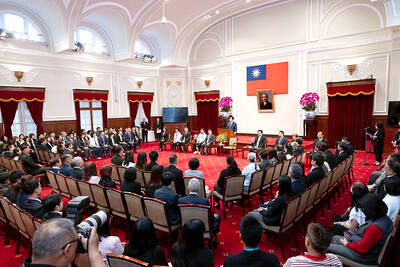
The next minimum wage hike is expected to exceed NT$30,000, President William Lai (賴清德) said yesterday during an award ceremony honoring “model workers,” including migrant workers, at the Presidential Office ahead of Workers’ Day today. Lai said he wished to thank the awardees on behalf of the nation and extend his most sincere respect for their hard work, on which Taiwan’s prosperity has been built. Lai specifically thanked 10 migrant workers selected for the award, saying that although they left their home countries to further their own goals, their efforts have benefited Taiwan as well. The nation’s industrial sector and small businesses lay
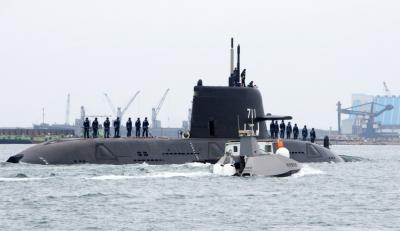
Taiwan's first indigenous defense submarine, the SS-711 Hai Kun (海鯤, or Narwhal), departed for its 13th sea trial at 7am today, marking its seventh submerged test, with delivery to the navy scheduled for July. The outing also marked its first sea deployment since President William Lai (賴清德) boarded the submarine for an inspection on March 19, drawing a crowd of military enthusiasts who gathered to show support. The submarine this morning departed port accompanied by CSBC Corp’s Endeavor Manta (奮進魔鬼魚號) uncrewed surface vessel and a navy M109 assault boat. Amid public interest in key milestones such as torpedo-launching operations and overnight submerged trials,


 RSS
RSS