


Taiwan is in talks with “certain countries” to conduct a joint humanitarian exercise within the Taiwan Strait to combat China’s “gray zone” tactics and legal warfare, Coast Guard Administration (CGA) Deputy Director-General Hsieh Ching-chin (謝慶欽) said yesterday.
Democratic Progressive Party (DPP) Legislator Wang Ting-yu (王定宇) yesterday asked what the coast guard is doing to address the force disparity in the Taiwan Strait when Beijing disguises Chinese People’s Liberation Army Navy warships as part of the China Coast Guard.
Wang also asked what options the CGA have regarding Chinese ships stopping Taiwanese ships for inspections, and the possibility of improving such measures.
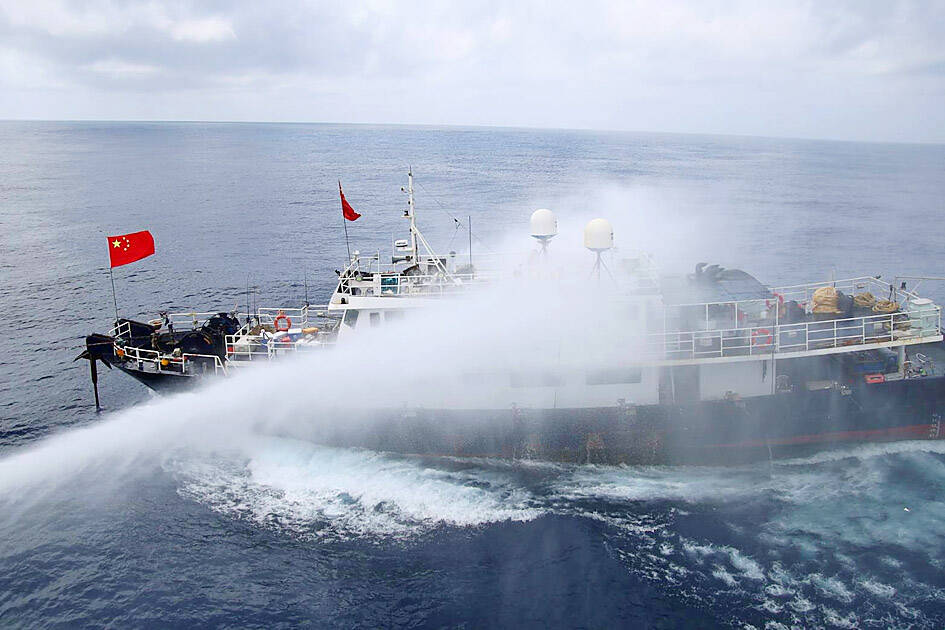
Photo courtesy of the Coast Guard Administration
Instituting a maritime lockdown would be considered an act of war, Hsieh said, adding that the coast guard is working closely with intelligence units and the navy to provide safe passage for Taiwanese ships.
The coast guard is prioritizing the protection of Taiwanese ships first, and extending protection to foreign ships sailing near Taiwan within a 24 nautical mile (44.4km) range, he said.
The CGA is mulling the possibility of developing air support, especially long-range reconnaissance capabilities, which would provide the service with much-needed time to react to Chinese incursions, he added.
Wang suggested that the best way to combat China’s “gray zone” tactics and legal warfare was to give China a taste of its own medicine by working with the US, Japan, the Philippines and Australia, and hosting a joint humanitarian rescue exercise in the Taiwan Strait.
Hsieh said that the coast guard and Ministry of Foreign Affairs are already in related talks with “certain nations.”
“It is true that rescues know no borders,” he said.
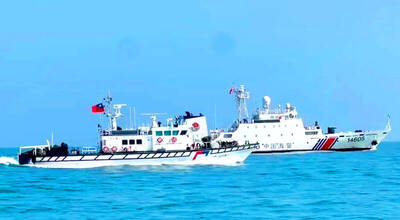
Separately, the CGA’s Kinmen-Matsu-Penghu branch dispatched four ships yesterday to monitor four China Coast Guard ships detected around Kinmen County while broadcasting messages for the Chinese ships to leave.
The four Chinese ships, bearing pennant numbers 14605, 14604, 14608 and 14521, sailed into restricted waters near Kinmen from the east and west, the CGA said.
The ships had left the area by 5pm, it said.
The CGA said there were 71 recorded incidents of Chinese ships’ incursions into the Kinmen area, and the branch is stepping up monitoring efforts, and hopes to increase deployment and reaction times to such incidents.
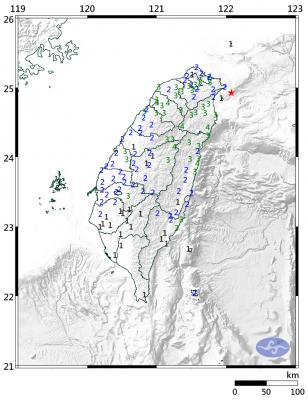
A magnitude 6.1 earthquake struck off the coast of Yilan County at 8:39pm tonight, the Central Weather Administration (CWA) said, with no immediate reports of damage or injuries. The epicenter was 38.7km east-northeast of Yilan County Hall at a focal depth of 98.3km, the CWA’s Seismological Center said. The quake’s maximum intensity, which gauges the actual physical effect of a seismic event, was a level 4 on Taiwan’s 7-tier intensity scale, the center said. That intensity level was recorded in Yilan County’s Nanao Township (南澳), Hsinchu County’s Guansi Township (關西), Nantou County’s Hehuanshan (合歡山) and Hualien County’s Yanliao (鹽寮). An intensity of 3 was
Instead of focusing solely on the threat of a full-scale military invasion, the US and its allies must prepare for a potential Chinese “quarantine” of Taiwan enforced through customs inspections, Stanford University Hoover fellow Eyck Freymann said in a Foreign Affairs article published on Wednesday. China could use various “gray zone” tactics in “reconfiguring the regional and ultimately the global economic order without a war,” said Freymann, who is also a nonresident research fellow at the US Naval War College. China might seize control of Taiwan’s links to the outside world by requiring all flights and ships entering or leaving Taiwan
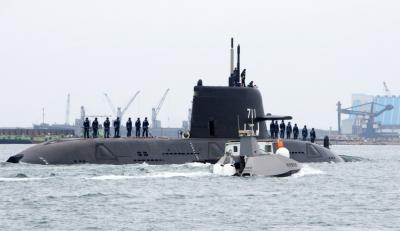
Taiwan's first indigenous defense submarine, the SS-711 Hai Kun (海鯤, or Narwhal), departed for its 13th sea trial at 7am today, marking its seventh submerged test, with delivery to the navy scheduled for July. The outing also marked its first sea deployment since President William Lai (賴清德) boarded the submarine for an inspection on March 19, drawing a crowd of military enthusiasts who gathered to show support. The submarine this morning departed port accompanied by CSBC Corp’s Endeavor Manta (奮進魔鬼魚號) uncrewed surface vessel and a navy M109 assault boat. Amid public interest in key milestones such as torpedo-launching operations and overnight submerged trials,
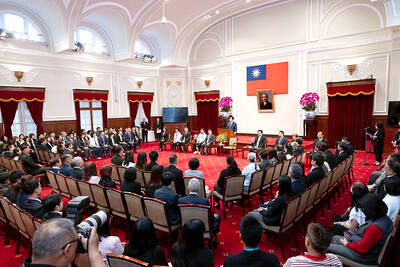
The next minimum wage hike is expected to exceed NT$30,000, President William Lai (賴清德) said yesterday during an award ceremony honoring “model workers,” including migrant workers, at the Presidential Office ahead of Workers’ Day today. Lai said he wished to thank the awardees on behalf of the nation and extend his most sincere respect for their hard work, on which Taiwan’s prosperity has been built. Lai specifically thanked 10 migrant workers selected for the award, saying that although they left their home countries to further their own goals, their efforts have benefited Taiwan as well. The nation’s industrial sector and small businesses lay


 RSS
RSS