


An economic cooperation agreement inked by the Taiwan Electrical and Electronic Manufacturers’ Association (TEEMA) and the Texas Association of Business would boost Taiwan’s role in “non-red” supply chains, Minister of Foreign Affairs Lin Chia-lung (林佳龍) told a signing ceremony in Texas on Friday.
Lin on Tuesday arrived in the US leading a delegation consisting of representatives from the Taipei-based association, the AI Innovation & Application Alliance and the Taipei-based Chinese International Economic Cooperation Association (CIECA) to attend the Taiwan-Texas Artificial Intelligence (AI) Innovation Forum.
The forum, organized by TEEMA, the Texas association and Opportunity Austin, was attended by industrial representatives, academics and officials from Taiwan and the US.
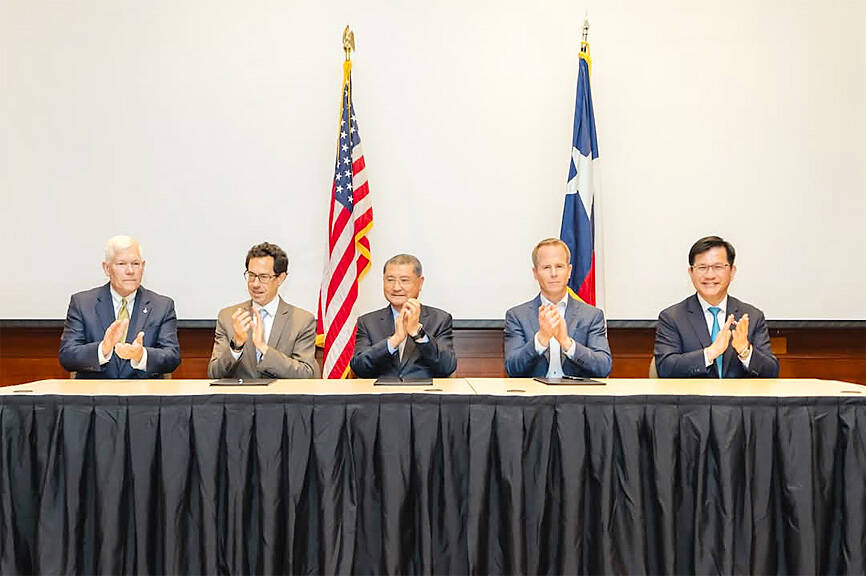
Photo courtesy of the Ministry of Foreign Affairs
US Representative Pete Sessions, Texas Representative Angie Chen Button (陳筱玲), TEEMA chairman Richard Lee (李詩欽), CIECA chairman Lyu Jye-cherng (呂桔誠) and representatives from US technology companies also attended.
AI has become a key to national security and economic development, and US President Donald Trump’s AI Action Plan, or the Stargate Project, and tech companies such as Nvidia and Apple are planning to invest more than US$1.5 trillion to initiate a new wave of AI revolution, Lin said.
Taiwan should not only seize the enormous business opportunity from the AI industry, but also invest in the US and incorporate local technology, funding and talent to give Taiwan a boost and integrate with the US innovation ecosystem to enhance the added value of all industries, he said.
Taiwan would offer cutting-edge AI semiconductor manufacturing and server assembly techniques, and join forces with the US to create a win-win situation in the global AI competition, Lin said, adding that the plan would consolidate the US’ leading role in AI and improve Taiwan’s critical role in “non-red” supply chains.
Taiwan and the US can create a win-win situation and benefit each other if they cooperate to establish an economic “Taiwan-US combined fleet,” Lin said, citing President William Lai’s (賴清德) strategy of “based in Taiwan, global layout, strengthen the US and marketing to the world.”
Lin said that during the visit, he witnessed the abundant talent, diversified energy system and low-tax environment of Texas, highlighting the potential for cooperation.
He and Sessions witnessed the signing of the agreement between TEEMA and the Texas Association of Business, which is “an important step toward deepening mutual investment relations,” Lin said.
GlobalWafers Co’s wafer fabrication facility in Texas is about to begin operations, while the SelectUSA Investment Summit and a drone exhibition are planned in the state and an agricultural procurement group is expected visit, he said, adding that there are plans to build a “Taiwan Tower” there — a center for Taiwanese companies seeking to invest in Texas.
Texas House of Representatives Speaker Dustin Burrows invited Lin to the House in Austin to accept a resolution passed on Thursday “expressing support for the strengthening of our partnership with Taiwan” and to be congratulated by its members.
“My heart is filled with gratitude and I was deeply moved,” Lin said, thanking the House for supporting the state government as it deepens relations with Taiwan and encourage agencies in Texas to establish sister-city ties with Taiwanese cities.
AIT Managing Director Ingrid Larson accompanied Lin’s delegation to meet with Texas Secretary of State Jane Nelson, Texas State Senate member Carol Alvarado and Button.
In other developments, Taipei Economic and Cultural Office in Boston Director-General Charles Liao (廖朝宏) thanked the New Hampshire State Senate for its support after it on Thursday signed a statement supporting Taiwan’s participation in international organizations, and affirming Lai and Vice President Hsiao Bi-khim’s (蕭美琴) first year in office and Taiwan-US ties.
It is the first time in a decade that the New Hampshire State Senate has signed a bipartisan statement supporting Taiwan.
Additional reporting by CNA

FUKUOKA SITUATION: Japanese media reported that the pathogen is expected to be identified by the summer, while the CDC downplayed the idea that it was hMPV A “mysterious cold-like illness” reported in Japan’s Fukuoka Prefecture does not seem to be a new disease, but Japanese authorities have been asked about the situation, the Centers for Disease Control (CDC) said yesterday. The Fukuoka Prefectural Medical Association on Wednesday told a news conference that a “mystery cold” that has become a hot topic on social media is “highly likely to be caused by some kind of viral infection,” Japan’s KBC News reported. “Many people are experiencing symptoms starting with a sore throat, followed by a runny nose, phlegm and a severe cough,” KBC News reported, citing association officials. Health authorities are

Nvidia Corp CEO Jensen Huang (黃仁勳) arrived in Taiwan yesterday ahead of upcoming AI and technology events, saying he plans to meet with clients and Taiwan Semiconductor Manufacturing Co Chairman C.C. Wei (魏哲家) during his visit. After landing at Taipei Songshan Airport, Huang posed for photos with fans and handed out Yakult drinks to reporters and supporters waiting at the scene, saying he has “a lot to do” during the trip. Asked about reports that Nvidia’s planned headquarters site in Taipei’s Beitou Shilin Technology Park could break ground on May 27, Huang said that if the company holds an event, he would

The Ministry of Finance this afternoon announced the winning numbers for the March-April uniform invoice lottery. The winning number for the NT$10 million (US$318,060) special prize is 19531471, and the winning number for the NT$2 million grand prize is 85941329. Three numbers were drawn for the NT$200,000 first prize: 07225810, 20231230 and 83518781. Those with receipts matching the last seven digits of any of the first-prize numbers will win the NT$40,000 second prize, while those matching the last six digits will win the NT$10,000 third prize. Those whose receipts match the last five digits of the first-prize numbers can claim the NT$4,000 fourth prize,
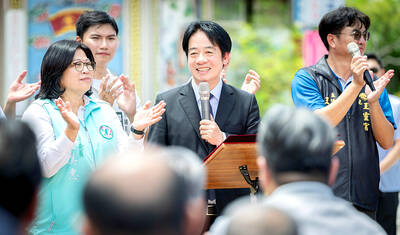
SIX SUBSIDIES: The monthly allowance for older farmers is to increase to NT$10,000, and NT$5,000 is to be given to homemakers under the national pension system, Lai said The government is to implement major welfare policies for disadvantaged groups, including raising the monthly allowance for older farmers to NT$10,000 and providing homemakers with NT$5,000 per month, President William Lai (賴清德) said yesterday. Lai made the remarks during a visit to Wangling Temple in Chiayi County, saying that the planned increases were being introduced amid economic growth and an increase in tax revenue. Touting a policy, in which the government plans to provide a monthly allowance of NT$5,000 for every child under the age of 18 in a bid to address Taiwan’s low birthrate, Lai said that if received for the


 RSS
RSS