


The legislature’s Internal Administration Committee passed the first reading of a proposed amendment to the Social Order Maintenance Act (社會秩序維護法) increasing penalties for ticket scalping.
The proposed amendment would increase the fine from NT$18,000 to NT$30,000 for those who buy transportation or entertainment tickets without intending to use them and instead resell them for profit.
Minister of the Interior Liu Shyh-fang (劉世芳) and National Police Agency Director-General Chang Jung-hsin (張榮興) both attended the legislative committee meeting.
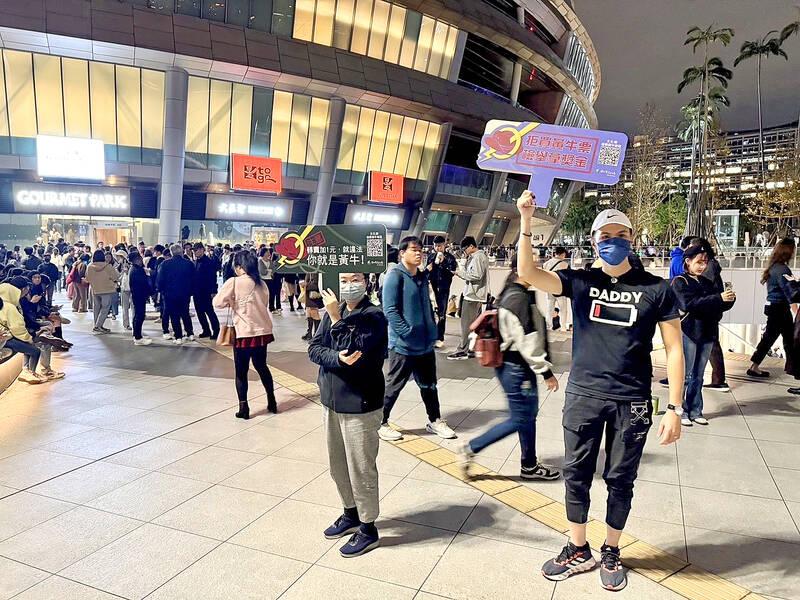
Photo courtesy of the Taipei Department of Cultural Affairs
Independent Legislator May Chin (高金素梅) and Chinese Nationalist Party (KMT) legislators Lo Ting-wei (羅廷瑋), Wang Hung-wei (王鴻薇) and Lin Szu-ming (林思銘), and other lawmakers proposed expanding the definition of “ticket scalping” to cover medical services, hospitality, leisure and merchandise.
Some of the categories proposed by lawmakers are already covered by the Development of the Cultural and Creative Industries Act (文化創意產業發展法) and the Sports Industry Development Act (運動產業發展條例), Liu said.
The Ministry of Health and Welfare and Ministry of Transportation and Communications should each draft specific laws to avoid giving police an overly broad task, she said.
Listing all the different types of tickets banned from scalping in one law could result in some of them being missed, she added.
The committee also passed a resolution clarifying that the Social Order Maintenance Act addresses minor contraventions, but scalpers who obtain substantial profits and harm consumer interests would face criminal penalties.
The resolution said that authorities should address scalping issues and propose legal revisions within two months.
The committee also approved two other proposed amendments to the act.
One would raise the maximum fine for noise disturbances at night to NT$10,000 from NT$6,000.
The other would raise the penalty for following someone and continuing to do so after being told to stop from NT$3,000 to NT$30,000 to address stalking and harassment incidents.

FUKUOKA SITUATION: Japanese media reported that the pathogen is expected to be identified by the summer, while the CDC downplayed the idea that it was hMPV A “mysterious cold-like illness” reported in Japan’s Fukuoka Prefecture does not seem to be a new disease, but Japanese authorities have been asked about the situation, the Centers for Disease Control (CDC) said yesterday. The Fukuoka Prefectural Medical Association on Wednesday told a news conference that a “mystery cold” that has become a hot topic on social media is “highly likely to be caused by some kind of viral infection,” Japan’s KBC News reported. “Many people are experiencing symptoms starting with a sore throat, followed by a runny nose, phlegm and a severe cough,” KBC News reported, citing association officials. Health authorities are

Nvidia Corp CEO Jensen Huang (黃仁勳) arrived in Taiwan yesterday ahead of upcoming AI and technology events, saying he plans to meet with clients and Taiwan Semiconductor Manufacturing Co Chairman C.C. Wei (魏哲家) during his visit. After landing at Taipei Songshan Airport, Huang posed for photos with fans and handed out Yakult drinks to reporters and supporters waiting at the scene, saying he has “a lot to do” during the trip. Asked about reports that Nvidia’s planned headquarters site in Taipei’s Beitou Shilin Technology Park could break ground on May 27, Huang said that if the company holds an event, he would

The Ministry of Finance this afternoon announced the winning numbers for the March-April uniform invoice lottery. The winning number for the NT$10 million (US$318,060) special prize is 19531471, and the winning number for the NT$2 million grand prize is 85941329. Three numbers were drawn for the NT$200,000 first prize: 07225810, 20231230 and 83518781. Those with receipts matching the last seven digits of any of the first-prize numbers will win the NT$40,000 second prize, while those matching the last six digits will win the NT$10,000 third prize. Those whose receipts match the last five digits of the first-prize numbers can claim the NT$4,000 fourth prize,

SIX SUBSIDIES: The monthly allowance for older farmers is to increase to NT$10,000, and NT$5,000 is to be given to homemakers under the national pension system, Lai said The government is to implement major welfare policies for disadvantaged groups, including raising the monthly allowance for older farmers to NT$10,000 and providing homemakers with NT$5,000 per month, President William Lai (賴清德) said yesterday. Lai made the remarks during a visit to Wangling Temple in Chiayi County, saying that the planned increases were being introduced amid economic growth and an increase in tax revenue. Touting a policy, in which the government plans to provide a monthly allowance of NT$5,000 for every child under the age of 18 in a bid to address Taiwan’s low birthrate, Lai said that if received for the


 RSS
RSS