


The air force yesterday said it was investigating the accidental firing of a flare from one of its Indigenous Defense Fighter (IDF) jets, also known as the AIDC F-CK-1 Ching Kuo, on Wednesday.
There were no injuries or damages, and an investigation has been launched to determine the cause of the accident, the air force said.
The flares, usually used to protect jets against incoming guided missiles, were released in flight, sources said.
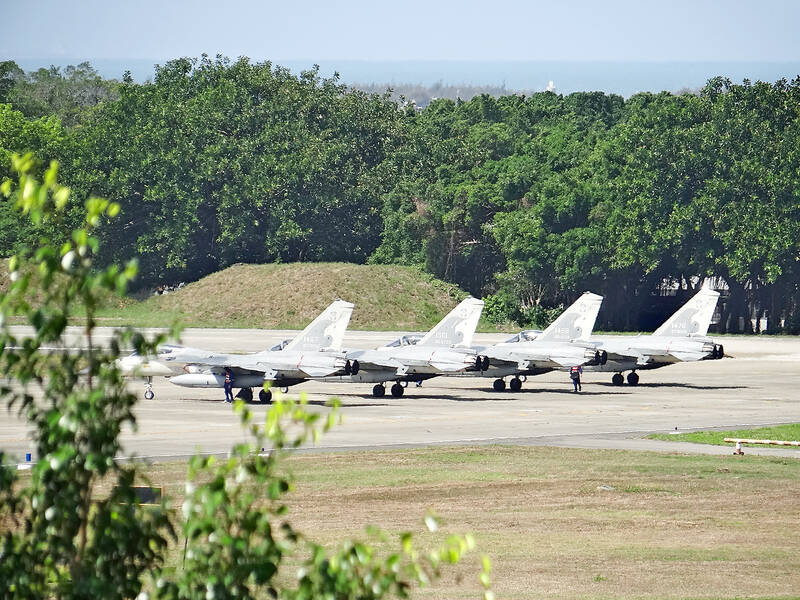
Photo: Taipei Times
Over the past few years, there have been several safety incidents in the air force.
In August 2023, during a flight demonstration exercise, strange flames emerged from an IDF jet’s nozzle. At the time, the air force said that normal engine flames escaped through a gap in the nozzle’s seals.
In September last year, a Dassault Mirage 2000 fighter jet crashed in a training exercise over waters off Hsinchu County.
In January, a master sergeant died after being sucked into an IDF jet engine, and in February, one aircraft crashed due to double engine failure.
In addition to a landing accident involving an IDF jet in Penghu County and an emergency ejection from a Mirage 2000 fighter in Taichung, there are reports that the air force has grounded all training flights for its main fleet while it investigates the cause of the incidents.
In other news, the Ministry of National Defense yesterday said that a large number of Chinese military aircraft were detected near Taiwan on Wednesday during China’s “joint combat readiness patrol” drill.
Twenty of the 34 aircraft detected were taking part in the drill, which involved the Chinese People’s Liberation Army’s (PLA) air force and navy, the ministry said.
Sixteen of the aircraft crossed the median line of the Taiwan Strait, while 11 crossed its extension, it added.
The Chinese warplane activity was detected between 6am and 7:20pm, and eight Chinese military vessels and one other ship were detected in the 24-hour period starting at 6am, the ministry said.
The ministry said it has been closely monitoring the situation, and deployed combat air patrol aircraft and coastal missile systems in response to the threats.
The PLA has held 14 joint combat readiness patrol drills this year, including three last month, ministry data showed.
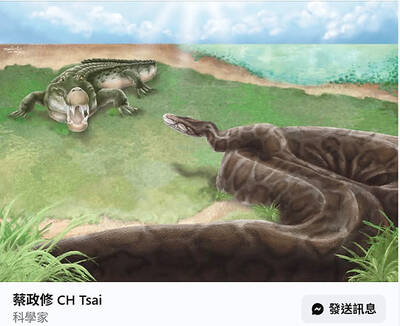
Taiwanese paleontologists have discovered fossil evidence that pythons up to 4m long inhabited Taiwan during the Pleistocene epoch, reporting their findings in the international scientific journal Historical Biology. National Taiwan University (NTU) Institute of Ecology and Evolutionary Biology associate professor Tsai Cheng-hsiu (蔡政修) led the team that discovered the largest snake fossil ever found in Taiwan. The single trunk vertebra was discovered in Tainan at the Chiting Formation, dated to between 400,000 and 800,000 years ago in the Middle Pleistocene, the paper said. The area also produced Taiwan’s first avian fossil, as well as crocodile, mammoth, saber-toothed cat and rhinoceros fossils, it said. Discoveries

Taiwanese paleontologists have discovered fossil evidence that pythons up to 4m long inhabited Taiwan during the Pleistocene epoch, reporting their findings in the international scientific journal Historical Biology. National Taiwan University (NTU) Institute of Ecology and Evolutionary Biology associate professor Tsai Cheng-hsiu (蔡政修) led the team that discovered the largest snake fossil ever found in Taiwan. A single trunk vertebra was discovered in Tainan at the Chiting Formation, dated to between 800,000 to 400,000 years ago in the Middle Pleistocene, the paper said. The area also produced Taiwan’s first avian fossil, as well as crocodile, mammoth, sabre-toothed cat and rhinoceros fossils, it said. Discoveries

Whether Japan would help defend Taiwan in case of a cross-strait conflict would depend on the US and the extent to which Japan would be allowed to act under the US-Japan Security Treaty, former Japanese minister of defense Satoshi Morimoto said. As China has not given up on the idea of invading Taiwan by force, to what extent Japan could support US military action would hinge on Washington’s intention and its negotiation with Tokyo, Morimoto said in an interview with the Liberty Times (sister paper of the Taipei Times) yesterday. There has to be sufficient mutual recognition of how Japan could provide
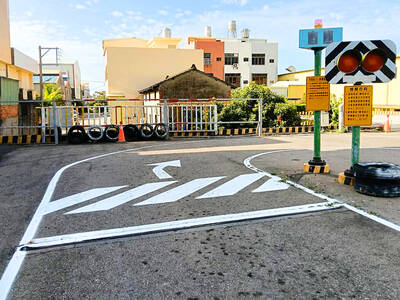
UPDATED TEST: The new rules aim to assess drivers’ awareness of risky behaviors and how they respond under certain circumstances, the Highway Bureau said Driver’s license applicants who fail to yield to pedestrians at intersections or to check blind spots, or omit pointing-and-calling procedures would fail the driving test, the Highway Bureau said yesterday. The change is set to be implemented at the end of the month, and is part of the bureau’s reform of the driving portion of the test, which has been criticized for failing to assess whether drivers can operate vehicles safely. Sedan drivers would be tested regarding yielding to pedestrians and turning their heads to check blind spots, while drivers of large vehicles would be tested on their familiarity with pointing-and-calling


 RSS
RSS