


Up-to-date testing protocols for car safety seat certification should be implemented, Democratic Progressive Party (DPP) lawmakers, a child safety group and industry representatives said yesterday.
Last year, 1,395 Taiwanese children died in car crashes, up 34 percent from child fatalities in 2020, Jing Chuang Child Safety Foundation executive director Hsu Ya-jen (許雅荏) told a news conference in Taipei, citing a government-run Web site at roadsafety.tw/.
The annual number of children killed in car crashes has increased for four consecutive years, she said, adding that car seat safety was a key factor in preventing deaths and serious injuries.
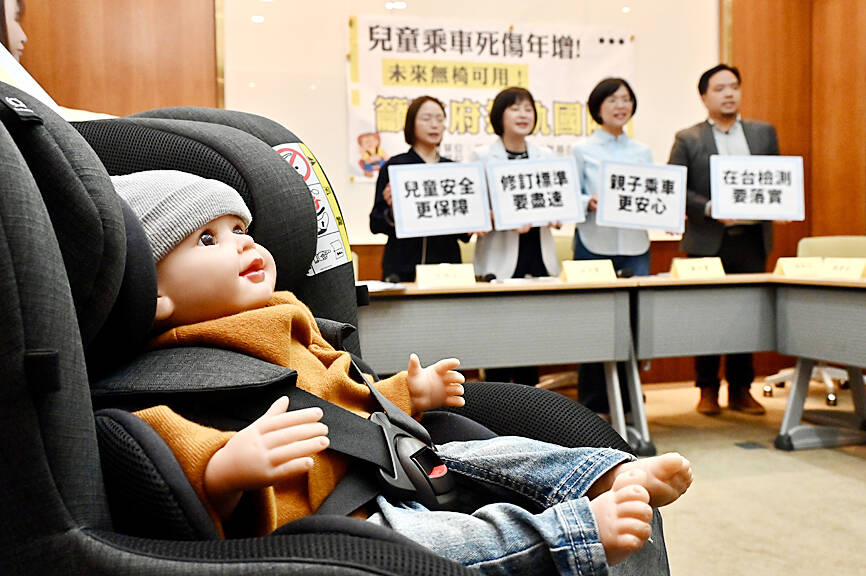
Photo: George Tsorng, Taipei Times
Taiwan uses the outdated ECE R44 regulations for car seat safety, which had been phased out in the EU since the bloc introduced the ECE R124 regulations in 2013, she said.
The old standard stipulated that the design of children’s safety seats should focus on the intended user’s age and weight instead of size, and it lacked tests for side collisions, while testing products on crash dummies capable of simulating only injuries to the head and sternum, Hsu said.
The ECE R124 regulations are based on body size to reflect actual safety needs, test safety in different types of collisions and use dummies also capable of simulating injuries to the neck and abdomen, she said.
Production of ECE R44-compliant seats have ceased altogether, meaning Taiwan would soon run out of import sources should the nation fail to amend its safety standards, she said.
The Ministry of Economic Affairs should update car seat safety standards and reduce dependency on third parties by establishing a domestic testing capability, DPP Legislator Lin Yueh-chin (林月琴) said.
The nation might require separate testing protocols better anticipating local conditions, she said.
Taiwan Toy and Children’s Articles Manufacturers Association deputy chairman Kuo Shih-chieh (郭時杰) said a failure to update safety standards would disrupt the industry’s ability to import or export products.
Regulators should introduce domestic legal standards equivalent to ECE R124 and upgrade safety test labs to protect children and the competitiveness of the industry, he said.

FUKUOKA SITUATION: Japanese media reported that the pathogen is expected to be identified by the summer, while the CDC downplayed the idea that it was hMPV A “mysterious cold-like illness” reported in Japan’s Fukuoka Prefecture does not seem to be a new disease, but Japanese authorities have been asked about the situation, the Centers for Disease Control (CDC) said yesterday. The Fukuoka Prefectural Medical Association on Wednesday told a news conference that a “mystery cold” that has become a hot topic on social media is “highly likely to be caused by some kind of viral infection,” Japan’s KBC News reported. “Many people are experiencing symptoms starting with a sore throat, followed by a runny nose, phlegm and a severe cough,” KBC News reported, citing association officials. Health authorities are

Nvidia Corp CEO Jensen Huang (黃仁勳) arrived in Taiwan yesterday ahead of upcoming AI and technology events, saying he plans to meet with clients and Taiwan Semiconductor Manufacturing Co Chairman C.C. Wei (魏哲家) during his visit. After landing at Taipei Songshan Airport, Huang posed for photos with fans and handed out Yakult drinks to reporters and supporters waiting at the scene, saying he has “a lot to do” during the trip. Asked about reports that Nvidia’s planned headquarters site in Taipei’s Beitou Shilin Technology Park could break ground on May 27, Huang said that if the company holds an event, he would

The Ministry of Finance this afternoon announced the winning numbers for the March-April uniform invoice lottery. The winning number for the NT$10 million (US$318,060) special prize is 19531471, and the winning number for the NT$2 million grand prize is 85941329. Three numbers were drawn for the NT$200,000 first prize: 07225810, 20231230 and 83518781. Those with receipts matching the last seven digits of any of the first-prize numbers will win the NT$40,000 second prize, while those matching the last six digits will win the NT$10,000 third prize. Those whose receipts match the last five digits of the first-prize numbers can claim the NT$4,000 fourth prize,

SIX SUBSIDIES: The monthly allowance for older farmers is to increase to NT$10,000, and NT$5,000 is to be given to homemakers under the national pension system, Lai said The government is to implement major welfare policies for disadvantaged groups, including raising the monthly allowance for older farmers to NT$10,000 and providing homemakers with NT$5,000 per month, President William Lai (賴清德) said yesterday. Lai made the remarks during a visit to Wangling Temple in Chiayi County, saying that the planned increases were being introduced amid economic growth and an increase in tax revenue. Touting a policy, in which the government plans to provide a monthly allowance of NT$5,000 for every child under the age of 18 in a bid to address Taiwan’s low birthrate, Lai said that if received for the


 RSS
RSS