


Labor rights groups would make seven key demands — including a call for a four-day workweek and additional public holidays — during a Labor Day march in Taipei on Thursday next week, the groups said on Monday.
The Labor Day 51 Alliance, a coalition of dozens of Taiwanese labor unions and non-governmental organizations, said the march would begin on Ketagalan Boulevard in front of the Presidential Office Building, proceed along Zhongxiao W Road and Zhongshan S Road, before returning to the boulevard.
The alliance expects up to 5,000 participants and said the demonstration would focus on improving working conditions, with one core demand aimed at reducing the amount of time people in Taiwan work.
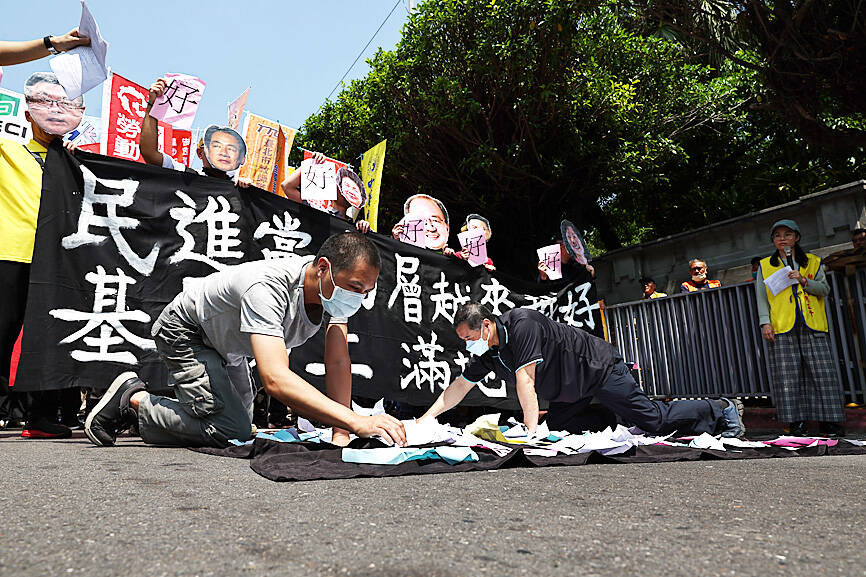
Photo: CNA
The alliance would call for amendments to the Labor Standards Act (勞動基準法) to grant workers more special leave days and gradually transition to a three-day weekend model, it said.
It would also push for Labor Day to be officially recognized as a national holiday, said Tai Kuo-jung (戴國榮), president of the Taiwan Confederation of Trade Unions and chief organizer of the rally.
Another key demand is the elimination of workplace bullying, Tai said.
The alliance would also propose expanding provisions under the Occupational Safety and Health Act (職業安全衛生法) to ensure protections against bullying apply to private-sector employees and civil servants, he said.
It would also propose that workplace bullying cases be handled jointly by an impartial third party and labor representatives to ensure fairness, he added.
The alliance would also call for legal safeguards to prevent employers from retaliating against employees who file complaints or those identified as victims, Tai said.
Another key demand is to raise the minimum employer contribution to workers’ labor pension accounts under the new pension scheme. The alliance is calling for an increase in the mandatory monthly contribution — currently set at no less than 6 percent of an employee’s wages — to provide greater retirement security for workers, Tai said.
It would also urge the removal of the 45-month cap on lump-sum pension payment calculations under the old pension system, Tai said.
Wages would be another key focus, he said.
The group plans to call for an increase in the minimum monthly wage from NT$28,590 to NT$32,000, and for the hourly minimum wage to rise from NT$190 to NT$210, citing rising inflation and cost of living pressures.
To strengthen labor protections, the alliance would advocate for more effective mechanisms for negotiations between employees and employers, and for lowering the threshold required to establish labor unions, he said.
The alliance would also highlight the need to safeguard employment rights for workers in high-emission industries as they undergo low-carbon transitions, he added.
he alliance would call on the government to address severe staff shortages in critical sectors such as healthcare, education, nursing and childcare, Tai said.

UPGRADE: The Kang Ding-class frigate is replacing its Chaparall missiles with Tien Chien II and Hua Yang VLS, which would provide it with long-range, 360° air defense Taiwan plans to produce 1,200 to 1,376 Hai Chien II missiles (海劍二, Sea Sword II) — also known as TC-2N — to serve as the standard air defense system of the navy’s surface combatant fleet, a source said yesterday. Last week, the Hai Chien II, the naval version of the Tien Kung II missile (天劍二, Sky Sword II), completed a live-fire test in waters off the National Chungshan Institute of Science and Technology’s Jiupeng facility (九鵬) in Pingtung County’s Manjhou Township (滿州). The MIM72 Chaparral and other dated air defense missiles that currently arm Taiwanese ships have inadequate range to combat Chinese

REASONS FOR TRAVEL: An assistant professor said that proposed amendments to penalize drivers if they used drugs overseas would not deter people from traveling People who operate a motor vehicle under the influence of marijuana would have their driver’s license revoked, even if they used the substance while overseas, the Ministry of Transportation and Communications said yesterday, citing proposed amendments to the Road Traffic Management and Penalty Act (道路交通管理處罰條例). The amendments would also authorize the government to revoke the licenses of people determined to have used Category 1 or Category 2 narcotics, even if they were not operating a vehicle while under the influence of drugs, as well as ban them from taking the license test for three years, the ministry said. People aged 18 or

HEAVY WEATHER: Typhoon Jangmi is due to crash straight into the Ryukyus as airlines look to shift flights to larger aircraft or cancel flights to Okinawa entirely Taiwan’s international air carriers announced flight adjustments over the weekend as Typhoon Jangmi is forecast to hit the Ryukyu Islands today and tomorrow. The Central Weather Administration (CWA) upgraded Jangmi from a tropical storm to a typhoon at 8am yesterday, with the eye located 580km south of Naha city. It was moving north at 19kph. Today, China Airlines’ CI-120, CI-121, CI-122 and CI-123 flights between Taoyuan and Naha, Okinawa, have been canceled as well as CI-132 and CI-133 between Kaohsiung and Naha. EVA Air’s BR-112, BR-113, BR-186 and BR-185 flights between Taoyuan and Naha are also canceled. Low-cost carrier Tigerair Taiwan canceled IT-230,

Johanne Liou (劉喬安), a Taiwanese woman who shot to unwanted fame during the Sunflower movement protests in 2014, returned to Taiwan last night after being deported from the US. She is to stand trial in Taiwan for charges involving embezzlement, fraud and drug crimes. The Criminal Investigation Bureau (CIB) said it took her into custody at Taiwan Taoyuan International Airport and would first question her before transferring her to the New Taipei District Prosecutors’ Office. She was arrested upon disembarking a flight from San Francisco that landed shortly before 7pm. Liou absconded to the US in 2019 after jumping bail


 RSS
RSS