


A civil society group advocating for the decriminalization of cannabis on Saturday held a rally outside the Legislative Yuan in Taipei calling on the government to end its “war” on marijuana.
At the “2025 Green Sensation” event, the Taiwan Weed Safety Education Association urged lawmakers and President William Lai (賴清德) to eliminate discriminatory policies against the use of marijuana, the association’s promotional materials said.
It also called on the government to ease limits on tetrahydrocannabinol (THC), align cannabis policy with international norms and remove marijuana from government anti-drug campaigns.
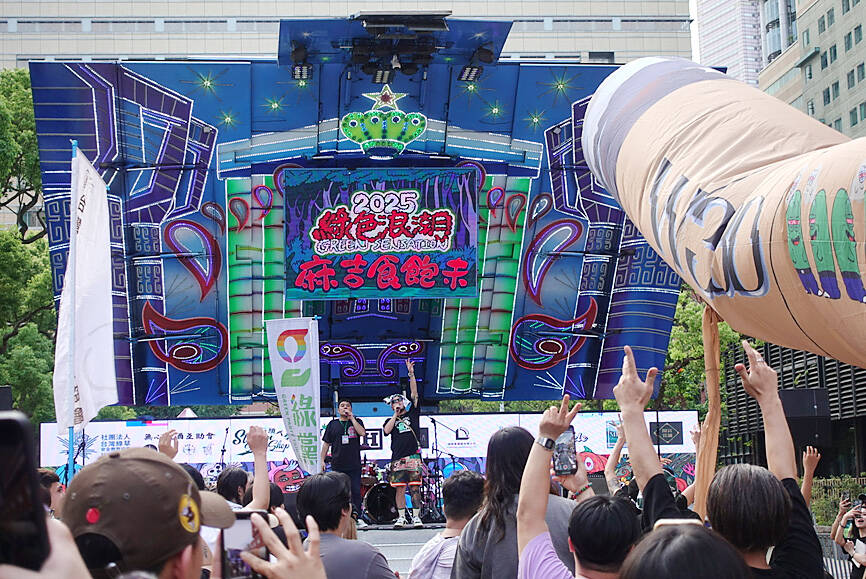
Photo: CNA
The event featured performances by the jazz band Soul Heist (盜魂) and the rock band Chillsome (秋山), as well as a march.
“There are still many misunderstandings about marijuana among the general public in Taiwan,” a volunteer in his 20s surnamed Wu (吳) said, adding that he hoped the event would encourage more people to pay attention to the issue.
The same day, the Ministry of Justice reiterated that cannabis remains illegal to possess or use, and warned that such offenses would be prosecuted as serious crimes.
Cannabis contains more than 65 chemical compounds, including THC and cannabidiol (CBD), which are classified as Category II narcotics under the Narcotics Hazard Prevention Act (毒品危害防制條例), the Ministry of Justice Investigation Bureau said.
THC affects the central nervous system and can lead to physical dependence and mental illness, although CBD may be legally used for medical purposes under the Pharmaceutical Affairs Act (藥事法), it said.
Any product containing more than 10 parts per million of THC qualifies as a Category II narcotic under the Narcotics Hazard Prevention Act and the Controlled Drugs Act (管制藥品管理條例), unless approved for medical or scientific use, Food and Drug Administration Deputy Director-General Wang Der-yuan (王德原) said.
Under the Narcotics Hazard Prevention Act, a person convicted of using a Category II narcotics, such as cannabis, may be sentenced to up to three years in prison, while those convicted of possession may be imprisoned for up to two years.

SECURITY: Starlink owner Elon Musk has taken pro-Beijing positions, and allowing pro-China companies to control Taiwan’s critical infrastructure is risky, a legislator said Starlink was reluctant to offer services in Taiwan because of the nation’s extremely high penetration rates in 4G and 5G services, the Ministry of Digital Affairs said yesterday. The ministry made the comments at a meeting of the legislature’s Transportation Committee, which reviewed amendments to Article 36 of the Telecommunications Management Act (電信管理法). Article 36 bans foreigners from holding more than 49 percent of shares in public telecommunications networks, while shares foreigners directly and indirectly hold are also capped at 60 percent of the total, unless specified otherwise by law. The amendments, sponsored by Chinese Nationalist Party (KMT) Legislator Ko
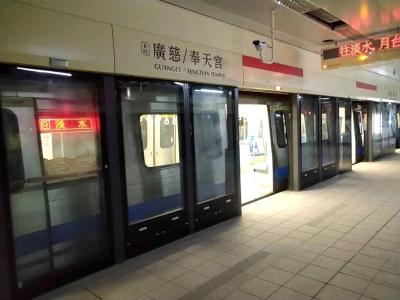
The eastern extension of the Taipei MRT Red Line could begin operations as early as late June, the Taipei Department of Rapid Transit Systems said yesterday. Taipei Rapid Transit Corp said it is considering offering one month of free rides on the new section to mark its opening. Construction progress on the 1.4km extension, which is to run from the current terminal Xiangshan Station to a new eastern terminal, Guangci/Fengtian Temple Station, was 90.6 percent complete by the end of last month, the department said in a report to the Taipei City Council's Transportation Committee. While construction began in October 2016 with an
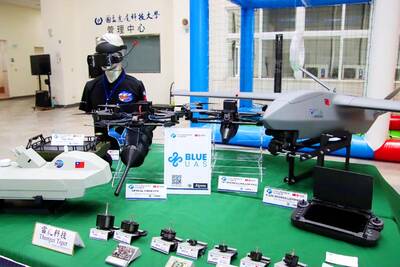
NON-RED SUPPLY: Boosting the nation’s drone industry is becoming increasingly urgent as China’s UAV dominance could become an issue in a crisis, an analyst said Taiwan’s drone exports to Europe grew 41.7-fold from 2024 to last year, with demand from Ukraine’s fight against Russian aggression the most likely driver of growth, a study showed. The Institute for Democracy, Society and Emerging Technology (DSET) in a statement on Wednesday said it found that many of Taiwan’s uncrewed aerial vehicle (UAV) sales were from Poland and the Czech Republic. These countries likely transferred the drones to Ukraine to aid it in its fight against the Russian invasion that started in 2022, it said. Despite the gains, Taiwan is not the dominant drone exporter to these markets, ranking second and fourth
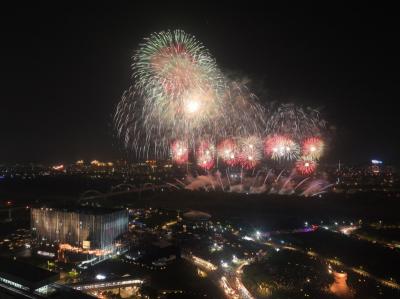
The New Taipei City Art Museum this weekend plans to celebrate its first anniversary with a two-day extravaganza featuring live concerts and a large-scale synchronized fireworks and drone display, the New Taipei City Cultural Affairs Department said. The two-day celebrations are to take place in the museum’s outdoor park, with markets and live performances by singers including Ann Bai (白安), Bii (畢書盡) and the Cosmos People (宇宙人), the department said. The highlight on both evenings would be the "Echoes of Light" show, an aerial spectacle combining fireworks and drone performances designed around the concept of "dual stages in the sky," it


 RSS
RSS