


The Executive Yuan yesterday approved a plan to boost healthcare for 5.35 million Taiwanese with cardiovascular disease and diabetes.
Heart strokes, brain strokes, diabetes and other forms of chronic or acute kidney failure account for 62,000 deaths in Taiwan per year, or 30 percent of the total, the Ministry of Health and Welfare told a news conference.
Medical costs for treating these chronic illnesses cost the National Health Insurance NT$170 billion (US$5.23 billion) on average a year, a fiscal burden that would only increase with the graying of the population, it said.
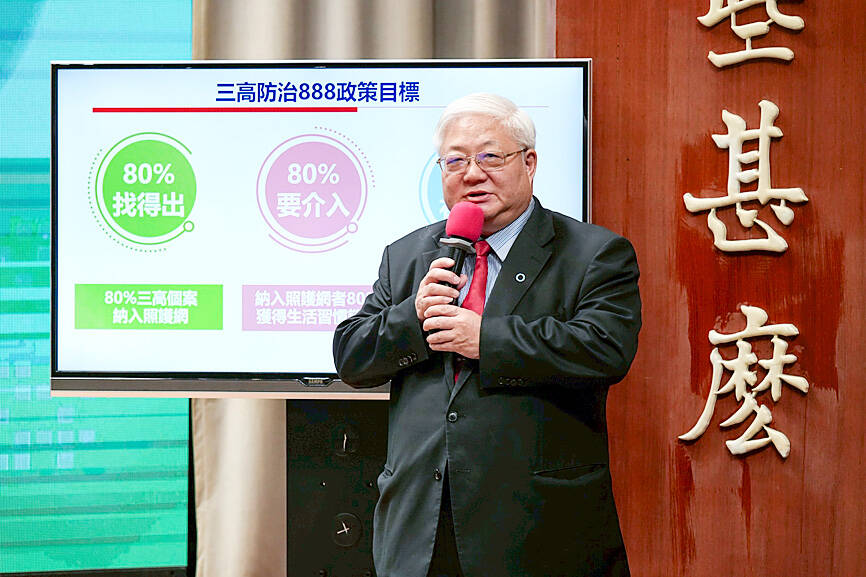
Photo courtesy of the Executive Yuan
Citing demographic data, the ministry said that, as of last month, 4.45 million Taiwanese were older than 65 years old, making up 19.4 percent of the total population.
Under President William Lai’s (賴清德) directive, the Cabinet authorized an initiative to improve preventive health programs to screen people for high blood pressure, cholesterol and sugar levels, or the “three highs.”
Dubbed the “888 Program,” the eight-year initiative aims to place 80 percent of Taiwanese with these health conditions into a preventive care system and provide them with lifestyle counseling, helping to make at least 80 percent of the subjects healthier, it said.
People with cardiovascular problems, diabetes and related conditions would be directed to receive specialized care at larger hospitals that would provide treatment and a comprehensive evaluation of their lifestyle, it said.
Large hospitals would create digital platforms to help doctors track their progress through the sharing of medical records, it said.
The public is urged to eat healthy, exercise more, avoid alcohol and nicotine use, and not delay health checkups to ensure conditions are diagnosed early, the ministry said.
People are encouraged to use free checkups funded by the government through their place of employment in the public or private sector, as well as preventive health screening services, the ministry said.
People who take part in the screenings are encouraged to upload the results to the My Health Bank portal, myhealthbank.nhi.gov.tw, the ministry said.
The portal provides resources to link members of the public with the medical services they need, it added.
Taiwanese aged 30 to 39 are entitled to a subsidized blood check once every three years, a policy that began in January and which is expected to benefit 3.2 million people.
Taiwanese found to have elevated blood pressure, lipids or sugar levels, but have not yet been diagnosed as having hypertension, hyperlipidemia or diabetes should consult government-supported clinics specializing in metabolic syndromes, it said.
An estimated 5,000 doctors and 3,000 clinics have joined the government initiative to improve the health of people who are at risk of developing these conditions, the ministry said.

SECURITY: Starlink owner Elon Musk has taken pro-Beijing positions, and allowing pro-China companies to control Taiwan’s critical infrastructure is risky, a legislator said Starlink was reluctant to offer services in Taiwan because of the nation’s extremely high penetration rates in 4G and 5G services, the Ministry of Digital Affairs said yesterday. The ministry made the comments at a meeting of the legislature’s Transportation Committee, which reviewed amendments to Article 36 of the Telecommunications Management Act (電信管理法). Article 36 bans foreigners from holding more than 49 percent of shares in public telecommunications networks, while shares foreigners directly and indirectly hold are also capped at 60 percent of the total, unless specified otherwise by law. The amendments, sponsored by Chinese Nationalist Party (KMT) Legislator Ko

The military has spotted two Chinese warships operating in waters near Penghu County in the Taiwan Strait and sent its own naval and air forces to monitor the vessels, the Ministry of National Defense (MND) said. Beijing sends warships and warplanes into the waters and skies around Taiwan on an almost daily basis, drawing condemnation from Taipei. While the ministry offers daily updates on the locations of Chinese military aircraft, it only rarely gives details of where Chinese warships are operating, generally only when it detects aircraft carriers, as happened last week. A Chinese destroyer and a frigate entered waters to the southwest

The eastern extension of the Taipei MRT Red Line could begin operations as early as late June, the Taipei Department of Rapid Transit Systems said yesterday. Taipei Rapid Transit Corp said it is considering offering one month of free rides on the new section to mark its opening. Construction progress on the 1.4km extension, which is to run from the current terminal Xiangshan Station to a new eastern terminal, Guangci/Fengtian Temple Station, was 90.6 percent complete by the end of last month, the department said in a report to the Taipei City Council's Transportation Committee. While construction began in October 2016 with an
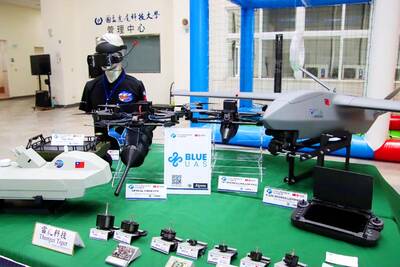
NON-RED SUPPLY: Boosting the nation’s drone industry is becoming increasingly urgent as China’s UAV dominance could become an issue in a crisis, an analyst said Taiwan’s drone exports to Europe grew 41.7-fold from 2024 to last year, with demand from Ukraine’s fight against Russian aggression the most likely driver of growth, a study showed. The Institute for Democracy, Society and Emerging Technology (DSET) in a statement on Wednesday said it found that many of Taiwan’s uncrewed aerial vehicle (UAV) sales were from Poland and the Czech Republic. These countries likely transferred the drones to Ukraine to aid it in its fight against the Russian invasion that started in 2022, it said. Despite the gains, Taiwan is not the dominant drone exporter to these markets, ranking second and fourth


 RSS
RSS