


A couple from the air force was found guilty of espionage and handed jail sentences following a retrial at the High Court’s Kaohsiung branch yesterday.
Sun Wei (孫緯) and his wife, Liu Yun-ya (劉芸雅), were found guilty of four counts of contravening the Criminal Code of the Armed Forces, including passing classified military information to Chinese intelligence.
Sun and Liu were sentenced to 47 years and 57 years in prison respectively.

Photo: EPA
The ruling can be appealed.
The retrial came after the Supreme Court in June last year found their original sentences to be flawed.
Sun and his wife were initially given jail terms of 19 years and six months, and 20 years and six months respectively.
An investigation found that the couple was connected to a case involving retired air force colonel Liu Sheng-shu (劉聖恕), who operated a spy network.
Liu Sheng-shu had begun doing business in China after retiring in 2013, and was recruited by Chinese intelligence officers to become a spy and get active military officers to engage in espionage activities in exchange for money.
He recruited six officers, including Sun and his wife, and received payments of between NT$200,000 and NT$700,000 from China through a shell company he set up for each person he recruited.
Liu Sheng-shu was also given bonuses of between NT$30,000 and NT$100,000 when his handlers passed on classified information on the Taiwanese military.
Liu Sheng-shu and the six other officers were arrested and indicted by prosecutors in April 2023.
Following subsequent rulings and appeals, the Supreme Court in June last year upheld most of the defendants’ sentences, except for Sun and his wife. Their cases were sent back to the High Court for retrial.
The Control Yuan censured the Ministry of National Defense over its handling of the incident.
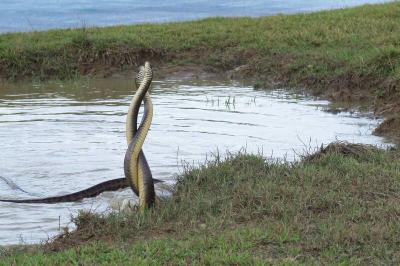
Kenting National Park service technician Yang Jien-fon (楊政峰) won a silver award in World Grand Prix Photography Awards Spring Season for his photograph of two male rat snakes intertwined in combat. Yang’s colleagues at Kenting National Park said he is a master of nature photography who has been held back by his job in civil service. The awards accept entries in all four seasons across six categories: architectural and urban photography, black-and-white and fine art photography, commercial and fashion photography, documentary and people photography, nature and experimental photography, and mobile photography. Awards are ranked according to scores and divided into platinum, gold and

SPACE VETERAN: Kjell N. Lindgren, who helps lead NASA’s human spaceflight missions, has been on two expeditions on the ISS and has spent 311 days in space Taiwan-born US astronaut Kjell N. Lindgren is to visit Taiwan to promote technological partnerships through one of the programs organized by the US for its 250th national anniversary. Lindgren would be in Taiwan from Tuesday to Saturday next week as part of the US Bureau of Educational and Cultural Affairs’ US Speaker Program, organized to celebrate the 250th anniversary of the signing of the Declaration of Independence, the American Institute in Taiwan (AIT) said in a statement yesterday. Lindgren plans to engage with key leaders across the nation “to advance cutting-edge technological partnerships and inspire the next generation of scientists and engineers,”

The Chinese Nationalist Party (KMT) caucus yesterday said it opposes the introduction of migrant workers from India until a mechanism is in place to prevent workers from absconding. Minister of Labor Hung Sun-han (洪申翰) on Thursday told the Legislative Yuan that the first group of migrant workers from India could be introduced as early as this year, as part of a government program. The caucus’ opposition to the policy is based on the assessment that “the risk is too high,” KMT caucus secretary-general Lin Pei-hsiang (林沛祥) said. Taiwan has a serious and long-standing problem of migrant workers absconding from their contracts, indicating that

TRADE-OFF: Beijing seeks to trade a bowl of tempura for a Chinese delicacy, an official said, while another said its promises were attempts to interfere in the polls The government must carefully consider the national security implications of building a bridge connecting Kinmen County and Xiamen, China, the Public Construction Commission (PCC) said yesterday. PCC Commissioner Derek Chen (陳金德), who is also a minister without portfolio, made the remarks in a meeting of the legislature’s Transportation Committee, after Democratic Progressive Party Legislator Hsu Fu-kuei (徐富癸) asked about China’s proposal of new infrastructure projects to further connect Kinmen and Lienchiang (Matsu) counties with Xiamen. China unveiled the bridge plan, along with nine other policies for Taiwan, on Sunday, the last day of Chinese Nationalist Party (KMT) Chairwoman Cheng Li-wun’s (鄭麗文) visit


 RSS
RSS