


The US is willing to discuss tariffs with Taiwan and has asked Taipei to provide more information on the issue, Minister of Foreign Affairs Lin Chia-lung (林佳龍) said yesterday.
The US on Wednesday last week announced “reciprocal” tariffs against multiple nations worldwide, including a 32 percent tax on Taiwanese goods.
Per the instructions of President William Lai (賴清德), a negotiation task force has reached out to the US regarding tariff negotiations, and Washington has responded affirmatively, stating that Taiwan is on the list for future tariff negotiations.
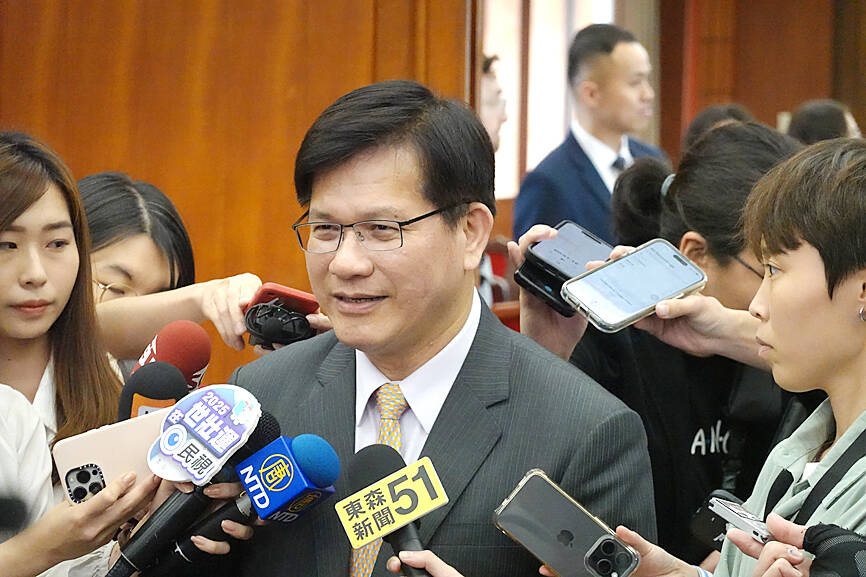
Photo: Fang Wei-li, Taipei Times
The US has requested additional information that the Taiwanese government is willing and is in the process of providing, Lin said, adding that the date for negotiations has not yet been confirmed.
The meeting with the US will not just be about tariffs, but will also touch on the issue of Taiwanese investments and purchases of US natural gas in Alaska, as mentioned by US Secretary of the Treasury Scott Bessent, Lin added.
Lin was referring to a report by Bloomberg report in which Bessent said: “We will see what our trading partners offer… For instance, there is talk of a big energy deal in Alaska where the Japanese and perhaps the [South] Koreans, perhaps the Taiwanese, would provide — would take a lot of the offtake.”
The Executive Yuan has made a list of industries in which the US would like to see increased Taiwanese investment and purchases, Lin said, adding that the government is discussing how to decrease tariffs, or resolve non-tariff trade barriers, on vehicles, pharmaceuticals and agricultural produce, Lin said.
Asked if he would accompany the task force, Lin said that Deputy Minister of Foreign Affairs Chen Ming-chi (陳明祺) is cochair of the Executive Yuan’s US-Taiwan Financial and Commerce Taskforce and would assist Minister Without Portfolio Yang Jen-ni(楊珍妮), who is the head of the Executive Yuan’s Office of Trade Negotiations, on the talks.
The president has also appointed Vice Premier Cheng Li-chun (鄭麗君) to oversee the talks, Lin said.
Meanwhile, the Ministry of Foreign Affairs yesterday said it is to lead a group of businesses to a US investment summit next month.
The Legislative Yuan has invited Cabinet ministers, trade officials and the central bank to report today on diplomatic and trade responses to US tariffs and competition with China.
In a written report submitted to lawmakers yesterday, the ministry said that in response to the US’ 32 percent tariffs, it is “working with relevant ministries to promote relevant contingencies.”
Primarily, the government is aiming to purchase more from the US to reduce the trade deficit, including major procurement of agricultural and manufactured goods, oil and natural gas, the report said.
It is also looking to expand investments in the US to deepen Taiwan-US trade cooperation and enhance Taiwan’s strategic position, it said.
To this end, the ministry and relevant agencies are to assist businesses in attending the SelectUSA Investment Summit organized by the US Department of Commerce to help them better understand the investment environment in the US.
According to its official Web site, this year’s summit is to be held from May 11 to 14 in National Harbor, Maryland.
Taiwan and the US share values and complimentary industrial trade structures, the ministry said.
“Taiwan is an indispensable, important and reliable partner in the US’ reconstruction of its manufacturing industry and consolidation of its high-tech leadership,” it said, adding that it hopes to seek a rational trade balance.

FUKUOKA SITUATION: Japanese media reported that the pathogen is expected to be identified by the summer, while the CDC downplayed the idea that it was hMPV A “mysterious cold-like illness” reported in Japan’s Fukuoka Prefecture does not seem to be a new disease, but Japanese authorities have been asked about the situation, the Centers for Disease Control (CDC) said yesterday. The Fukuoka Prefectural Medical Association on Wednesday told a news conference that a “mystery cold” that has become a hot topic on social media is “highly likely to be caused by some kind of viral infection,” Japan’s KBC News reported. “Many people are experiencing symptoms starting with a sore throat, followed by a runny nose, phlegm and a severe cough,” KBC News reported, citing association officials. Health authorities are

Nvidia Corp CEO Jensen Huang (黃仁勳) arrived in Taiwan yesterday ahead of upcoming AI and technology events, saying he plans to meet with clients and Taiwan Semiconductor Manufacturing Co Chairman C.C. Wei (魏哲家) during his visit. After landing at Taipei Songshan Airport, Huang posed for photos with fans and handed out Yakult drinks to reporters and supporters waiting at the scene, saying he has “a lot to do” during the trip. Asked about reports that Nvidia’s planned headquarters site in Taipei’s Beitou Shilin Technology Park could break ground on May 27, Huang said that if the company holds an event, he would

The Ministry of Finance this afternoon announced the winning numbers for the March-April uniform invoice lottery. The winning number for the NT$10 million (US$318,060) special prize is 19531471, and the winning number for the NT$2 million grand prize is 85941329. Three numbers were drawn for the NT$200,000 first prize: 07225810, 20231230 and 83518781. Those with receipts matching the last seven digits of any of the first-prize numbers will win the NT$40,000 second prize, while those matching the last six digits will win the NT$10,000 third prize. Those whose receipts match the last five digits of the first-prize numbers can claim the NT$4,000 fourth prize,
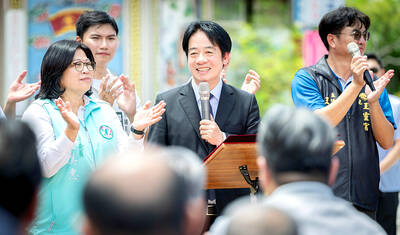
SIX SUBSIDIES: The monthly allowance for older farmers is to increase to NT$10,000, and NT$5,000 is to be given to homemakers under the national pension system, Lai said The government is to implement major welfare policies for disadvantaged groups, including raising the monthly allowance for older farmers to NT$10,000 and providing homemakers with NT$5,000 per month, President William Lai (賴清德) said yesterday. Lai made the remarks during a visit to Wangling Temple in Chiayi County, saying that the planned increases were being introduced amid economic growth and an increase in tax revenue. Touting a policy, in which the government plans to provide a monthly allowance of NT$5,000 for every child under the age of 18 in a bid to address Taiwan’s low birthrate, Lai said that if received for the


 RSS
RSS