


The National Immigration Agency (NIA) yesterday said it has notified a “minority” of Chinese immigrants in Taiwan to renounce their citizenship.
The agency’s statement came hours after the Chinese-language United Daily News reported that the notifications have sparked panic among Chinese immigrants married to Taiwanese nationals.
In a news release, the agency said that a majority of naturalized citizens from China had submitted proof that they had renounced their Chinese citizenship.
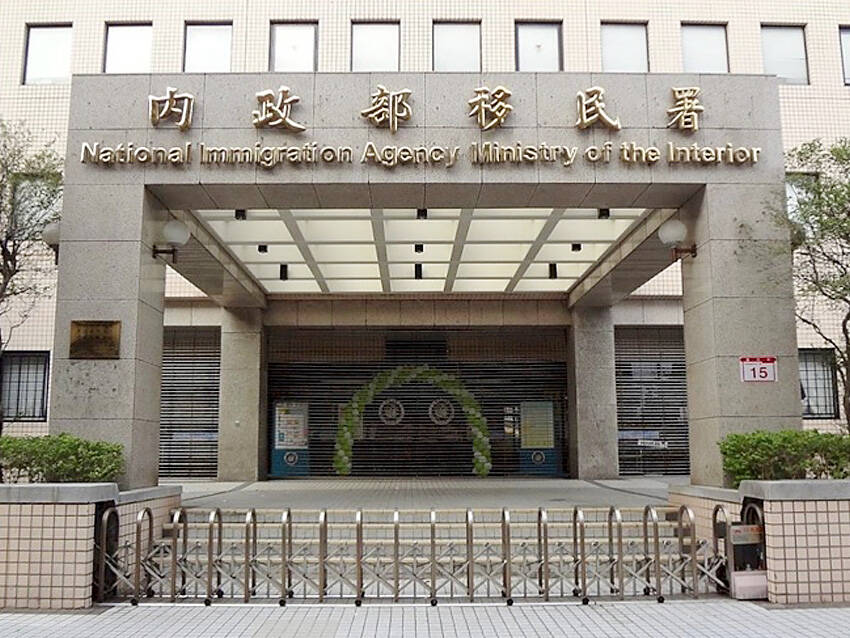
Photo: Taipei Times
However, a small number have failed to do so, the agency said, adding that in most cases, they were unable to travel to China due to the COVID-19 pandemic or other issues.
Chinese residents must provide officials with proof that they have canceled their household registration in China within three months of the receipt of a notice from the agency or the government would cancel their household registration in Taiwan, the agency said.
However, they can apply for long-term residency in Taiwan again based on regulations governing Chinese nationals seeking permanent residency based on family relations, it said.
In the same way, the government bans Taiwanese from concurrently holding household registrations in China, based on the 2004 amendments to the Act Governing Relations Between the People of the Taiwan Area and the Mainland Area (臺灣地區與大陸地區人民關係條例), it said.
Those who encounter difficulties obtaining the required documents renouncing Chinese citizenship or who might have lost their records can seek the assistance of the immigration agency, which would liaise with the Mainland Affairs Council and the Straits Exchange Foundation to deal with these issues, it said.
The government is fully committed to protecting the rights and privileges of foreign-born citizens who are loyal and abide by the law, the agency said.
Recipients of the immigration agency notices have little to worry about if their problems stem from paperwork or red tape, so long as they follow the process, it added.
Separately, Mainland Affairs Council Minister Chiu Chui-cheng (邱垂正) said on the sidelines of a legislative session that Taiwanese law requires Chinese to give up their citizenship and household registration in China to become Taiwanese nationals.

Taiwanese were praised for their composure after a video filmed by Taiwanese tourists capturing the moment a magnitude 7.5 earthquake struck Japan’s Aomori Prefecture went viral on social media. The video shows a hotel room shaking violently amid Monday’s quake, with objects falling to the ground. Two Taiwanese began filming with their mobile phones, while two others held the sides of a TV to prevent it from falling. When the shaking stopped, the pair calmly took down the TV and laid it flat on a tatami mat, the video shows. The video also captured the group talking about the safety of their companions bathing

US climber Alex Honnold is to attempt to scale Taipei 101 without a rope and harness in a live Netflix special on Jan. 24, the streaming platform announced on Wednesday. Accounting for the time difference, the two-hour broadcast of Honnold’s climb, called Skyscraper Live, is to air on Jan. 23 in the US, Netflix said in a statement. Honnold, 40, was the first person ever to free solo climb the 900m El Capitan rock formation in Yosemite National Park — a feat that was recorded and later made into the 2018 documentary film Free Solo. Netflix previewed Skyscraper Live in October, after videos

Starting on Jan. 1, YouBike riders must have insurance to use the service, and a six-month trial of NT$5 coupons under certain conditions would be implemented to balance bike shortages, a joint statement from transportation departments across Taipei, New Taipei City and Taoyuan announced yesterday. The rental bike system operator said that coupons would be offered to riders to rent bikes from full stations, for riders who take out an electric-assisted bike from a full station, and for riders who return a bike to an empty station. All riders with YouBike accounts are automatically eligible for the program, and each membership account

A classified Pentagon-produced, multiyear assessment — the Overmatch brief — highlighted unreported Chinese capabilities to destroy US military assets and identified US supply chain choke points, painting a disturbing picture of waning US military might, a New York Times editorial published on Monday said. US Secretary of Defense Pete Hegseth’s comments in November last year that “we lose every time” in Pentagon-conducted war games pitting the US against China further highlighted the uncertainty about the US’ capability to intervene in the event of a Chinese invasion of Taiwan. “It shows the Pentagon’s overreliance on expensive, vulnerable weapons as adversaries field cheap, technologically


 RSS
RSS