


A complete carcass of a fin whale was discovered off the coast of Yilan County, the first time the world’s second-largest marine mammal has been discovered in its entirety near Taiwan, the Taiwan Cetacean Society said yesterday.
The whale washed up on Turtle Island (Guishan, 龜山島) early last month, it said.
The society wrote on Facebook that it received a report on Feb. 12 about a large baleen whale drifting in the waters surrounding Dasi Fishing Harbor (大溪漁港) in Toucheng Township (頭城).
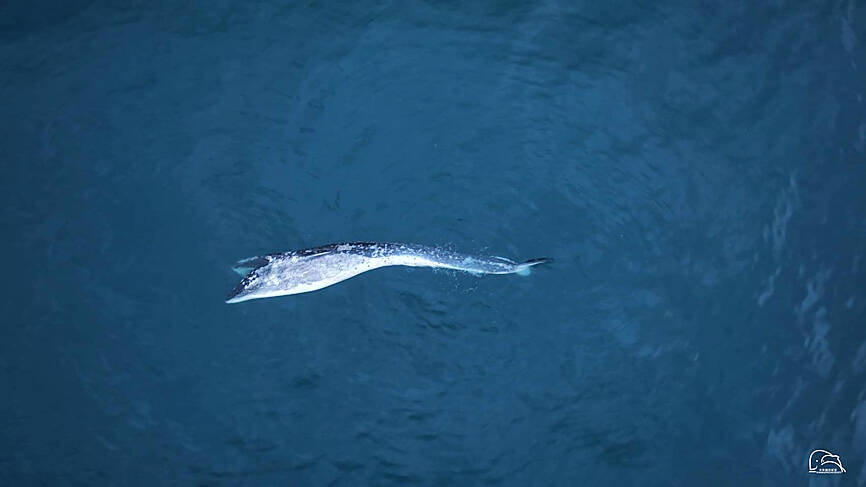
Photo courtesy of director Zhang Hong-jie
A team was immediately dispatched to investigate and it captured rare aerial footage of the whale, estimated to be about 10m long. It seemed to have died recently, as its skin had not yet shown signs of significant peeling, it said.
However, the whale did not wash ashore and the case was initially deemed as a “sighting,” it added.
On March 3, people said they had spotted a large whale stranded on the northern coast of Turtle Island, the society said.
The shore is not safely accessible by land, so a team could not be immediately dispatched to investigate, it added.
On Thursday last week, the society said it was able to collect samples from the whale, with the assistance of the Ocean Conservation Administration (OCA).
The whale was already decomposing and its sex could not be confirmed, it added.
It seemed to have been a young fin whale, and had several fractures in its spinal column, although it is unclear if those injuries occurred before or after its death, it said.
The whale’s complete skeleton was extracted and moved to higher ground, and samples of its skin and muscles were collected and sent to the National Museum of Natural Science for analysis, it added.
On Wednesday, it was confirmed as a fin whale, a species second to blue whales in size, reaching up to 23m in length, the society said.
The fin whale is listed as a vulnerable species on the International Union for Conservation of Nature’s Red List of Threatened Species after nearly becoming extinct due to industrial whaling.
Taiwan is the southernmost habitat for the North Pacific population of fin whales, the society added.
Separately, a humpback whale was spotted in waters off southern Taiwan in recent days. Local authorities dispatched a patrol boat on Tuesday to ensure the mammal was not disturbed by whale watchers.
Kenting National Park Service deputy director Chen Chun-shan (陳俊山) said that the marine conservationists made sure the whale was left undisturbed in waters between Pingtung County’s Hengchun Peninsula (恆春) and Houbihu (後壁湖) from about 10am to 5pm on Tuesday.
The park service and the OCA called for whale watchers to maintain a safe distance, particularly from mothers with their calves, Chen said.
National Cheng Kung University Marine Biology and Cetacean Research Center director Wang Hao-wen (王浩文) said that photographs shared online suggested that the whale might be one of four spotted last week in waters near Taitung County’s Changbin Township (長濱).
Humpback whales migrate south to Japan, Taiwan and the Philippines during the winter and return north in the spring, Wang said.
Although it is rare for humpback whales to come this close to Taiwan, further investigation is needed to understand why that whale moved south to Hengchun, instead of continuing north, he added.

NATIONAL SECURITY: Authorities are working to confirm the identities of the military personnel involved and investigating possible illegal conduct and regulatory violations Authorities are probing possible national security implications after Kinmen police and immigration officers on Sunday found a Chinese woman allegedly posing as a tourist while engaging in prostitution involving more than 10 military personnel. The woman, surnamed Chen (陳), has since been deported, authorities said, adding that investigators are still working to confirm the identities of those implicated, as the records only listed code names and aliases. The case stemmed from a report received by the Kinmen District Prosecutors’ Office on Friday last week from the Jinhu Precinct of the Kinmen County Police Bureau. On Sunday, police, along with the National Immigration

GLOBALGIVING: ‘ Caving to external pressure is not acceptable for an organization that has cultivated justice reform and human rights for 30 years,’ one NGO said A slew of non-government organizations (NGOs) have withdrawn from the GlobalGiving fundraising platform after it announced it would use “Chinese Taipei” instead of “Taiwan” from next month. The Taiwan Good Rice Association wrote on Facebook on Friday that it was informed on April 28 via a teleconference call of the change, which was made because the platform wanted to operate in China. Taiwan Good Rice is to terminate all cooperative relationships with GlobalGiving in response to the platform’s “unilateral and non-negotiable” decision to remove references to Taiwan, the NGO said. “Taiwan is in the official name of Taiwan Good Rice Association and the

HEAVY WEATHER: Typhoon Jangmi is due to crash straight into the Ryukyus as airlines look to shift flights to larger aircraft or cancel flights to Okinawa entirely Taiwan’s international air carriers announced flight adjustments over the weekend as Typhoon Jangmi is forecast to hit the Ryukyu Islands today and tomorrow. The Central Weather Administration (CWA) upgraded Jangmi from a tropical storm to a typhoon at 8am yesterday, with the eye located 580km south of Naha city. It was moving north at 19kph. Today, China Airlines’ CI-120, CI-121, CI-122 and CI-123 flights between Taoyuan and Naha, Okinawa, have been canceled as well as CI-132 and CI-133 between Kaohsiung and Naha. EVA Air’s BR-112, BR-113, BR-186 and BR-185 flights between Taoyuan and Naha are also canceled. Low-cost carrier Tigerair Taiwan canceled IT-230,

REASONS FOR TRAVEL: An assistant professor said that proposed amendments to penalize drivers if they used drugs overseas would not deter people from traveling People who operate a motor vehicle under the influence of marijuana would have their driver’s license revoked, even if they used the substance while overseas, the Ministry of Transportation and Communications said yesterday, citing proposed amendments to the Road Traffic Management and Penalty Act (道路交通管理處罰條例). The amendments would also authorize the government to revoke the licenses of people determined to have used Category 1 or Category 2 narcotics, even if they were not operating a vehicle while under the influence of drugs, as well as ban them from taking the license test for three years, the ministry said. People aged 18 or


 RSS
RSS