


Taiwanese young people’s suicide rate has gone from 4.5 per 100,000 people in 2021 to 7 per 100,000 people in 2023, a trend that experts attribute to increased divorce rates, Internet habits and lack of sleep.
“The National Taiwan University (NTU) Children and Family Research Center Sponsored by CTBC Charity Foundation’s Organisation for Economic Co-operation and Development (OECD) Family Database: Taiwanese Family and Youth Rights Index 2024 Comparison Report” released yesterday called on the government to focus more on the rights of young people and family support policies.
Familial structural changes are apparent based on the report, NTU Department of Sociology associate professor Janet Kuo (郭貞蘭) said.
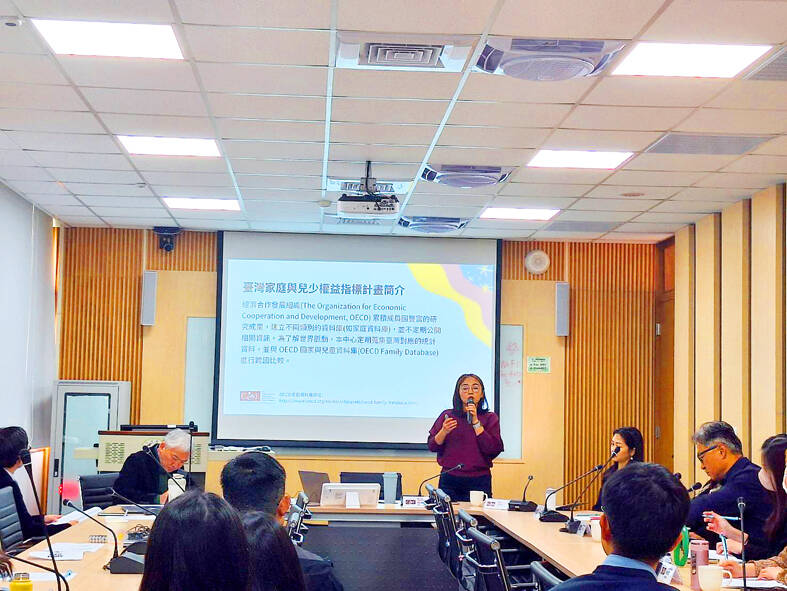
Photo: CNA
The report showed that Taiwanese nuclear families decreased from 57.24 percent in 2011 to 52.78 percent in 2023, while single-person families increased from 10.12 percent to 15.4 percent in the same timeframe, she said.
Single-parent families increased from 9.31 percent in 2011 to 10.57 percent in 2023, according to the report.
Compared with nations within the OECD, Taiwan has a higher percentage of nuclear families, while the rate of families without children and single-person households is lower, Kuo said.
While such developments show a distinct deviation from traditional family composition, Taiwan’s statistics do not stand out when compared with other countries, showing that this is an international trend and reflecting a conscious choice to embrace certain ideas and values, Academia Sinica Institute of Sociology research fellow Wu Chi-yin (吳齊殷) said.
The US and the EU are cognizant of such shifts and have begun implementing policies that are friendlier toward those without children, he said.
Research showed that divorce rates, Internet usage and sleep disorders all contribute to the increased rates that young people think of, or attempt, suicide, NTU Institute of Health Behaviors and Community Services professor Chang Shu-sen (張書森) said.
More young people are espousing the belief that committing suicide is a personal right, Chang said.
Chang said that counseling to help adolescents sort through psychological issues, providing care for disadvantaged children and promoting information that would reduce negative stereotypes of single-parent families are preventive measures.
Schools should also work on adding more safety nets and similar facilities to prevent suicide attempts involving jumping off buildings, and work on providing children and adolescents with a “clean and safe” online experience.

SECURITY: Starlink owner Elon Musk has taken pro-Beijing positions, and allowing pro-China companies to control Taiwan’s critical infrastructure is risky, a legislator said Starlink was reluctant to offer services in Taiwan because of the nation’s extremely high penetration rates in 4G and 5G services, the Ministry of Digital Affairs said yesterday. The ministry made the comments at a meeting of the legislature’s Transportation Committee, which reviewed amendments to Article 36 of the Telecommunications Management Act (電信管理法). Article 36 bans foreigners from holding more than 49 percent of shares in public telecommunications networks, while shares foreigners directly and indirectly hold are also capped at 60 percent of the total, unless specified otherwise by law. The amendments, sponsored by Chinese Nationalist Party (KMT) Legislator Ko

The eastern extension of the Taipei MRT Red Line could begin operations as early as late June, the Taipei Department of Rapid Transit Systems said yesterday. Taipei Rapid Transit Corp said it is considering offering one month of free rides on the new section to mark its opening. Construction progress on the 1.4km extension, which is to run from the current terminal Xiangshan Station to a new eastern terminal, Guangci/Fengtian Temple Station, was 90.6 percent complete by the end of last month, the department said in a report to the Taipei City Council's Transportation Committee. While construction began in October 2016 with an
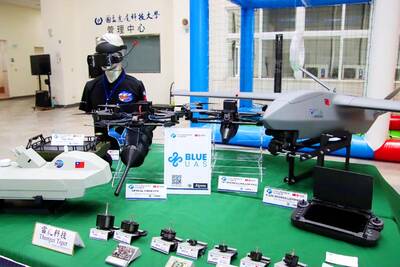
NON-RED SUPPLY: Boosting the nation’s drone industry is becoming increasingly urgent as China’s UAV dominance could become an issue in a crisis, an analyst said Taiwan’s drone exports to Europe grew 41.7-fold from 2024 to last year, with demand from Ukraine’s fight against Russian aggression the most likely driver of growth, a study showed. The Institute for Democracy, Society and Emerging Technology (DSET) in a statement on Wednesday said it found that many of Taiwan’s uncrewed aerial vehicle (UAV) sales were from Poland and the Czech Republic. These countries likely transferred the drones to Ukraine to aid it in its fight against the Russian invasion that started in 2022, it said. Despite the gains, Taiwan is not the dominant drone exporter to these markets, ranking second and fourth

The New Taipei City Art Museum this weekend plans to celebrate its first anniversary with a two-day extravaganza featuring live concerts and a large-scale synchronized fireworks and drone display, the New Taipei City Cultural Affairs Department said. The two-day celebrations are to take place in the museum’s outdoor park, with markets and live performances by singers including Ann Bai (白安), Bii (畢書盡) and the Cosmos People (宇宙人), the department said. The highlight on both evenings would be the "Echoes of Light" show, an aerial spectacle combining fireworks and drone performances designed around the concept of "dual stages in the sky," it


 RSS
RSS