


The Coast Guard Administration (CGA) this morning apprehended a Chinese man who unlawfully entered Taiwanese waters in an inflatable boat near Hanshehua (寒舍花) in Kinmen County.
At 6:49am, the Coast Patrol Corps 9th division under the Kinmen-Matsu-Penghu branch of the agency detected and intercepted the boat.
The man was taken into custody and is under investigation by the Kinmen District Prosecutors’ Office.
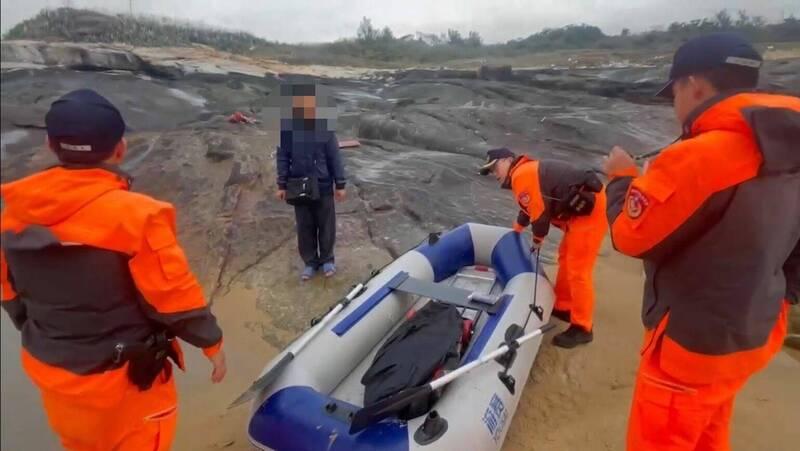
Photo courtesy of the Coast Guard Administration Kinmen-Matsu-Penghu branch
Shortly afterward at 8am, four China Coast Guard vessels were found entering the waters around Lienchiang County’s Siyin Island (西引) and Wuciou Township (烏坵).
The CGA deployed patrol boats to monitor the situation.
It comes as China's coast guard said it conducted "law enforcement patrols" around Taiwan today, the same day Beijing announced military drills around the nation.
The CGA said that it detected China Coast Guard vessels 14607 and 14517 approaching Dongyin Island (東引) in Lienchiang County.
The agency said it dispatched vessels in response to the ships, which the China Coast Guard claimed were "conducting law enforcement patrols."
"Coast guard vessel formations conducted law enforcement patrols in waters surrounding Taiwan Island, and carried out drills such as inspection and capture, interception and detention operations against unwarranted vessels," China Coast Guard East China Sea Bureau spokesperson Zhu Anqing (朱安慶) said in a statement.
The timing of the Chinese drills and the small-scale illegal entry attempt has raised suspicions that the two are connected, and it is not being ruled out that the man found this morning is involved in Chinese military operations, the CGA said.
Kinmen and Lienchiang are positioned at the front line of China’s “gray zone” tactics, the CGA branch said.
The coast guard is on high alert against potential threats from China, employing surveillance technology and round-the-clock patrols to strengthen response measures, it added.
Additional reporting by AFP and CNA
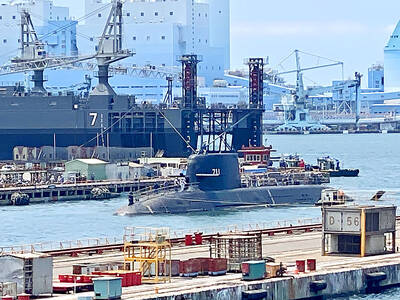
AGING: While Japan has 22 submarines, Taiwan only operates four, two of which were commissioned by the US in 1945 and 1946, and transferred to Taiwan in 1973 Taiwan would need at least 12 submarines to reach modern fleet capabilities, CSBC Corp, Taiwan chairman Chen Cheng-hung (陳政宏) said in an interview broadcast on Friday, citing a US assessment. CSBC is testing the nation’s first indigenous defense submarine, the Hai Kun (海鯤, Narwhal), which is scheduled to be delivered to the navy next month or in July. The Hai Kun has completed torpedo-firing tests and is scheduled to undergo overnight sea trials, Chen said on an SET TV military affairs program. Taiwan would require at least 12 submarines to establish a modern submarine force after assessing the nation’s operational environment and defense

Yangmingshan National Park authorities yesterday urged visitors to respect public spaces and obey the law after a couple was caught on a camera livestream having sex at the park’s Qingtiangang (擎天崗) earlier in the day. The Shilin Police Precinct in Taipei said it has identified a suspect and his vehicle registration number, and would summon him for questioning. The case would be handled in accordance with public indecency charges, it added. The couple entered the park at about 11pm on Thursday and began fooling around by 1am yesterday, the police said, adding that the two were unaware of the park’s all-day live
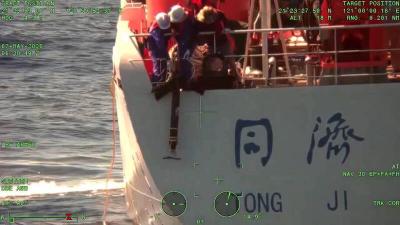
The coast guard today said that it had disrupted "illegal" operations by a Chinese research ship in waters close to the nation and driven it away, part of what Taipei sees a provocative pattern of China's stepped up maritime activities. The coast guard said that it on Thursday last week detected the Chinese ship Tongji (同濟號), which was commissioned only last year, 29 nautical miles (54km) southeast of the southern tip of Taiwan, although just outside restricted waters. The ship was observed lowering ropes into the water, suspected to be the deployment of scientific instruments for "illegal" survey operations, and the coast

A former soldier and an active-duty army officer were yesterday indicted for allegedly selling classified military training materials to a Chinese intelligence operative for a total of NT$79,440. The Taipei District Prosecutors’ Office indicted Chen Tai-yin (陳泰尹) and Lee Chun-ta (李俊達) for contravening the National Security Act (國家安全法) and the Anti-Corruption Act (貪污治罪條例). Chen left the military in September 2013 after serving alongside then-staff sergeant Lee, now an army lieutenant, at the 21st Artillery Command of the army’s Sixth Corps from 2011 to 2013, according to the indictment. Chen met a Chinese intelligence operative identified as “Wang” (王) through a friend in November


 RSS
RSS