


A team of Taiwanese high-school students advanced to the championship of this year’s FIRST Robotics Competition (FRC) in the US after competing in the four-day San Diego Regional.
The team, consisting of 41 students from Taipei Municipal Chien Kuo High School robotics club, was one of four teams that emerged victorious from the 51 teams competing in the regional event to secure a spot in the FIRST Championship in Houston next month.
According to FRC rules, “teams of high-school students are challenged to raise funds, design a team brand, hone teamwork skills, and build and program a robot to compete against other teams” within a limited timeframe and with restricted resources.
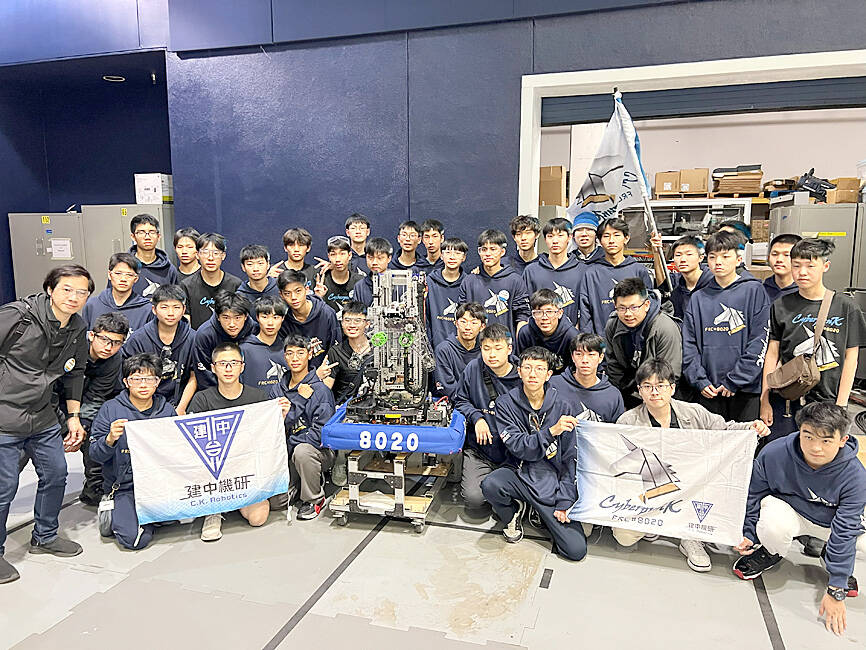
Photo: CNA
That experience simulates real-world engineering as closely as possible for students, the competition’s Web site says.
At the regionals, the Taiwanese students advanced through the first two rounds, but lost twice and did not make the regional finals. However, they directly qualified for the championship after winning the tournament’s FIRST Impact Award in recognition of their contributions to their community.
The other three teams to advance were the two regional finalists and the winner of the tournament’s Engineering Inspiration Award.
The Taiwanese team since 2019 has collaborated with the Taiwan Fund for Children and Families to provide hands-on robotics education for disadvantaged students and promote robotics learning in elementary and junior-high schools.
Chang Chen-wei (章宸瑋), a second-year high-school student, said he learned a lot from the US participants and that they “did not just come here to compete.”
The local teams valued more than just wins and losses, Chang said, adding that he was impressed by their collaboration and enjoyment of the process, which allowed them to showcase their individual talents.
The FRC is an annual tournament featuring more than 3,000 teams worldwide. This year’s San Diego event marks the 19th edition of the regional competition.

Considering that most countries issue more than five denominations of banknotes, the central bank has decided to redesign all five denominations, the bank said as it prepares for the first major overhaul of the banknotes in more than 24 years. Central bank Governor Yang Chin-lung (楊金龍) is expected to report to the Legislative Yuan today on the bank’s operations and the redesign’s progress. The bank in a report sent to the legislature ahead of today’s meeting said it had commissioned a survey on the public’s preferences. Survey results showed that NT$100 and NT$1,000 banknotes are the most commonly used, while NT$200 and NT$2,000

The Centers for Disease Control (CDC) yesterday reported the first case of a new COVID-19 subvariant — BA.3.2 — in a 10-year-old Singaporean girl who had a fever upon arrival in Taiwan and tested positive for the disease. The girl left Taiwan on March 20 and the case did not have a direct impact on the local community, it said. The WHO added the BA.3.2 strain to its list of Variants Under Monitoring in December last year, but this was the first imported case of the COVID-19 variant in Taiwan, CDC Deputy Director-General Lin Ming-cheng (林明誠) said. The girl arrived in Taiwan on

South Korea is planning to revise its controversial electronic arrival card, a step Taiwanese officials said prompted them to hold off on planned retaliatory measures, a South Korean media report said yesterday. A Yonhap News Agency report said that the South Korean Ministry of Foreign Affairs is planning to remove the “previous departure place” and “next destination” fields from its e-arrival card system. The plan, reached after interagency consultations, is under review and aims to simplify entry procedures and align the electronic form with the paper version, a South Korean ministry official said. The fields — which appeared only on the electronic form

The Ministry of Foreign Affairs (MOFA) is suspending retaliation measures against South Korea that were set to take effect tomorrow, after Seoul said it is updating its e-arrival system, MOFA said today. The measures were to be a new round of retaliation after Taiwan on March 1 changed South Korea's designation on government-issued alien resident certificates held by South Korean nationals to "South Korea” from the "Republic of Korea," the country’s official name. The move came after months of protests to Seoul over its listing of Taiwan as "China (Taiwan)" in dropdown menus on its new online immigration entry system. MOFA last week


 RSS
RSS