


The Mainland Affairs Council (MAC) on Wednesday warned that Beijing often sets up reporting portals to create the illusion of having jurisdiction over Taiwan, after China’s Taiwan Affairs Office (TAO) earlier in the day said that 323 e-mails had been sent to its reporting portal for “Taiwan independence thugs, accomplices and persecutors.”
As of 5pm on Wednesday, the TAO said it had received 323 e-mails about people such as Minister of the Interior Liu Shyh-fang (劉世芳) and YouTuber Pa Chiung (八炯).
Complaints have been lodged against Taiwanese independence figures, public officials and social media influencers, who the TAO pledged to hold accountable “according to the law.”

Photo: CNA
The MAC criticized the portal, saying that the Chinese Communist Party (CCP) often sets up reporting portals in an attempt to create the illusion of extraterritorial jurisdiction over Taiwan, calling the tactics a false narrative that has little effect on Taiwanese.
Reports said that the people fabricated accusations to suppress the opposition in Taiwan, threatened to dissolve patriotic pro-unification groups, purposefully detained supporters of peaceful cross-strait relations and encroached on the rights of Chinese-born spouses of Taiwanese by initiating “witch hunts” against them.
Other politicians and officials named in reports include Democratic Progressive Party (DPP) legislators Puma Shen (沈伯洋) and Huang Jie (黃捷), DPP caucus chief executive Rosalia Wu (吳思瑤) and Taipei Prosecutor Lin Ta (林達), TAO spokesman Chen Binhua (陳斌華) said.
Complaints have also been lodged against public figures such as United Microelectronics Corp founder Robert Tsao (曹興誠), the financial backer of nonprofit civil defense organization Kuma Academy, and Taiwanese rapper Chen Po-yuan (陳柏源), he added.
The TAO would investigate the tip-offs and take necessary legal action against the “thugs, accomplices and persecutors,” he said.
Throughout the CCP’s history, informant systems have been used to suppress dissent, the MAC said, adding that once a culture of informing and reporting takes hold, it can be difficult to stop.
The MAC compared the latest move to the Anti-Rightist Campaign in China in the 1950s, in which the CCP purged “rightists” and “intellectuals” from the party and the nation as a whole, enlisting ordinary people as spies and informants.
In Hong Kong, a similar reporting system has resulted in 750,000 complaints, the council said, warning that encouraging informants is political oppression that only escalates the situation and leads to disaster.
The TAO’s tactics would only disrupt and damage cross-strait exchanges, it added.
The MAC again warned Taiwanese to remain vigilant about China’s arbitrary detentions and illegal arrests, urging them to carefully assess personal safety before traveling to China.
Wu said at the Legislative Yuan that “being ‘blacklisted’ by the TAO means I must have spoken the truth, which the CCP does not do.”
She would continue to do and say the right things even if China adds her to a dozen blacklists, she said, adding: “I am not afraid.”
China’s intentions are crystal clear — to extend the long arm of the law to create disturbances in Taiwan’s internal affairs and meddle in Taiwan’s legal system, she said.
Huang on social media said that being named by the office is “a form of recognition,” which she would accept with honor as it signifies her contributions to protecting Taiwan.
Instead of “Taiwan independence thugs,” the TAO should refer to them as “Taiwan defenders,” she added.
Huang said she has proposed many national security bills and reaffirmed her commitment to safeguarding Taiwan.
“Hurry up and classify me as a hardcore Taiwan independence figure,” she added.
Additional reporting by CNA

A magnitude 6.1 earthquake struck off the coast of Yilan County at 8:39pm tonight, the Central Weather Administration (CWA) said, with no immediate reports of damage or injuries. The epicenter was 38.7km east-northeast of Yilan County Hall at a focal depth of 98.3km, the CWA’s Seismological Center said. The quake’s maximum intensity, which gauges the actual physical effect of a seismic event, was a level 4 on Taiwan’s 7-tier intensity scale, the center said. That intensity level was recorded in Yilan County’s Nanao Township (南澳), Hsinchu County’s Guansi Township (關西), Nantou County’s Hehuanshan (合歡山) and Hualien County’s Yanliao (鹽寮). An intensity of 3 was
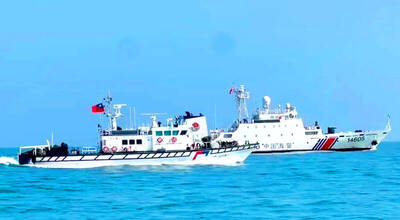
Instead of focusing solely on the threat of a full-scale military invasion, the US and its allies must prepare for a potential Chinese “quarantine” of Taiwan enforced through customs inspections, Stanford University Hoover fellow Eyck Freymann said in a Foreign Affairs article published on Wednesday. China could use various “gray zone” tactics in “reconfiguring the regional and ultimately the global economic order without a war,” said Freymann, who is also a nonresident research fellow at the US Naval War College. China might seize control of Taiwan’s links to the outside world by requiring all flights and ships entering or leaving Taiwan
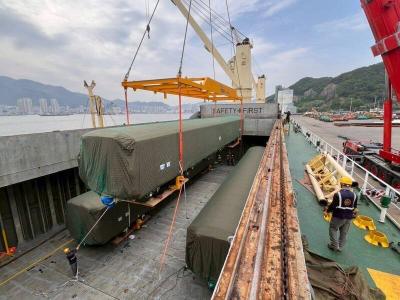
The first of 10 new high-capacity trains purchased from South Korea’s Hyundai Rotem arrived at the Port of Taipei yesterday to meet the demands of an expanding metro network, Taipei Rapid Transit Corp (TRTC) said yesterday. The train completed a three-day, 1,200km voyage from the Port of Masan in South Korea, the company said. Costing NT$590 million (US$18.79 million) each, the new six-carriage trains feature a redesigned interior based on "human-centric" transportation concepts, TRTC said. The design utilizes continuous longitudinal seating to widen the aisles and optimize passenger flow, while also upgrading passenger information displays and driving control systems for a more comfortable
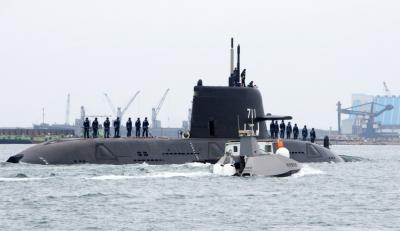
Taiwan's first indigenous defense submarine, the SS-711 Hai Kun (海鯤, or Narwhal), departed for its 13th sea trial at 7am today, marking its seventh submerged test, with delivery to the navy scheduled for July. The outing also marked its first sea deployment since President William Lai (賴清德) boarded the submarine for an inspection on March 19, drawing a crowd of military enthusiasts who gathered to show support. The submarine this morning departed port accompanied by CSBC Corp’s Endeavor Manta (奮進魔鬼魚號) uncrewed surface vessel and a navy M109 assault boat. Amid public interest in key milestones such as torpedo-launching operations and overnight submerged trials,


 RSS
RSS