


About 900 civilians would practice using military field hospital equipment without the assistance of military personnel during civil defense drills in Tainan on Thursday, a source said yesterday.
Although the drills are to be staged in Tainan, fire departments in Kaohsiung and Chiayi County and alternative service conscripts would also participate, the official said on condition of anonymity.
On Tuesday last week, Presidential Office spokesperson Karen Kuo (郭雅慧) said that the small-scale exercise would simulate a severe “compound disaster” scenario involving earthquakes, tsunamis and critical infrastructure disruptions.
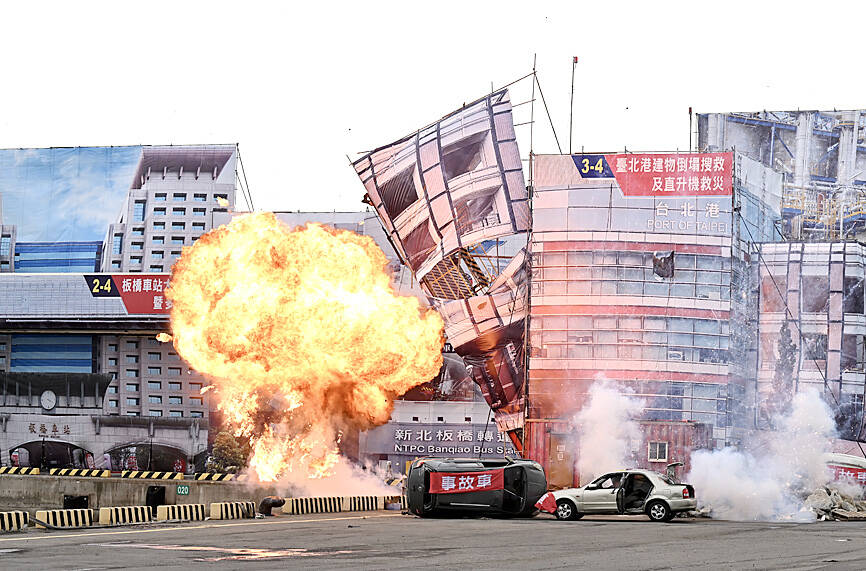
Photo: Lo Pei-de, Taipei Times
The drills would test central and local governments’ emergency response capabilities, such as large-scale evacuations, sheltering and establishing emergency medical facilities, she said.
They would also feature civilian participation to test public-private sector cooperation in the event of a major disaster to enhance whole-of-society defense resilience, she said.
Although military personnel would not take part, the Ministry of National Defense’s Medical Affairs Bureau would lend its newly purchased Forward Resuscitative and Surgical Detachment (FRSD) medical sets and inflatable field hospital tents for use in the exercise, the source said.
FRSD is a set of medical supplies and equipment designed to enable the rapid deployment of an urgent, initial surgical care unit, providing critical treatment capabilities close to the front line, the source said.
The weatherproofed inflatable field hospital tents are quick and easy to set up and light for transportation and are used to treat patients in the aftermath of natural disasters and in war zones, the source added.
A senior Ministry of the Interior official said on condition of anonymity yesterday that unlike previous rounds of civil defense or Wanan air raid drills, Thursday’s exercise would be “unscripted and more realistic.”
The official added that following the Tainan exercise, the government would proceed with Urban Resilience Exercises from next month until July, which combine the Wanan air raid and Minan disaster response drills.
The series of exercises would culminate in the live-fire portion of the armed forces’ annual Han Kuang drills in July, the official added.
Thursday’s exercise is to take place from 10am to 2pm at Tainan Municipal Nan-ning High School, the Anping Port Visitors’ Center and the square across from the Tainan Yuping Post Office, the Presidential Office said.
President William Lai (賴清德) and Vice President Hsiao Bi-khim (蕭美琴) are to travel to Tainan to preside over the exercises, the source said.
Representatives from foreign missions in Taiwan have also been invited, the source added.

Considering that most countries issue more than five denominations of banknotes, the central bank has decided to redesign all five denominations, the bank said as it prepares for the first major overhaul of the banknotes in more than 24 years. Central bank Governor Yang Chin-lung (楊金龍) is expected to report to the Legislative Yuan today on the bank’s operations and the redesign’s progress. The bank in a report sent to the legislature ahead of today’s meeting said it had commissioned a survey on the public’s preferences. Survey results showed that NT$100 and NT$1,000 banknotes are the most commonly used, while NT$200 and NT$2,000

The Centers for Disease Control (CDC) yesterday reported the first case of a new COVID-19 subvariant — BA.3.2 — in a 10-year-old Singaporean girl who had a fever upon arrival in Taiwan and tested positive for the disease. The girl left Taiwan on March 20 and the case did not have a direct impact on the local community, it said. The WHO added the BA.3.2 strain to its list of Variants Under Monitoring in December last year, but this was the first imported case of the COVID-19 variant in Taiwan, CDC Deputy Director-General Lin Ming-cheng (林明誠) said. The girl arrived in Taiwan on

South Korea is planning to revise its controversial electronic arrival card, a step Taiwanese officials said prompted them to hold off on planned retaliatory measures, a South Korean media report said yesterday. A Yonhap News Agency report said that the South Korean Ministry of Foreign Affairs is planning to remove the “previous departure place” and “next destination” fields from its e-arrival card system. The plan, reached after interagency consultations, is under review and aims to simplify entry procedures and align the electronic form with the paper version, a South Korean ministry official said. The fields — which appeared only on the electronic form

The Ministry of Foreign Affairs (MOFA) is suspending retaliation measures against South Korea that were set to take effect tomorrow, after Seoul said it is updating its e-arrival system, MOFA said today. The measures were to be a new round of retaliation after Taiwan on March 1 changed South Korea's designation on government-issued alien resident certificates held by South Korean nationals to "South Korea” from the "Republic of Korea," the country’s official name. The move came after months of protests to Seoul over its listing of Taiwan as "China (Taiwan)" in dropdown menus on its new online immigration entry system. MOFA last week


 RSS
RSS