


State-owned Chunghwa Post is to transform into a logistics-centered business to stem financial losses, company chairman Wang Kwo-tsai (王國材) said yesterday.
The transition is inevitable as the company fights a global decline in postal services, he said at an event marking the firm’s 129th anniversary.
The company’s income would primarily come from logistics, while mail delivery would be the secondary source, Wang said.
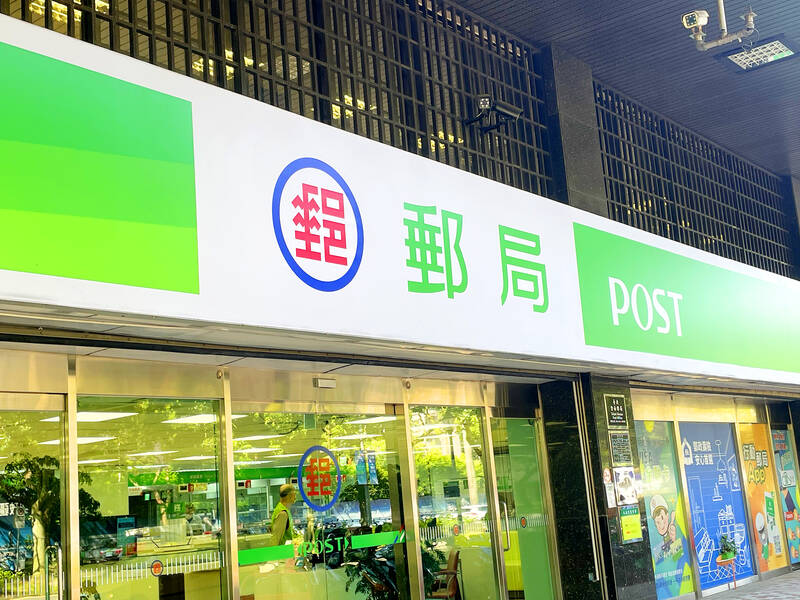
Photo: Lin Chih-yi, Taipei Times
Postal workers are this year to begin delivering packages directly to the doors of recipients, as part of Chunghwa Post’s new corporate mission, he said.
Chunghwa Post expects to complete the construction of the A7 logistics zone in New Taipei City’s Linkou District (林口) by the end of the year, Wang said.
The company has begun searching for contractors to provide state-of-the-art technology for the planned postal processing facility, he said, adding that the facility would have automated sorting and improved storing efficiency to make Chunghwa Post a competitive player in the logistics sector.
The company’s priority this year is to roll out a door-to-door delivery for corporate and individual clients, and a digital platform for corporate clients that need to transport bulk or urgent materials, Wang said.
The latter would be available to big businesses, online-based vendors and small farmers, he added.
This year, the company also aims to create an algorithmic delivery system for the delivery of vendors’ and farmers’ merchandise or products, and to open 100 pick-up locations that are open 24 hours, Wang said.
Chunghwa Post would establish a shopping platform for vendors and customers, and introduce new services for small farmers, such as expediting gift deliveries, he added.
Apps and Web sites for digital or credit card payments, and mail insurance are being developed, he said, adding that the company plans to link those to government services.
The company must be more efficient in utilizing its funds by including mailing risk management, lowering mail insurance values and joining the government’s tech innovation projects, Wang said.
Chunghwa Post must gather the courage and resolve to overcome the challenges ahead, he added.

UPGRADE: The Kang Ding-class frigate is replacing its Chaparall missiles with Tien Chien II and Hua Yang VLS, which would provide it with long-range, 360° air defense Taiwan plans to produce 1,200 to 1,376 Hai Chien II missiles (海劍二, Sea Sword II) — also known as TC-2N — to serve as the standard air defense system of the navy’s surface combatant fleet, a source said yesterday. Last week, the Hai Chien II, the naval version of the Tien Kung II missile (天劍二, Sky Sword II), completed a live-fire test in waters off the National Chungshan Institute of Science and Technology’s Jiupeng facility (九鵬) in Pingtung County’s Manjhou Township (滿州). The MIM72 Chaparral and other dated air defense missiles that currently arm Taiwanese ships have inadequate range to combat Chinese

REASONS FOR TRAVEL: An assistant professor said that proposed amendments to penalize drivers if they used drugs overseas would not deter people from traveling People who operate a motor vehicle under the influence of marijuana would have their driver’s license revoked, even if they used the substance while overseas, the Ministry of Transportation and Communications said yesterday, citing proposed amendments to the Road Traffic Management and Penalty Act (道路交通管理處罰條例). The amendments would also authorize the government to revoke the licenses of people determined to have used Category 1 or Category 2 narcotics, even if they were not operating a vehicle while under the influence of drugs, as well as ban them from taking the license test for three years, the ministry said. People aged 18 or

GLOBALGIVING: ‘ Caving to external pressure is not acceptable for an organization that has cultivated justice reform and human rights for 30 years,’ one NGO said A slew of non-government organizations (NGOs) have withdrawn from the GlobalGiving fundraising platform after it announced it would use “Chinese Taipei” instead of “Taiwan” from next month. The Taiwan Good Rice Association wrote on Facebook on Friday that it was informed on April 28 via a teleconference call of the change, which was made because the platform wanted to operate in China. Taiwan Good Rice is to terminate all cooperative relationships with GlobalGiving in response to the platform’s “unilateral and non-negotiable” decision to remove references to Taiwan, the NGO said. “Taiwan is in the official name of Taiwan Good Rice Association and the

HEAVY WEATHER: Typhoon Jangmi is due to crash straight into the Ryukyus as airlines look to shift flights to larger aircraft or cancel flights to Okinawa entirely Taiwan’s international air carriers announced flight adjustments over the weekend as Typhoon Jangmi is forecast to hit the Ryukyu Islands today and tomorrow. The Central Weather Administration (CWA) upgraded Jangmi from a tropical storm to a typhoon at 8am yesterday, with the eye located 580km south of Naha city. It was moving north at 19kph. Today, China Airlines’ CI-120, CI-121, CI-122 and CI-123 flights between Taoyuan and Naha, Okinawa, have been canceled as well as CI-132 and CI-133 between Kaohsiung and Naha. EVA Air’s BR-112, BR-113, BR-186 and BR-185 flights between Taoyuan and Naha are also canceled. Low-cost carrier Tigerair Taiwan canceled IT-230,


 RSS
RSS