


Taiwan Semiconductor Manufacturing Co’s (TSMC) continued expansion in Arizona would become a model of technology cooperation between Taiwan and the US, President William Lai (賴清德) said on Tuesday.
Speaking at a meeting with a delegation led by Arizona Governor Katie Hobbs in Taipei, Lai said Taiwan’s ties with Arizona had seen “significant progress,” marked by TSMC’s investment in the state.
He was referring to TSMC’s previous commitments between 2020 and last year to invest US$65 billion in three chip foundries in Arizona, one of which has begun operations, and its pledge to invest another US$100 billion to build three more foundries, a research and development center, and two packaging facilities in the state.
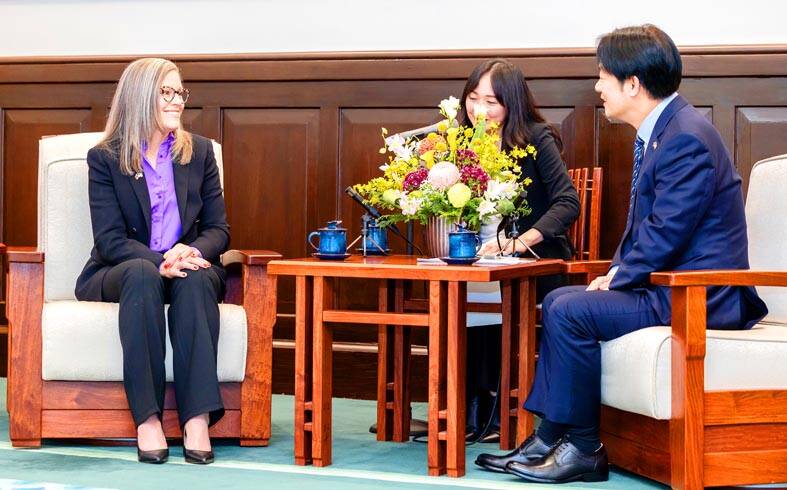
Photo: screen grab from the Presidential Office’s Flickr page
Lai said he believed that by continuing to work together, Arizona would become the “best model” of bilateral cooperation on advanced technology and efforts to build a “non-red” supply chain, referring to a network of industries free from Chinese involvement.
Hobbs said that TSMC’s venture would not only contribute to the global advancement of artificial intelligence and other technologies, but also strengthen bilateral ties, according to a statement provided by the Presidential Office following the meeting.
The governor, who assumed office in 2023 and is in Taiwan for the second time in her official capacity, also noted the shared values, and cultural and education exchanges between the two sides.
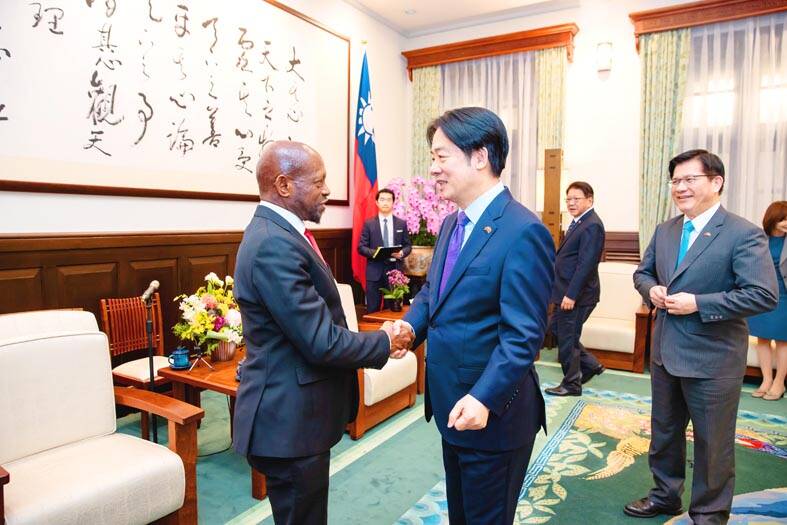
Photo: screen grab from the Presidential Office’s Flickr page
Hobbs’ delegation was visiting Taiwan until yesterday after arriving on Sunday to meet with representatives of the Ministry of Economic Affairs, TSMC and other enterprises, the Ministry of Foreign Affairs said.
Lai on Tuesday also met with Saint Kitts and Nevis Minister of Foreign Affairs Denzil Douglas at the Presidential Office in Taipei.
Lai noted longstanding collaborations between Taiwan and the Caribbean ally in areas such as education, agriculture, women’s empowerment and environmental protection and said the two nations should continue to support each other on the global stage and promote more exchanges that benefit their people.
Douglas, who is visiting Taiwan until tomorrow, said Saint Kitts and Nevis would continue to champion Taiwan’s international participation and advocate peace across the Taiwan Strait, a Presidential Office statement said.

FUKUOKA SITUATION: Japanese media reported that the pathogen is expected to be identified by the summer, while the CDC downplayed the idea that it was hMPV A “mysterious cold-like illness” reported in Japan’s Fukuoka Prefecture does not seem to be a new disease, but Japanese authorities have been asked about the situation, the Centers for Disease Control (CDC) said yesterday. The Fukuoka Prefectural Medical Association on Wednesday told a news conference that a “mystery cold” that has become a hot topic on social media is “highly likely to be caused by some kind of viral infection,” Japan’s KBC News reported. “Many people are experiencing symptoms starting with a sore throat, followed by a runny nose, phlegm and a severe cough,” KBC News reported, citing association officials. Health authorities are

Nvidia Corp CEO Jensen Huang (黃仁勳) arrived in Taiwan yesterday ahead of upcoming AI and technology events, saying he plans to meet with clients and Taiwan Semiconductor Manufacturing Co Chairman C.C. Wei (魏哲家) during his visit. After landing at Taipei Songshan Airport, Huang posed for photos with fans and handed out Yakult drinks to reporters and supporters waiting at the scene, saying he has “a lot to do” during the trip. Asked about reports that Nvidia’s planned headquarters site in Taipei’s Beitou Shilin Technology Park could break ground on May 27, Huang said that if the company holds an event, he would

Carrefour Taiwan is to begin using a new name from the start of July, but it cannot divulge the name until then, the chairman of the supermarket chain's parent company said today. President Chain Store Co chairman Lo Chih-hsien (羅智先) was asked by reporters after a shareholders' meeting to confirm whether the company has settled on a new name for the supermarket brand. In March, the government-registered name of two Carrefour Taiwan branches was quietly changed to "Le Chia Kang" (樂家康) in Chinese, raising speculation that has been selected as the name. Lo said that because of local regulations and contractual obligations, the
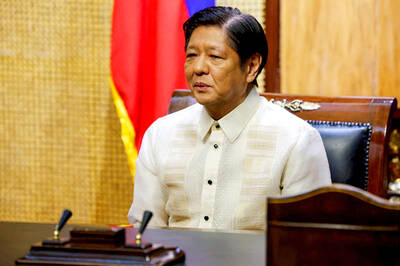
The Philippines would likely be involved in any conflict over Taiwan due to its proximity to the democracy claimed by China, President Ferdinand Marcos Jr said, reiterating a stance that risks angering Beijing. “In the Philippines, we do not have a choice because Taiwan is so close to the Philippines and we have almost 200,000 Filipino nationals living and working in Taiwan,” Marcos said in an interview with Japanese media in Manila on Monday. The Philippine leader’s comments come ahead of a state visit to Japan next week, where he is to meet with Japanese Prime Minister Sanae Takaichi to discuss security


 RSS
RSS